Lessons From Spending $15M On Flooring Ads
Over the past two years, I’ve planned and executed over $15M of flooring ads across Google, Meta, Pinterest, Reddit, CTV, and more. Along the way, I’ve tested creative strategies, messaging frameworks, and media mixes to find what actually drives in-store sales.
After running thousands of ads and analyzing hundreds of leads, a few patterns became clear – where ROI really comes from, and where budgets quietly go to die.
This report breaks down the five biggest insights from that $15M dataset – covering channels, seasonality, creative, and buyer behavior.
Read a deeper look at the broader flooring customer journey and marketing landscape
TL;DR
- Google converts, but synergy wins. Adding Meta lifted incremental conversions from 2 % → 11 %.
- Timing shapes ROI. Peaks hit in spring & fall; budget heavier in Jan–Mar and Jul–Sep to capture intent early.
- Product tier = audience. Luxury buyers chase design, functional buyers value durability, budget buyers chase deals.
- Message-to-segment alignment matters. Match creative and platform to each segment’s motivators.
- National builds demand, local closes it. Awareness on Meta/Pinterest → conversion on Google with transparent offers.
- Real beats polished. Authentic renovation imagery doubled CTR vs. stock photos.
- Fast follow-up multiplies ROI. Contacting leads within 24 hours raised close rates ≈ 40 %.
Breaking Down The Background
Results were measured over 4 accounts with a mix of channels in each. The goal across all accounts was the same – drive leads that lead to in-store sales.
Total annual spend exceeded $15M, with budgets distributed roughly 60% Google/Meta, 25% video and CTV, and 15% experimental channels like Pinterest, Reddit, and display.
Campaigns focused on both national and local advertising with objectives ranging from awareness to conversion.
1. Google Converts Well But Has Lower Incrementality
Most shoppers will at some point in their journey do a search on Google (or Bing), making it a great channel to reach in-market consumers. However, this search often takes weeks and is exhaustive of many resources.
Testing Incremental Lift Across Channels
We conducted a matched market test to determine the incremental lift in conversion from a market with no ads vs Google Ads vs Google + Meta.
The findings showed that Google Ads only contributed 2% incremental conversions, while Google + Meta saw 11% incremental conversion lift.
This directly contradicts most flooring marketing strategies which heavily focus on Google Search. However, as we’ll explore later, Google remains a highly effective channel for Local Advertising.
Key Takeaway: Google captures demand, but Meta creates it. Run them together for compounding ROI instead of treating search as a standalone engine.
2. Seasonality Shapes Flooring Demand
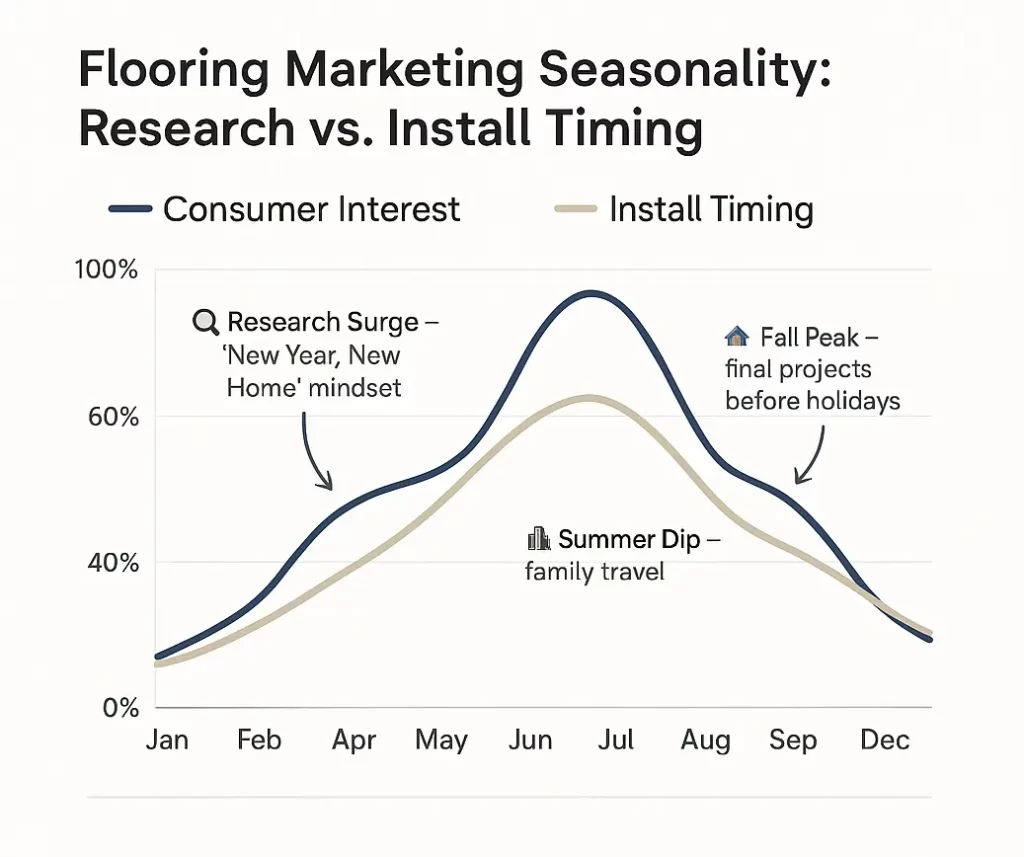
Just like any product, flooring purchases follow a seasonal pattern. Because the install process takes days or in some cases weeks (depending on the product), most consumers will have it installed during the warmer months (March – October).
However, as we’ve reviewed, the floor buying journey is on average 3-6+ months from initial research to final purchase and install.
When Homeowners Actually Buy
For this reason, marketing sees strong performance at the beginning of the year – think new year, new me. These installs won’t actually happen until March – June.
The early summer months actually see a decline in marketing performance as many families prepare for summer travel plans. However, the fall time sees this pick back up to another peak later in the year (around October).
The holidays (November and December) see a significant pull-back in renovations as most people host family and friends during the holiday season.
Planning Budgets Around Seasonal Peaks
Setting marketing budget to capitalize on these periods of higher consideration is key. January – March and July – September and the crucial months to focus budget, particularly to drive in-store sales.
Key Takeaway: Budget around research seasons, not installation seasons—January–March and July–September are the most valuable windows.
3. Flooring Type Determines Purchase Motivation
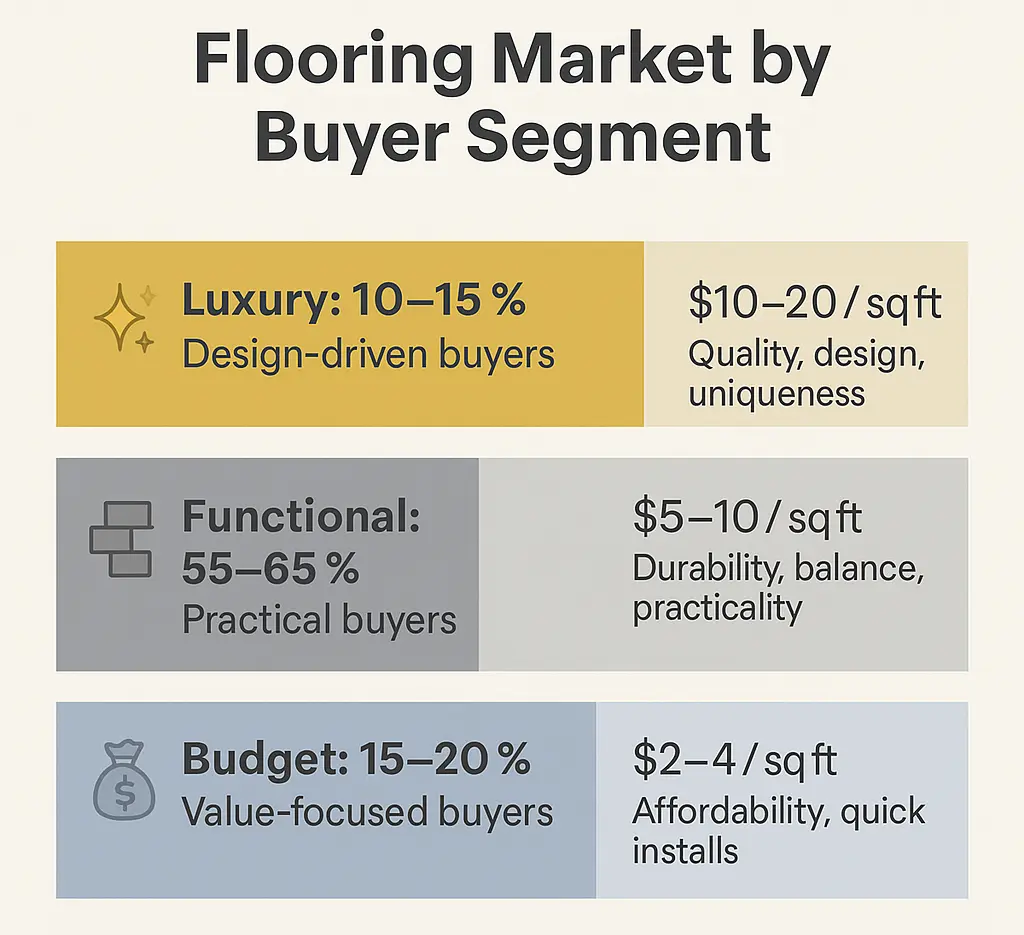
The price of flooring varies from low-end options at $2-3 per square foot, all the way up to $10-20 per square foot for more luxury styles.
These segments appeal to completely different segments of the market – and knowing what audience your product appeals to most is crucial.
Luxury Styles (10–15% of market)
Appeal to the homeowner looking to make an investment in their property. Often the consumer will opt for hardwood or premium carpet as they have the most quality options.
These shoppers first consideration is not price. Rather, they want something with quality, longevity, and above all else a unique aesthetic.
This represent a small portion of the total consumer base with roughly 10-15% and more than 50% this segment buys floors through an interior designer.
Functional Styles (55–65% of market)
Appeal to most consumers because of their ability to cover a lot of needs with relative proficiency. This segment opts more often for luxury vinyl plank or durable carpet styles that range anywhere from $5-10 per square foot.
Price is a considerable factor in decision but not the only one. Durability and function are equally as important – think households with kids or pets, or high traffic areas.
Style and aesthetic is still a large factor, but not as important. As long as an option matches the interior style of the room, most consumers will be happy with it.
This is the largest portion of the market with roughly 55-65% of the total consumer base.
Budget Styles (15–20% of market)
Appeal most to budget-conscious consumers with a large emphasis on price sensitivity. Styles that range from $2-4 per square foot are most considered, so laminate and low-end LVP are the most popular.
Often times these consumers are first-time homebuyers that have a fixed budget or landlords looking to put a low-cost option into a rental.
While this might seem like a large portion of the market, it’s actually only about 15-20% of the total consumer base.
Key Takeaway: Creative that reflects the buyer’s tier (luxury, functional, or budget) drives stronger engagement and higher conversion rates.
4. Align Marketing With Product & Audience
Understanding what audience segment you’re marketing to is key because it will drive the messaging strategy.
Let’s take a look at the three categories we broke out earlier: Luxury, Functional, and Budget.
Messaging for Luxury
Rather than marketing directly to consumers, luxury style messaging should lean into the trade (designers, contractors, installers).
Building a program that offers things like style look-books, free samples, even discounts for bulk orders are ways to appeal to this professional audience.
You can still find this audience on core channels like Google or Meta, but thoughtful strategies will incorporate platforms like Pinterest or even LinkedIn.
Messaging for Functionality
Most buyers of function-focused styles are either hiring a contractor or installing it themselves. Either way, the consumer will have more input into what product is actually purchased.
Because this is still a large purchase (ranging from $2000-10,000+), consumers carefully consider their decision. Content like real customer testimonials, user-generated content, and video of installation are most effective.
This audience lives across all digital platforms, though the most effective at driving action are Google and Meta.
Messaging for Budget Buyers
Most buyers in this category are just looking for a deal regardless of how the product is installed. Rather than sell on the quality, incentivize with discounts and promotions.
This could look like dollar savings or BOGO (except with square footage). Platforms like Google, Meta, or specific communities on Reddit are best to find this audience.
Key Takeaway: Match platform and message to audience motivation—Pinterest and Meta for inspiration, Google for decision-stage intent.
5. National vs. Local Campaigns Have Different Roles
While most industries can have the same ads and message at the nationally and locally, flooring is different. Local retailers sell the product direct to consumers while manufacturers (national brands) play a backseat role in the actual sale.
National Advertising — Awareness & Inspiration
Instead of focusing on ‘buy now’ messaging, national advertising becomes a brand-focused awareness effort.
Strong performing content includes:
- Popular interior styles/designs
- Buying guides detailing steps in the journey
- Video of product installs showing the process
- Lifestyle-aligned content
There are micro-audiences within the three segments explained earlier. This could include young parents, mindful mannered, pragmatic, or design enthusiast – the list goes on and on.
National ads can appeal to these audiences to win their attention and ultimately consideration. Channels like Meta, Pinterest, Youtube, CTV, and even Reddit are most effective at this stage.
Just remember, with such a long buying journey, high ad frequency has a profound impact on brand consideration.
Local Advertising — Conversion & Attribution
Once a shopper starts looking at local retailers, it’s time to focus on the sale. Transparent pricing and promotions are key at this stage.
Channels like Google are the most essential focus due to the high intent of keyword searches. While not all consumers will do a Google search before buying, it’s well within 80-90% that will search on Google prior to going in store.
Attributing revenue back to your advertising efforts also becomes crucial at this stage. Methods like Offline Conversion Imports in Google or CAPI Imports in Meta will significantly improve advertising ROI.
For a deeper breakdown of how to measure in-store impact, see Three Ways to Track Store Visits and Prove Real-World ROI. It covers step-by-step setup for Google, Meta, and programmatic tracking so you can attribute foot traffic directly to your ads.
Key Takeaway: National campaigns build consideration; local campaigns close sales. Keep both active for steady pipeline flow.
6. Flooring Purchases Are Triggered by Predictable Events
Unlike some industries where purchase are more impulse, flooring is carefully considered and only undertaken when necessary.
The Core Triggers
Buyers often only start this process when:
- Floors are damaged or deteriorated (on average this happens every 10-15 years without maintenance)
- A house is sold or bought and interior style changes
- Room-specific needs change (i.e. kitchen or bathroom)
Appealing to these life events in messaging becomes an effective way of relating to the consumer.
Aligning Messaging to Life Events
Across campaigns, ads that featured shots of damaged floors or home renovations drove 2x higher CTRs than stock images or lifestyle shots.
Flooring buyers will relate to their circumstances more than simple aesthetics. Show real floors and real people, not just pretty rooms.
Key Takeaway: Buyers act when life changes—new homes, damage, remodels. Show real moments to make your ads relatable and timely.
Applying These Insights Beyond Flooring
While these are learnings specific to the flooring industry, some can be applied more broadly. Understanding your audience’s needs, wants, ambitions, and desires is key to marketing any product or service.
The flooring industry makes that reality obvious because it sits at the intersection of emotion, function, and timing. Homeowners don’t replace floors every year; they do it when life changes – new homes, kids, damage, renovations. Campaigns that align with those moments consistently outperform those that just chase reach.
Start with identifying your target audience and key motivators that drive their purchase decisions, then how they move through their journey. Only then, apply your channel strategy, and don’t forget to measure ROI. If yo uwant to close that loop, read Three Ways to Track Store Visits (and Prove Real-World ROI) for a step-by-step walkthrough of store visit tracking across Google, Meta, and programmatic platforms.
For marketers outside flooring, the takeaway is simple:
Marketing scale without insight is just expensive noise. Marketing that aligns message, medium, and moment consistently wins.