Google Ads in 2026: Why Landing Pages Matter More Than Ever
A good landing page is key to success in digital marketing, but it becomes especially important within paid advertising strategy. It does the heavy lifting of communicating an offer, creating clarity, and moving people to take action.
Nowhere is that more important than Google Ads, where intent is highest.
In years past, Google Ads performance was often framed around keyword selection, bid strategy, and campaign structure. That is changing as Google’s automated campaign types increasingly control targeting, matching, and bidding.
In 2026, some of the biggest performance opportunities sit on the website itself, starting with the landing page as part of the broader paid media system.
With less control over exactly who arrives on site, the landing page has to do more work qualifying traffic, guiding behavior, and driving measurable action.
This article looks at why landing page experience matters more now, what a landing page actually needs to do in Google Ads, and how to use a data-driven framework to improve landing page performance.
TL;DR
- As Google Ads becomes more automated, landing pages play a larger role in qualifying and converting traffic.
- A strong landing page helps confirm intent, create a clear next step, and reveal which offers resonate with different audiences.
- Landing page analysis should focus on intent alignment, next-step efficiency, and device-level performance.
- In many cases, what looks like a campaign problem is actually a landing page problem.
Why Landing Page Experience Matters More Now
Landing pages do more than move customers toward a purchase. They also shape the signals Google receives after the click, which influences how campaigns optimize over time.
Signals include:
- Intent matching
- Post-click behavior
- Offer strength
Intent Matching
As Google pushes broader query matching and more automated campaign types, the landing page takes on more responsibility for relevance.
Instead of relying only on tight keyword control, advertisers increasingly need the page itself to clarify what the business offers, who it is for, and what actions matter most. Page content, structure, and message alignment all help reinforce that relevance.
Post-Click Behavior
Campaign optimization relies more on conversion and engagement signals than ever before. Without a steady flow of meaningful actions, campaigns struggle to identify and prioritize high-intent users.
Calls to action, clear next steps, and trackable on-page interactions all help Google understand whether traffic is actually valuable.
Offer Strength
Another key lever of control is the offer itself, or what a user receives in exchange for taking action.
That could be a guide, free consultation, discount, demo, calculator, tutorial, or another form of value beyond the page itself.
Landing pages create an opportunity to test how well those offers resonate with different audiences. In that sense, they are not just destinations. They are testing environments for message and offer fit.
Together, these three elements make landing pages one of the most important performance levers in a modern Google Ads strategy.
What a Landing Page Needs to Do in Google Ads
Traditionally, Google Ads has looked closely at relevance and usefulness when assessing landing page experience.
At a basic level, that means asking:
- Does the page relate to the click that drove the visit?
- Does it make the next step clear?
- Does it help the user take action?
As strategy shifts toward more automated buying systems, a good landing page has to do more than simply “match the keyword”.
Connect to an Audience
Strong landing pages connect first to a real audience motivation, problem, or identity.
That could mean emphasizing sustainability for a younger audience, convenience for a busy family audience, or value for a more price-conscious segment.
The point is not just to describe the business. It is to make the visitor feel like the page is relevant to them.
For more on identifying audience motivations and message drivers, read Why Some Ads Work and Others Fail: The Creative Demand Stack.
Make the Next Step Clear
A landing page has two core roles: education and action. In most cases, action does not happen without some degree of education first.
Where teams often miss the mark is by overloading the page with information and underemphasizing progression. The page should act as a gateway to deeper consideration, not a complete information archive.
Brief, useful content paired with a clear call to action is often more effective than trying to explain everything at once.
Every section of the page should help answer one question: what should the user do next?
Test and Strengthen Offers
An offer is the specific value a business provides that helps differentiate it in the market. It could be as simple as a free consultation, a quiz, a product sample, or a store locator.
The goal is not to find one perfect offer immediately. It is to test different offers and learn which ones resonate most with different segments of an audience.
In that sense, a landing page is a menu of possible value exchanges. The more clearly those offers are presented and tracked, the more useful the page becomes as a source of performance insight.
In home improvement, for example, offer variety might include design consultations, room visualizers, financing options, or retailer locator tools.
A strong go-to-market strategy prior to running ads helps determine which offers belong on the page. Ongoing analysis helps determine which ones deserve more emphasis.
A Framework for Evaluating Google Ads Landing Pages
Landing page analysis requires visibility into both engagement and progression.
That means clear goals and event tracking set up in an analytics platform like Google Analytics.
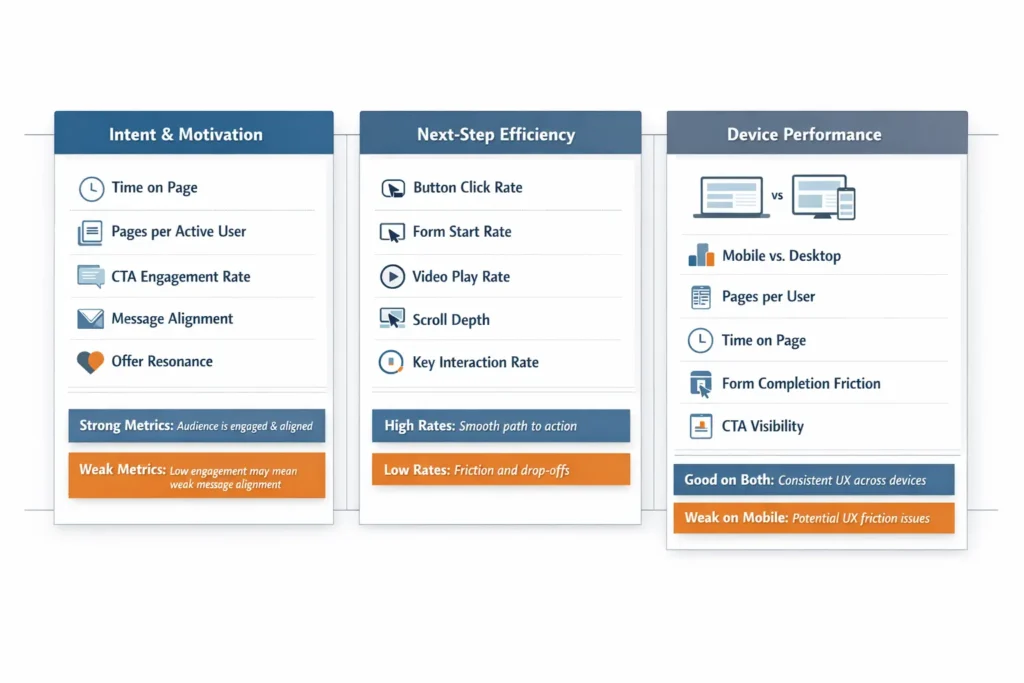
Analyze Pages by Intent and Motivation
When building landing pages around different themes or motivations, compare page performance to understand which messages are truly resonating.
Look at metrics like:
- Time on page
- CTA engagement rate
- Pages per active user
These metrics help show which pages are capturing attention and sustaining enough interest to move users forward.
Measure Next-Step Efficiency
Event tracking makes it possible to analyze the actions users take after landing on the page, such as button clicks, form starts, or video plays.
The goal is not just to see whether users visited the page. It is to understand whether they progressed.
Look at metrics like:
- Button click rate
- Form start rate
- Video play rate
These help explain what users are actually engaging with on the page, and whether the page is creating meaningful movement.
Break Out Performance by Device
One commonly overlooked factor in landing page analysis is device type.
Ad platforms overwhelmingly drive mobile traffic in most consumer categories. A page may perform adequately on desktop while failing on mobile.
Compare the same metrics by device:
- Pages per user
- Next-step efficiency
- Time on page
This often reveals friction that is hidden in aggregate performance. Applied consistently, this type of analysis uncovers clear opportunities for improvement.
Using Landing Page Data to Guide Strategy
A dataset of landing pages for an online ordering platform uncovered clear patterns in how users preferred to engage.
This kind of analysis is most useful when it is treated as directional evidence rather than absolute truth, especially since landing page performance often reflects a mix of page quality, traffic quality, and campaign structure.
For more on evaluating performance signals appropriately, read Why Most Marketing Decisions Use the Wrong Evidence.
Metrics assessed included:
- Pages per user
- Next-step rate
What the Data Showed
/ordermaterially stronger than/menuand homepage-style paths- Broad pages generated scale but weak business action
- Engagement alone was not enough to judge landing page quality
How the Strategy Changed
- High-intent order pages were prioritized as landing pages
- Key events were made more prominent on broad entry pages
- Tracking was expanded to capture more detailed on-page behavior
Performance is now reviewed on a monthly cadence to identify changes and inform the next round of updates.
What to Fix Before Changing Campaign Settings
The reflex when performance is under target is often to change campaign settings, budgets, or targeting.
In many cases, that response ignores how modern customer journeys actually work.
The landing page and onsite experience are just as important as the message that generated the click, and in some cases more important. The page is what turns attention into interest and interest into action.
Before changing campaign settings, ask:
- Does the landing page clearly match the ad?
- Does it give the user the right next step?
- Does it reduce friction?
- Does it work on mobile?
If the answer to any of these is no, poor campaign performance may have less to do with headlines, bids, or descriptions than with landing page quality.
Conclusion
In 2026, Google Ads success is less about forcing traffic through tighter controls and more about receiving traffic well. As Google gets broader and more automated, landing pages matter more because they are tied to a specific audience, built to push users forward, and work in the broader media format ecosystem.
A strong landing page facilitates this: driving quality traffic through key signal feedback and optimized messaging flow. Since Google Ads is a click-based channel, the post-click experience is where advertisers increasingly differentiate.
Improving the onsite experience is one of the most effective levers advertisers can pull in 2026. The teams that treat landing pages as part of the broader paid media system, not just the destination, will be the ones best positioned to turn Google’s automation into better performance.
Want to learn what fundamentals make a good landing page? Read SaaS Landing Page Best Practices: 7 Keys to Higher Conversion