Understanding Meta’s 2026 Attribution Update
Attribution models in Meta Ads are one of the first pieces of supporting evidence advertisers use to judge whether campaigns are working. It estimates the likelihood that an ad influenced someone to buy a product, book an appointment, or complete another desired action.
That attribution powers performance metrics marketers use every day, including reported revenue, return on ad spend, and cost per result. In practice, those numbers often shape budget decisions, reporting narratives, and confidence in future investment.
The problem is that attribution in Meta is often misunderstood. Meta reports conversions across three action types: clicks, engagements, and impressions. They may appear side by side in reporting, but they are not equal in quality or in what they suggest about actual campaign impact.
Treating all attributed conversions the same is one of the fastest ways to overstate performance and make poor budget decisions. This is especially true in cross-channel analysis, where overlapping attribution can make platform-reported results look better than they really are.
This article breaks down the three attribution types in Meta, what changed in 2026, and how advertisers should interpret each one if the goal is to optimize for impact instead of credit.
TL;DR
- Meta now counts more non-link ad clicks inside engagement attribution.
- That shifted more conversions into the engagement bucket after the update.
- In the data here, click share fell, engagement share rose, and view stayed mostly flat.
- Overlap between attribution types increased materially.
- Click is still the best in-platform signal for direct response; engagement is context, and view-through is directional.
The Three Attribution Types in Meta Ads
Attribution in Meta Ads is broken down into three primary types:
- Click
- Engagement
- Impression
Each type has a separate definition, and can overlap with other types.
Click-Based Attribution
Conversions are counted for any actions that happen after link clicks only.
These are most closely tied to direct response behavior in backend reporting due to the nature of engagement – a user had to land on a website after clicking through to be counted.
Click-based activity is broken into 1-day, 7-day, and 28-day. To better understand attribution lag, read Meta Attribution Lag: How to Measure and Fix Misleading Performance Data.
Engagement-Based Attribution
Formerly known as ‘engaged-view’ attribution, conversions are counted for any actions that happen after ad engagement or engaged views.
Meta defines the criteria for engagements as:
- Ad engagement: any click on an ad excluding link clicks
- Engaged view: 5-second view or 95% viewed for ads less than 5 seconds.
Meta made engagement attribution much stronger when they added ad clicks excluding links to the attribution criteria in 2026. Now instead of simply applying to video ads, it includes reactions, shares, carousel clicks, and more engagements with the ad itself.
Impression-Based Attribution
Impression conversions or view-through conversions are counted for any actions that happen after an impression, but no click.
Meta defines an impression as any ad that is 50% in view for at least 1 second. This means that a recorded impression may not even be a full view of your ad creative, or someone scrolling quickly through the feed.
For this reason, impression conversions are the least valuable to advertisers, and should be considered as such when making budget allocation decisions.
How Attribution in Meta is Changing in 2026
In March 2026, Meta changed its attribution criteria around engaged-view conversions. Instead of simply measuring 5-second video plays, they separated ad clicks into link clicks and ad clicks.
Link clicks are outbound clicks that send a user toward a destination, but should not be confused with confirmed landing page views.
Ad clicks are actions like reactions, shares, comments, saves, see more, carousel navigation, and more.
The effect on performance measurement is comparatively small, but noteworthy.
How Conversion Totals Changed Post Update
Conversion performance analysis changed with the updated engagement attribution definition.
Comparing before and after the change shows how conversion totals changed.
| Attribution | Before Update | After Update |
| Click | 64.46% | 58.41% |
| Engagement | 6.55% | 12.76% |
| Impression | 28.99% | 28.83% |
As expected, engagement attribution pulled mostly from click conversions. This makes sense given ad clicks which were formerly attributed as click conversions are now bucketed into engagement.
While the change doesn’t significantly shift conversion totals, it does present more opportunities to learn.
How Meta Totals Conversions Based on Attribution
Meta has always counted conversions against various attribution types if the user completes several actions.
For example, an impression conversion and engagement conversion may be recorded for the same purchase if a user views an ad and also reacts to the ad within a 1-day window.
The same basic problem shows up in broader reporting systems too: platform-reported conversions are often overlapping rather than deduplicated, which is why cross-channel reporting needs to be interpreted with care. For more on that issue, see Why Most Marketing Decisions Use the Wrong Evidence.
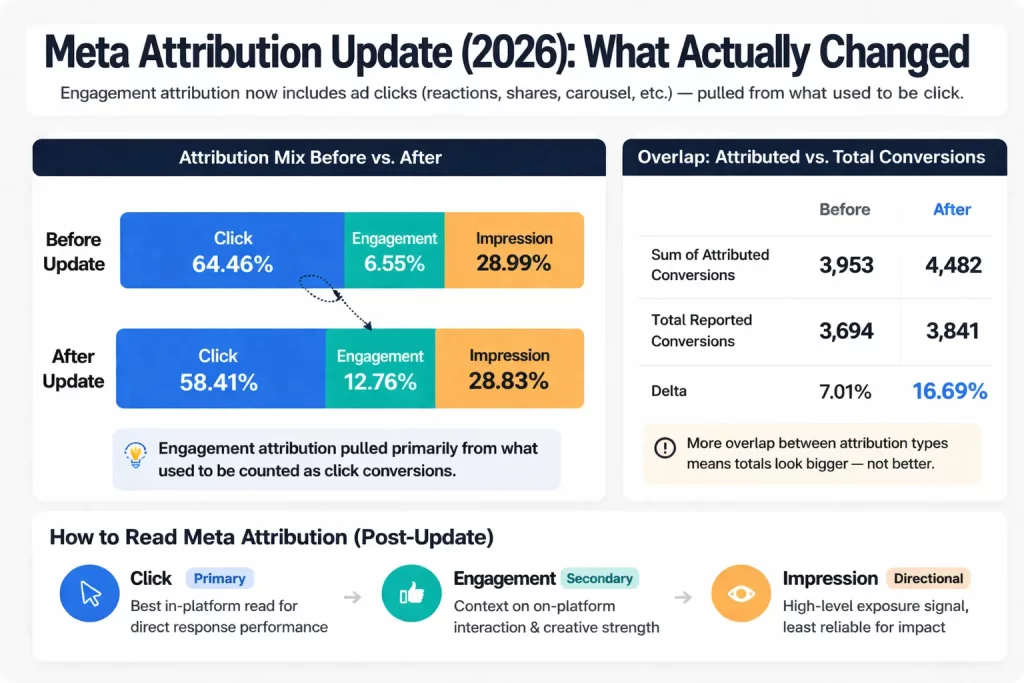
After the change, the sum of all attributed conversions jumped from 7% higher than the total reported to over 16% higher than the total reported.
This signals that there is more overlap between attribution types now that engagement attribution includes ad clicks. How advertisers use this data to analyze results also faces some change.
What These Changes Mean For Performance Analysis
With changes to how ad attribution works in Meta Ads, analysis of campaign performance also deserves a rethink.
Performance analysis relies on clean, unduplicated data to inform decision making. Engagement attribution muddies that analysis in part.
How to Use Engagement Attribution
Engagement attribution has evolved from a basic analysis of video engagement to broader ad engagement overall. It now helps identify impact beyond direct website visits.
Using engagement attribution in analysis must be done carefully though. Because it overlaps with click and view attribution, clean analysis should be done separately.
Engagement attribution supplements click attribution as an impact–driving metric, but can’t be combined or else risk double counting conversions.
Why Click Attribution Still Matters Most
Click attribution has always been the strongest in-platform measure of direct response performance because it tracks conversions following an actual outbound action. The changes to engagement attribution only make that distinction clearer.
That said, better attribution reading is not the same thing as perfect measurement. If you want to improve how much usable conversion data Meta receives in the first place, especially for qualified leads, long sales cycles, or offline sales, see Fix Facebook Attribution Issues: Offline Conversion Tracking Guide.
Why Impression Attribution Still Matters Least
Impression attribution being largely unchanged means it still offers little to no value in analysis, other than to show what ads are having the least actual impact.
High impression attribution often means the ad is doing heavy retargeting, but not influencing actual behavior – this is one of the situations to avoid at all costs.
A Performance Analysis Model for Meta in 2026
Meta’s updated attribution framework requires a more structured way to evaluate performance. Not all attributed conversions should be treated equally, and not all attribution types should be combined.
Using that framework, the results above suggest three clear takeaways.
1. Click attribution remains the primary performance signal
2,618 of 3,841 total appointments were attributed to clicks, indicating that most measured performance was still tied to users who took an outbound action rather than only being exposed to or lightly interacting with the ad.
That is important because click-attributed conversions are the most defensible measure of direct response performance under Meta’s current reporting structure.
2. View-through attribution should be treated cautiously
The campaign also reported 1,292 view-attributed appointments. But view attribution is highly likely to overlap with both engagement and click attribution, since these reporting categories are not mutually exclusive.
For that reason, view-through conversions should not be treated as incremental or added into a broader performance estimate without caution. They are better understood as a directional signal of ad exposure than as a standalone measure of business impact.
3. Engagement attribution adds context, but not a clean additive total
The 572 engagement-attributed appointments suggest the campaign influenced some users through meaningful on-platform actions, not just outbound clicks.
That is useful context, especially for understanding broader ad impact. However, engagement-attributed conversions may still overlap with click-attributed conversions, which means they should not automatically be summed and treated as a unique conversion total.
Instead, engagement attribution is best used as a secondary layer of analysis: evidence that the campaign may have influenced additional behavior beyond direct click-driven conversion, but not a deduplicated measure of incremental impact.
What this means for performance analysis
Using this model, the campaign can be interpreted through three separate lenses:
- Primary performance: click-attributed conversions
- Broader active influence: engagement-attributed conversions
- Directional exposure: view-attributed conversions
How to Analyze Meta Performance After the Update
The core principles of analysis have not changed, but this update requires more care in how Meta results are interpreted in a measurement strategy.
Click attribution should be the primary benchmark for direct response analysis because it now requires an actual link click path.
Engagement attribution should be used as a secondary signal that the ad influenced users beyond outbound visits, but not as additive conversion volume.
View-through attribution should remain a directional exposure metric, useful for understanding how much passive ad exposure may be present, but not a standalone estimate of incremental business impact.
| Attribution Type | What it’s good for | How to use it | Main risk |
|---|---|---|---|
| Click | Primary performance read | ROAS / CPA benchmark | Still not true incrementality |
| Engagement | Context on active influence | Secondary analysis | Overlap with click |
| View | Exposure signal | Directional only | Heavy overstatement |
That distinction matters because attribution can help optimize campaigns, but it cannot tell you on its own whether those conversions would have happened anyway. For that, you need incrementality testing. Read How to Test Marketing Incrementality (Real Case Study) for a deeper breakdown.
Using Meta’s Attribution in 2026 and Beyond
Meta’s attribution update does not make platform reporting more truthful. It makes the reporting categories more interpretable.
Click attribution is now the strongest in-platform read on direct response performance. Engagement attribution is useful context, but not additive. View-through attribution remains directional at best.
The takeaway for advertisers is simple: stop treating all attributed conversions as equal, and start reading Meta reporting based on the type of action that actually preceded the conversion.