Ad Optimization Explained: Aligning Campaign Objectives with Buyer Intent
For decades, advertising was a game of chance – spray your message wide, pray for a response, and hope someone noticed. A billboard, a magazine ad, a radio spot, success was measured in gut instinct.
Then came digital marketing. With pixels, UTMs, and user tracking, advertisers suddenly had more data than they knew what to do with. Every click, scroll, and hover became a signal.
The paradox? The more data we gained, the harder it became to decide what actually matters. Most advertisers today aren’t struggling with a lack of information – they’re drowning in it. It’s rumored platforms like Google & Meta have millions of data points on each user – you can even check how many gigabytes of data Google has stored on you.
This article breaks down the three most common campaign objectives – awareness, engagement, and conversion – and how to think about optimization in a world where ad platforms know everything, but results still come down to strategy.
TL;DR
Ad optimization is about matching your campaign objective to buyer intent, not chasing the cheapest clicks.
Start with conversion goals (sales or leads), use mid-funnel signals like add-to-cart to train algorithms, and test changes slowly.
Measure results in your CRM, not ad platforms. Remember, don’t chase conversions – chase outcomes.
The Three Core Methods of Ad Optimization
We’ve reviewed in detail the three primary objectives in ad optimization for Meta Ads, which apply to just about every ad network that exists.
1. Awareness – Reach and Recall
Awareness is the most traditional form of advertising. It treats everyone the same and aims to reach as many people in a defined audience as possible.
2. Engagement – Actions Without Intent
Engagement looks to drive action, but only as far as getting a user to click. Ad clicks can lead to sales or leads further down the road, but are not great indicators.
Read why not all engagements are equal and how to drive better engagement with custom conversions
3. Conversion – Intent Optimization
Conversions are the most desirable actions – usually sales or leads – and often contribute directly to sales and revenue. The trade-off is these actions are usually taken by the fewest people because they cost time and money.
Choosing the Right Optimization Method
TL;DR: It’s conversions — but context matters.
While each objective serves a purpose, marketing has to be profitable. Conversions are closest to sales, so that’s where optimization should begin.
Awareness and engagement can fuel conversions but ultimately you want to target closer to the point of decision first. After all, it’s estimated that only 3% of your potential market is actively prepared to make a purchase.
But when it comes to conversions, there are many types. The aforementioned sales and leads might be the first that come to mind, but it goes much further than that.
What Is a Conversion Event?
Before we get into the specifics, conversion events refer to the different actions users can take on your website or app, or in your physical store.
Think of things like viewing a product page, finding the nearest location to your physical store, or most commonly buying something from your e-commerce shop.
There is a natural progression to how users will interact with your website and this naturally effects how ad platforms optimize.
How the Conversion Funnel Impacts Ad Performance
The conversion funnel is the roadmap ad platforms use to decide who to show your ads to and what signals to optimize for.
Understanding how many users exist at each stage helps determine which conversion event provides enough data for your campaigns to learn effectively.
In a healthy funnel, for every 100 users who view a page, around 75 might explore a product, 10 might add to cart, and roughly 5 will purchase.
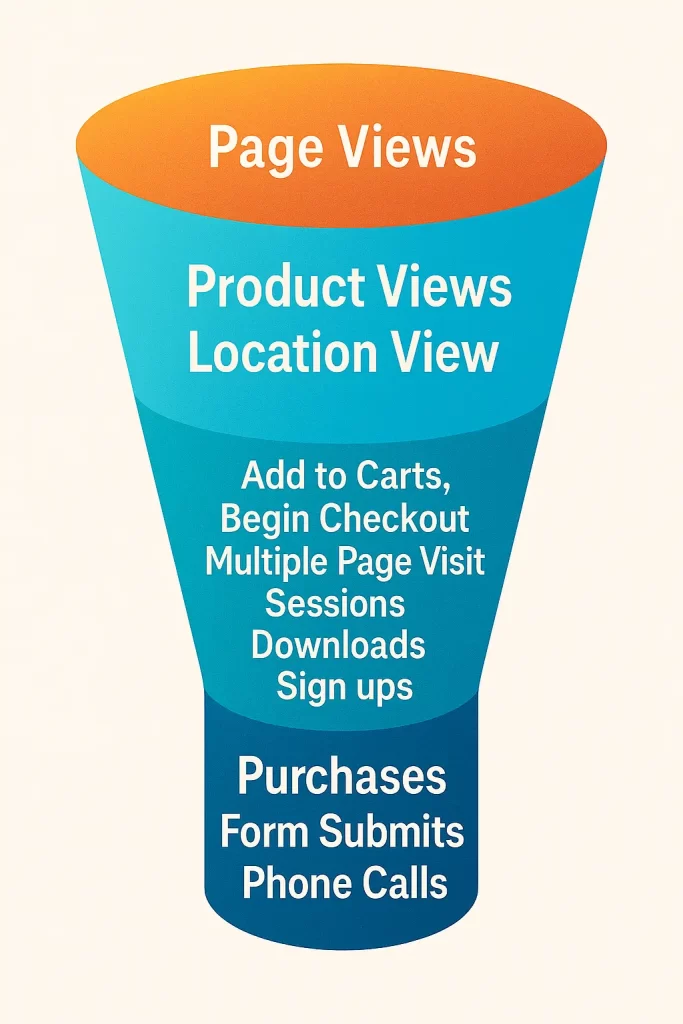
Remember this follows the principle of the buying pyramid
Your goal is to choose a conversion event far enough down the funnel to reflect intent, but high enough up to give the algorithm enough data to learn.
Low Intent
Actions like page views or specific pages like product pages or locations pages act as the introduction to your brand. All or most users that engage with your ads will complete one of these actions.
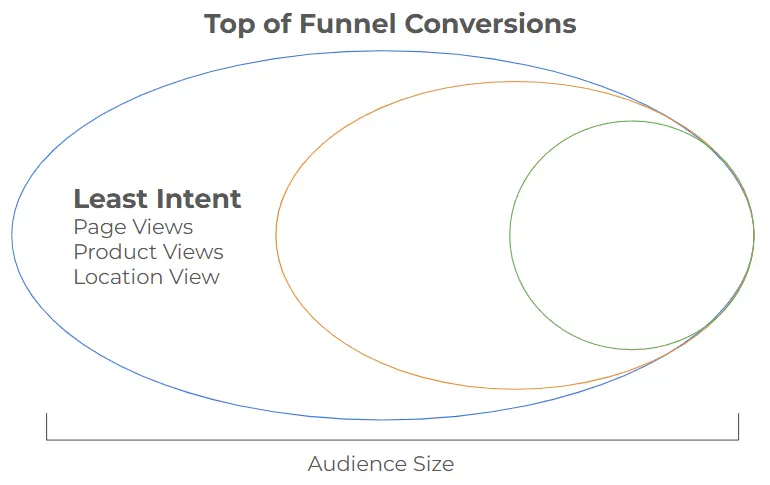
Because the barrier to entry is low, these actions typically aren’t great intent signals, though they are good at driving engagement with your ads.
Mid Intent
Actions like add to carts, begin checkout, multiple page visit sessions, downloads or sign ups are more intentful, and therefore happen less.
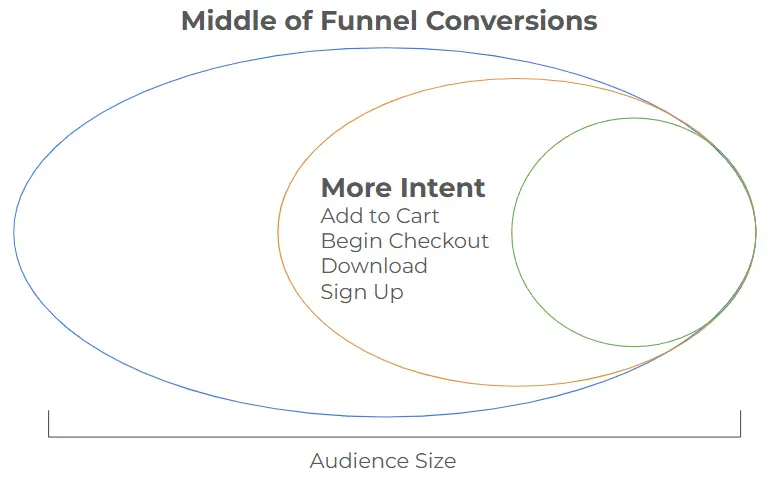
Because fewer users that make it to you site complete these actions, they are better signals to optimize against. The audience is smaller, but is more in line with an audience that is actually looking to buy something from you.
High Intent
The final action that you want users to complete – often a purchase, lead submission, phone call – carry the most intent. Their proximity to a sale makes them the most valuable but also the least common.
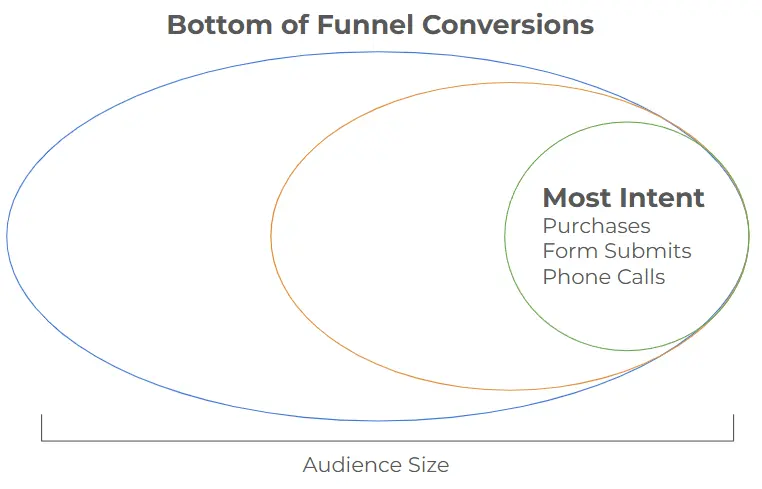
Optimizing for these events is effective, but can lead to inefficiency because the audience to optimize against is so small. In addition, competitors are also likely targeting these people (because they are valuable), adding to the inefficiency.
Strategy by Business Type
TL;DR: Don’t just optimize for purchases or leads
If you just read the TL;DR, you’d get part of the story. As is always the case with marketing, the real answer is it depends.
Low Traffic Sites (New Brands)
New brands or websites without a lot of organic or referral traffic need to generate awareness of their brand. Even if the goal is sales, converting customers on the first click is not typically possible (unless you have no competition).
Using a small campaign optimizing for a signal like Product Page Views or Add to Carts helps generate that initial interest without paying the premium associated with a purchase objective.
For example: Page View optimization CPMs can be up to 5x cheaper than Purchase optimization
A product view campaign won’t convert to sales as effectively as optimizing for purchases, but it will drive clicks much more efficiently.
Recommendation: Run a purchase campaign + product view campaign at a 85/15 budget split respectively.
High Traffic Sites (Established Brands)
Sites that already get a lot of traffic via organic, referral, or other awareness efforts (offline, word of mouth) don’t have as much need to grow their audience.
Focusing on bottom of funnel conversions is more feasible because there is already a pool of warm users that know about your product or service.
This applies most to e-commerce businesses or any business with online direct-to-consumer sales
Recommendation: Run a purchase campaign that optimizes for first-click attribution.
Lead Generation & Long Sales Cycles
Any product or service that has a sales process (after lead generation) or cycle that takes weeks/months requires more touchpoint prior to conversion.
Educating the end user is absolutely necessary to build confidence and consideration. Middle of funnel optimization like sign ups, downloads, long sessions, etc. helps prioritize this.
This works with cross-channel strategies too. Platforms like LinkedIn and Facebook can act as the discovery tactics that drive conversions through Google.
Case Study: We used LinkedIn and Youtube to drive a massive 475% increase in qualified leads through Google.
Testing and Optimization Best Practices
Regardless of your business type and size, there are some best practices to always follow.
1. Test Small First
Takeaway: Making large changes at once like dedicating 30% of your budget to a new tactic is incredibly risky.
Always start with a small amount of ad spend (5-10%) to prove the concept. If you see CPA improve, slowly increase budget (+5% per week) until you start to see diminishing returns.
2. Make One Change At A Time
Takeaway: Changing too many things at once muddies results and limits the learning potential.
Make a change (add a tactic, change creative, etc.) and allow it to run for at least 1 week. Businesses with longer sales cycles will need to wait even longer.
3. Respect Your Sales Cycle
Takeaway: If your average time lag to convert is 2 weeks, don’t draw conclusions after 1 week of running a new test.
You will need to wait at least 2 weeks (or 4 weeks) to see the full effect of changes you’ve made.
Rule of Thumb: Use “AverageTime Lag x 2″ as your test duration before judging results.
4. Measure in the Right Place
Takeaway: Savvy marketers know attribution is a flawed concept. Measure performance against real business results from your CRM.
Using in-platform reporting is susceptible to inflated performance metrics due to things like view-through conversions and greedy last-click attribution.
Measuring against the actual numbers in your backend systems (CRM, CDP, Bank Account) eliminates biased reporting.
Conclusion – From Data to Decisions
Ad optimization isn’t about choosing the “right” objective – it’s about choosing the right one for where your audience is in the journey.
Awareness and engagement campaigns build the runway; conversion campaigns land the plane. The best marketers know how to fly both.
Start by optimizing for the signals you can measure reliably, whether that’s a product view or a checkout. Test with small budgets, give results time to mature, and always validate performance with real business metrics from your CRM, not just the ad platform dashboard.
Mastering this balance means you’ll stop chasing vanity metrics and start scaling sustainably with clarity, confidence, and campaigns that actually convert.