Campaign Management Automation: What to Automate
Efficiency isn’t just a campaign goal, it’s a necessity in operational process.
The fastest way to burn out a media buyer isn’t poor performance. It’s forcing them to manually manage noise: pacing budgets, checking dashboards, exporting reports, scanning for anomalies.
Modern platforms have automated much of delivery. Bid adjustments, audience expansion, and auction dynamics are increasingly handled by algorithms. But that doesn’t mean the job of campaign management has disappeared – it’s shifted.
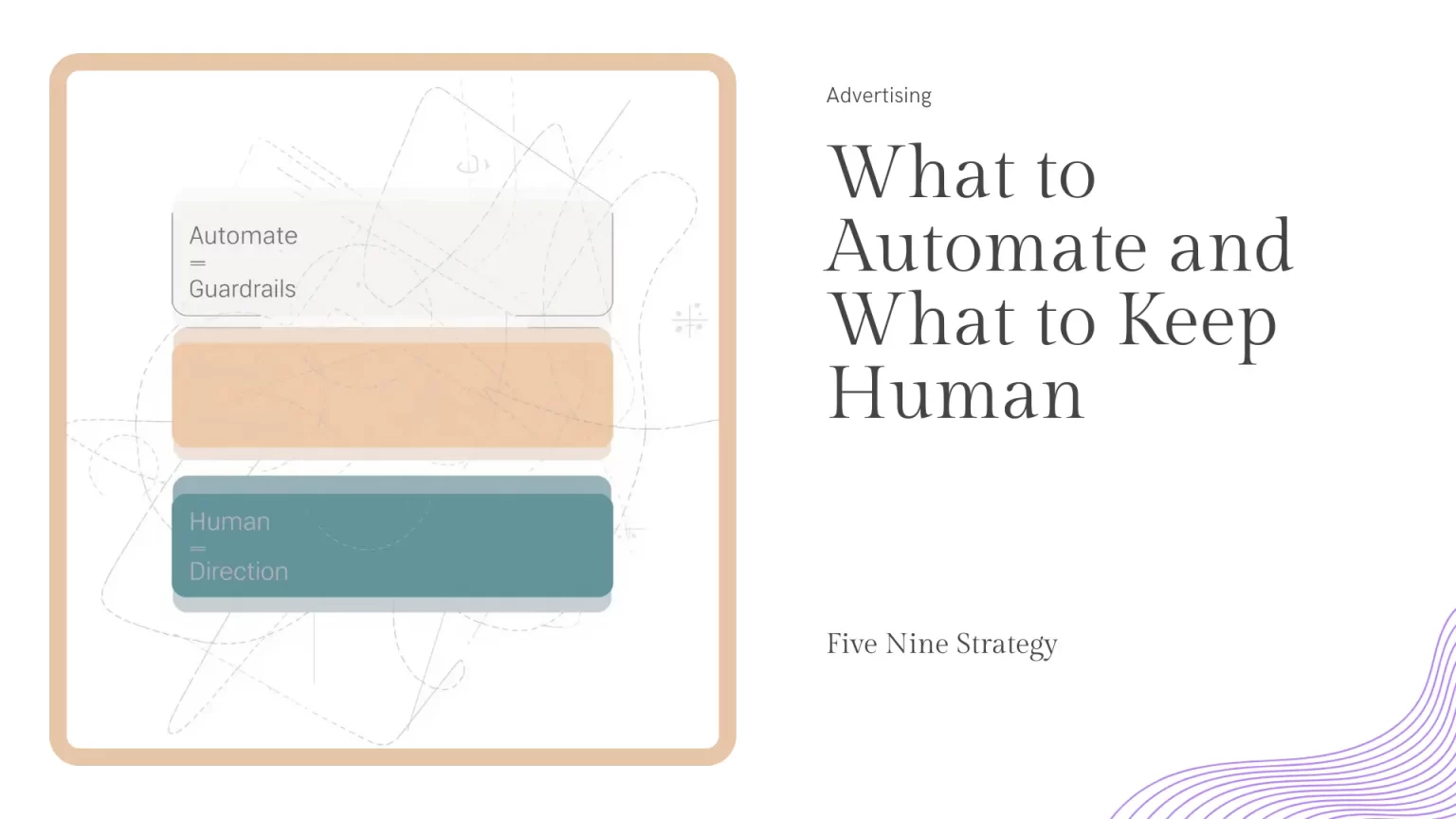
Automation isn’t about replacing decision-making. It’s about deciding what deserves human judgment and what doesn’t.
Most teams attempt automation in some form, but risk automating the wrong layer of work. This article breaks down each layer, and how to work automation into your campaign management strategy.
TL;DR
Automation in campaign management should reduce noise — not replace judgment.
Fully automate repetitive, rule-based tasks like budget pacing, reporting, alerts, and QA checks. Semi-automate monitoring processes like creative fatigue and scaling guardrails.
Never automate strategic decisions like campaign structure, objective changes, creative direction, or cross-channel budget allocation.
Automate for efficiency, not strategic decision making.
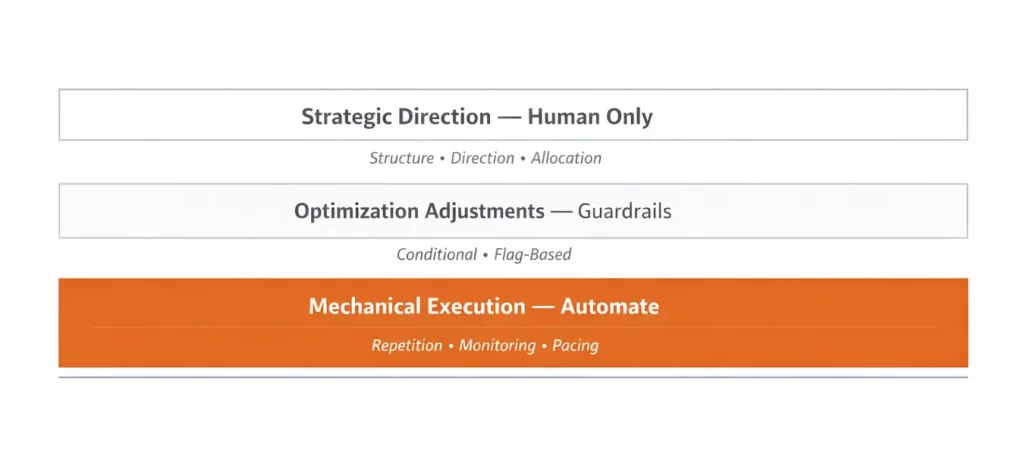
The Three Layers of Campaign Management
Campaign system design breaks down into three distinct layers. Each layer benefits from a different level of automation.
Layer 1: Mechanical Execution
These tasks are largely rule-based, and very repeatable. Think of things like:
- Budget pacing
- Naming conventions
- Reporting exports
- QA checks
- Monitoring core KPIs
These decisions are small system adjustments. They don’t change direction.
Automate these aggressively
Layer 2: Optimization Adjustments
These decisions influence performances but don’t redefine strategy.
- Scaling budgets
- Pausing fatigued creative
- Adjusting CPA targets
- Monitoring frequency and saturation
They’re conditional and require interpretation. Automation can support them, but should not fully execute them.
Semi-automate here.
Layer 3: Strategic Direction
These decisions define learning after strategist analysis.
- Campaign structure
- Objective changes
- Creative angles
- Funnel shifts
- Attribution modeling
These tasks are nuanced and often require multiple data sources to determine an answer. Automating them risks encoding bias and poor decision making.
Never automate this layer.
What Should Be Fully Automated
Fully automated processes should improve operational efficiency without altering learning direction. Below are three of my most used automations.
Budget Pacing Controls
Google and Meta can exceed daily budgets within platform allowances. That flexibility is useful, but isn’t always reliable.
For example, a restaurant driving weekend traffic may benefit from increasing budgets Friday evening and reducing them Sunday night.
An automated rule that adjusts daily budget by time of week ensures discipline without changing targeting, structure, or optimization.
This protects stability. It doesn’t change strategy.
Performance Alerts
Metric monitoring for KPIs like CPA and CTR are basic tasks of a media buyer. They don’t require creativity – simply monitoring.
Create rules that notify you when:
- CPA deviates significantly from historical averages
- CTR drops below threshold
- Conversion volume falls below learning minimums
Alerts surface changes in performance, they don’t make actual changes. That keeps judgement in the hands of the strategist.
Oversaturation Detection
In social platforms like Meta, creative fatigue often appears as rising frequency and declining engagement.
Automate notifications when:
- Frequency exceeds 3 within 7 days
This protects users against ad fatigue and wasted budget.
Without automation, these checks become time drains. With automation, they become guardrails.
What Should Be Semi-Automated
Similar to automated checks, semi-automation is a safety system, not an execution engine.
For this reason, automated rules don’t make decisions. They ensure visibility of decisions that need to be made.
Data Collection & Reporting
Export campaign data automatically using tools like Supermetrics. Set dashboards to refresh weekly.
This removes manual reporting friction and ensures trend visibility.
Humans still interpret the data.
Creative Fatigue Detection
Set thresholds such as:
- 5,000+ impressions and CPA significantly above benchmark
- CTR decline for 2 or more weeks in a row
Platform rules alone won’t let you do this, but reporting automation and dashboard visualization will.
Creative decay isn’t always linear, but using weekly trends to smooth variance helps.
Again, let automation notify. Let humans decide.
Creative Rotation
Not all creatives deserve ad spend. Set up a rules to:
- Review an ad when impressions exceed 5000 and CPA surpasses a benchmark.
However, use it as an early indicator. Assess post-click metrics like time on site and traffic quality before pausing creative outright.
Sometimes a creative might look efficient, but drive upper funnel demand that converts elsewhere.
Semi-automation acts as a safety system, so you know when something needs attention. It won’t replace decision-making.
What Should Never Be Automated
Automation works as a helper – it’s not a decision maker. That responsibilities lies solely with the strategist.
Campaign Structure
Developing a tactic mix that drives results relies heavily on regular performance analysis – great for automation.
However, when it comes to deciding how to structure campaigns (consolidation is your friend), the decision and structure is a human decision.
Objective Changes
Changing optimization events alters what the algorithm values. Switching from conversions to engagement isn’t an optimization tweak – it’s a directional shift.
These require deliberate thought.
To learn more about how ad optimization works, read my guide on ad optimization strategy.
Creative Strategy
Automation can surface winning formats. It cannot invent new positioning angles.
The best marketers developing messaging angles based on data, which can be automated in part.
However, the bulk of creative direction requires synthesis of data, market context, and human psychology – human work.
Get started on new creative topics with my article on creative examples that convert.
Budget Reallocation
Channel allocation is an incrementality question, not a CPA question. This requires in-depth analysis aided by automation.
Cross-channel budget decisions should be driven by understanding where growth is created and not by reactive rules.
The Automation Principle
Generally when considering whether to automate a process, ask yourself two questions.
- Is this repetitive and rule-based?
- Does this maintain stability rather than create change?
- If this rule executed automatically, would it alter learning direction?
If the answer to #3 is yes, don’t automate it.
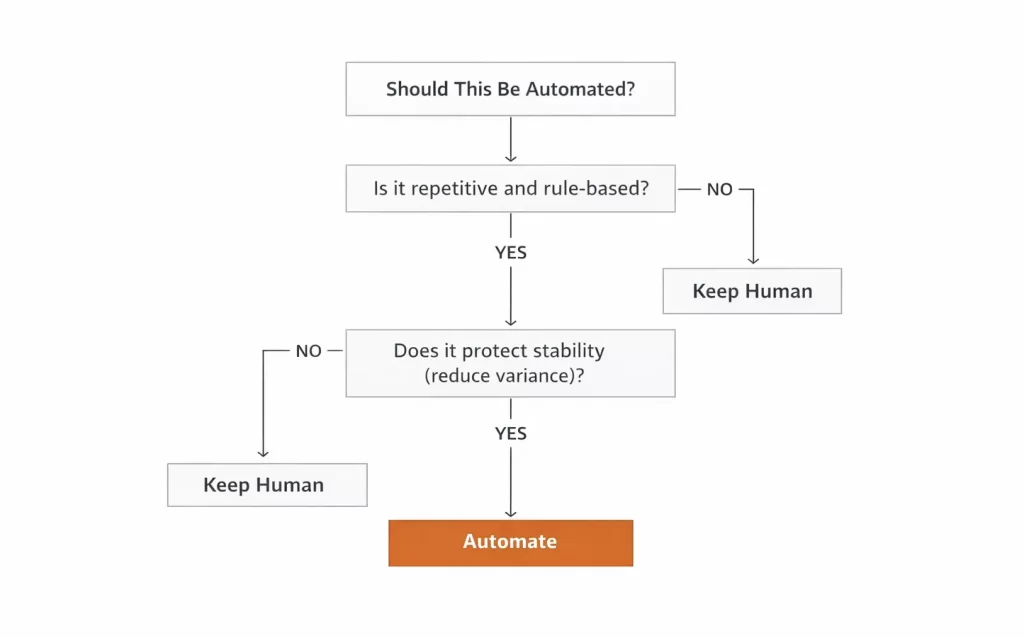
Automating processes that happen more frequently. Data pulls, performance checks, regular budget changes all fall within this group.
Manually manage directional shifts. Automation should improve analysis without sacrificing exploration.
Practical Automation Stack
For those just starting their journey into automation, there are several tools that are non-negotiable.
- Native platform rules (Google, Meta, etc.)
- Supermetrics for reporting
- Zapier
- Looker Studio for visualization
Each of these tools fit into a different part of the process.
- Full Automation: Platform rules, Supermetrics
- Semi-Automation: Zapier, Looker Studio
As reporting complexity increases, ingestion often moves from spreadsheet connectors to warehouse-native systems. I’ve documented how to automate paid media reporting with Fivetran at that stage.
Automate Noise. Own Direction.
Automation isn’t about replacing media buyers. It’s about eliminating friction.
The goal is not to build a machine that runs campaigns without oversight. It’s to remove the mechanical work that comes before strategic thinking.
Automate:
- Guardrails
- Monitoring
- Repetition
- Budget discipline
Protect manually:
- Structure
- Exploration
- Creative direction
- Budget allocation
Automation should stabilize the system – not decide where it goes. Work faster and smarter, but reserve judgement for strategic decisions.