Understand the Psychology Behind Working Ad Creative
Ad performance has always relied heavily on creative – the concept, message, offer, and general theme of communicating what a company is, does, and provides.
However, most advertisers mistakenly think creative is a display of quality and creativity. This leads to expensive ads that look stunning, but fail to convert.
Regardless of the targeting or campaign structure, some ads simply fail to connect. Not because the algorithm doesn’t evaluate them, but because users don’t care.
No amount of savvy targeting or tracking will fix this. It’s in the psychological structure of the offer and message.
The takeaway: Creative doesn’t create demand. It reveals it.
TL;DR
Most advertisers try to fix struggling campaigns by changing the ad. But creative sits near the top of the performance stack.
This article explains the deeper layers that determine whether ads can scale in the first place. Human motivation and emotional problem intensity to identity alignment, differentiation, messaging, and offer friction.
When these layers align, advertising works. When they don’t, campaigns feel unpredictable and expensive.
Why Some Ads Work Instantly
People see thousands of ads per day, yet some are able to stick in their mind. On platforms like Meta or TikTok, users aren’t actively shopping.
They’re scrolling.
The brain decides whether to engage in a fraction of a second, before conscious thought even begins.
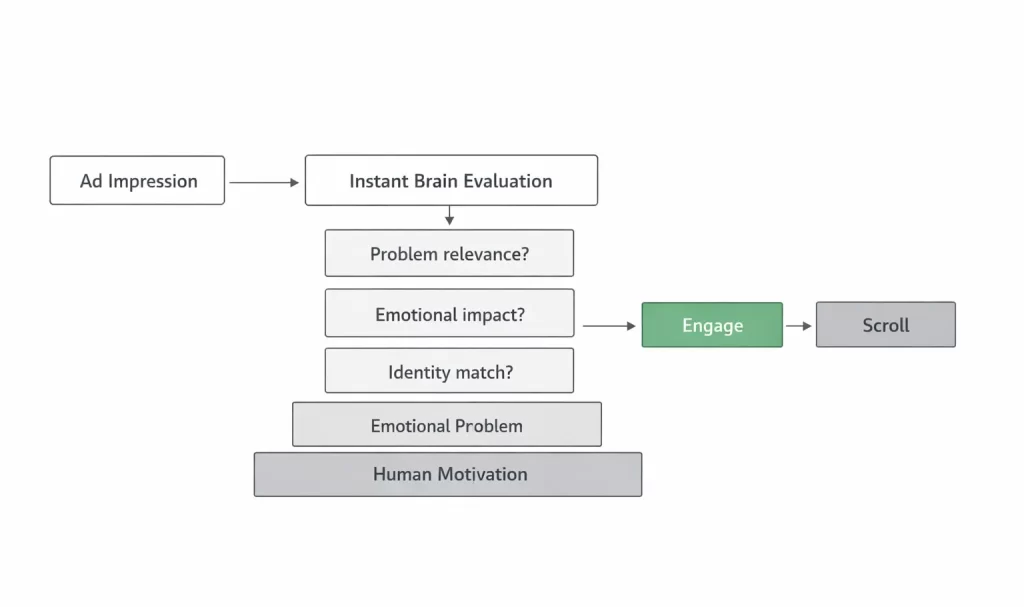
In that moment, the brain quickly evaluates three questions:
- Does this solve a meaningful problem?
- Does it feel emotionally relevant?
- Does it align with who I am (or who I want to be)?
If the answer isn’t immediately clear, the user scrolls past. This means ad performance is determined long before optimization or creative testing begins.
On platforms like Meta, the early engagement signal is hook rate, which often determines which ads receive distribution before CPA or ROAS ever come into play.
The Demand Stack Behind Every Ad
All high-performing ads have a deeper appeal than simply communicating a product or service.
Think of it as a stack of wants, needs, and desires that form human motivation, applied to marketing execution.
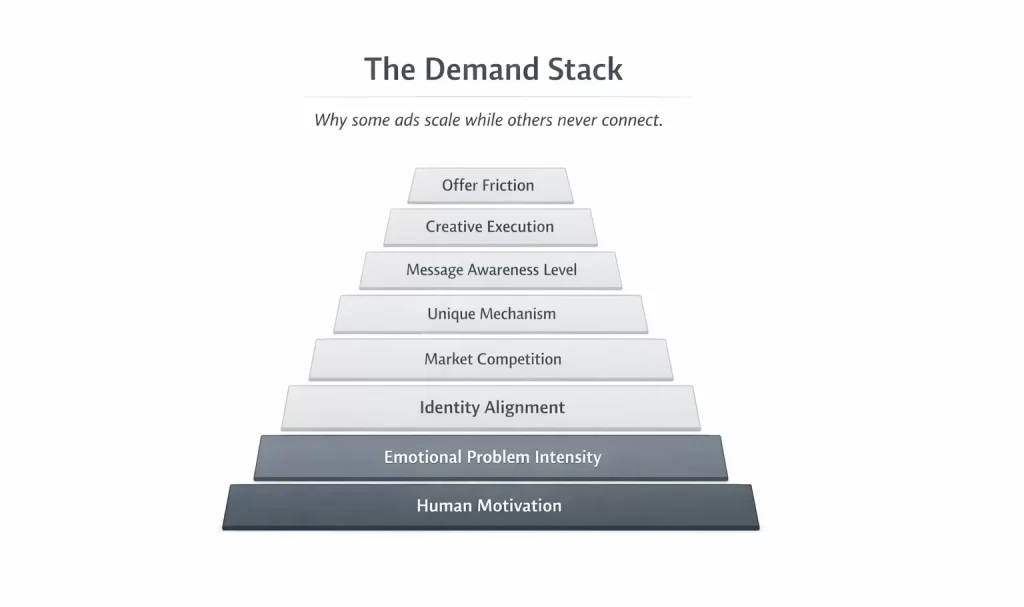
Each layer supports the one above it. If a lower layer is weak, the layers above it struggle to perform.
Layer 1: Human Motivation
At the deepest level, purchase decisions are linked to fundamental human motivations. These are influenced by years of evolution and survival.
Successful products connect to one of a few core forces:
- Safety and risk avoidance
- Belonging and community
- Status and recognition
- Self-improvement and mastery
- Financial gain or time savings
- Caring for family
- Health and longevity
These motivations span across industries and generations, making them powerful anchors. Products that align with them feel naturally compelling.
Those that don’t often fall flat, or must rely heavily on incentives and promotions to gain traction.
Layer 2: Emotional Problem Intensity
Products and services are created to provide a solution to a problem. This makes for particularly powerful marketing messaging.
Ads perform best when they address problems that are:
- Frequent
- Emotionally charged
- Identity threatening
- Physically uncomfortable
Minor inconveniences rarely interrupt the scroll. On the other hand, problems that are experienced daily (poor sleep, lack of confidence) create immediate attention.
They resonate deeply with us. That’s why some categories scale easily while others struggle.
The difference is problem intensity, not creative quality or execution.
Layer 3: Identity Alignment
Simply aligning with a solution doesn’t sell a product. People buy identity reinforcement.
Every purchase sends a small signal about who someone is or who they want to become.
For example: Lululemon doesn’t sell leggings. They sell the identity of someone who prioritizes health.
Likewise, Notion doesn’t sell productivity software. They sell the identity of an organized thinker.
When a product aligns with someone’s identity, the purchase feels more natural. When it conflicts, it becomes much harder to sell.
Layer 4: Market Competition
Some categories are intrinsically harder to scale. Think:
- Supplements
- Skincare
- Weight loss
This is because these verticals are extremely competitive. To succeed requries much stronger differentiation and messaging.
That’s why so many brands in these spaces lean into borderline predatory messaging. They’re doing what the can to stand out.
Without it, products become commodities competing only on price.
Layer 5: Unique Mechanism
Success products almost always have clear mechanisms explaining why they work.
This is more than simple benefits. It connects to the broader solution of the product.
A weak message for a sleep supplement would be: “Improves sleep quality”.
A stronger message might be: “A mineral blend that helps you fall asleep in 15 minutes”
The mechanism is the mineral blend. The time to fall asleep reduces skepticism, and gives the brain a reason to believe.
Layer 6: Awareness Level
Not every audience understands their problem the same way. A key part of messaging strategy is categorizing these awareness levels.
Eugene Schwartz describes five stages:
- Unaware
- Problem aware
- Solution aware
- Product aware
- Most aware
Different stages require different messages and problem appeal. If your message assumes a higher awareness level than your audience has, the ad won’t resonate.
Mismatch here is one of the most common causes of poor ad performance.
Layer 7: Creative Execution
Creative is what typically receives the most focus. Aligning visuals to the brand theme and image.
Contrary to popular belief, this makes it less important than most elements of the overarching messaging strategy.
Its role is to translate the deeper layers into:
- Visual communication
- Emotional storytelling
- Identity signaling
- Pattern interruption
- Social proof
Creative is a means for communicating the elements of a product while amplifying psychological relevance.
It can’t inherently change psychology.
For a deeper look at how to structure creative testing once these fundamentals are in place, see my article on creative testing in algorithmic systems.
Layer 8: Offer Friction
Up to this point, everything has been focused on capturing attention and building consideration. The final stage of a strong messaging strategy is converting that into action.
The wrong offer creates friction which can kill conversions.
Examples include:
- Slow shipping
- Complicated terms & conditions
- Slow website
- Complicated checkout funnels
Each point of friction reduces the likelihood of conversion. Minimizing these as much as possible is a step that’s often overlooked.
Offer testing is an entirely separate part of the strategy that should be optimized to find the smoothest path to converison.
Diagnosing Structural Weakness
When campaigns struggle, the instinct is to change the ad. But often the issue exists deeper in the stack.
Creative is the most visible layer of advertising, which makes it the easiest place to intervene. But when the underlying message is weak, new creative simply exposes the same problem in a different format.
More likely, the failure points are:
- Weak emotional resonance
- No clear differentiation
- Misaligned identity signals
- Messaging that assumes too much awareness
- Excessive purchase friction
These issues are frequently mistaken for creative fatigue. When performance drops, teams produce new ads, believing the message has worn out.
In reality, the message never worked structurally.
Launching more creative won’t solve the problem until the underlying positioning and messaging are fixed.
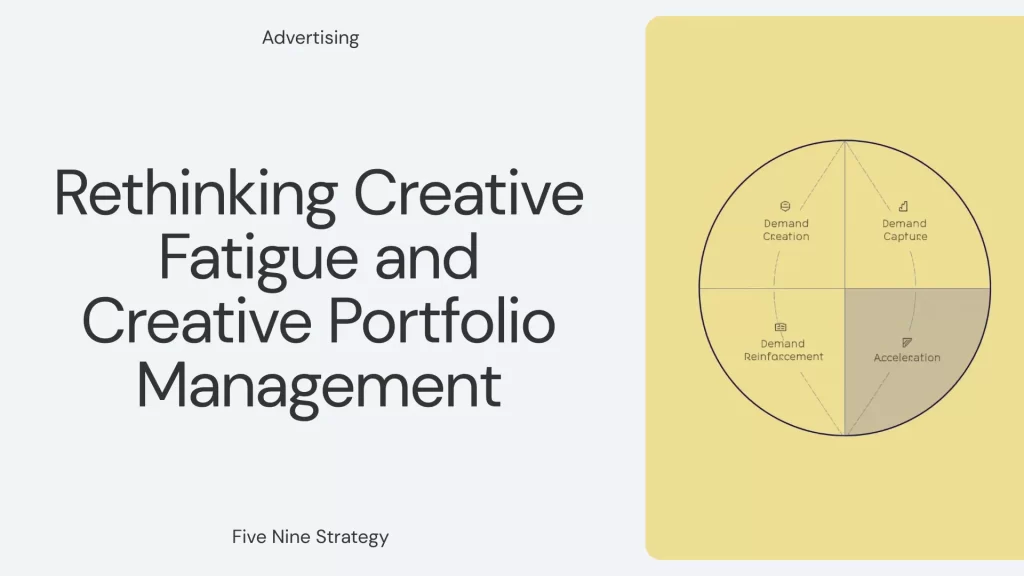
For a deeper explanation of how creative fatigue is often misdiagnosed in algorithmic systems, see my guide on structuring a creative portfolio.
Rethinking Creative Strategy
Advertising systems today are very efficient at amplifying signals. If demand exists, platforms will find it.
If it doesn’t no amount of creative testing or optimization will create it.
Successful campaigns align:
- Real human motivations
- Emotionally meaningful problems
- Identity reinforcement
- Differentiated mechanisms
- Clear messaging
- Strong creative
- Frictionless purchasing
When these layers work together, advertising feels predictable. Almost easy.
When they don’t however, campaigns are expensive and inconsistent. And it’s hard to pinpoint what’s not working.
Creative doesn’t create demand. It reveals whether demand was there all along.