Feeder Campaigns: The Simple Strategy That Fixes Algorithm Blind Spots
In today’s world of algorithmic ad optimization, reaching the right audience has never been easier, but harder at the same time. We’ve reviewed the tendency of campaigns like Google’s Performance Max to retarget existing customers.
Giving up control to the algorithm is an exercise in trust, but one that can pay off in performance and efficiency. However, there are still certain controls advertisers need to exercise.
One of the most important is choosing the right optimization event. Optimizing strictly for Purchases or Leads often drives up costs, shrinks your addressable audience, and limits your ability to acquire new customers.
In this article, we’ll break down a proven strategy that restores control, reduces acquisition costs, and scales conversions sustainably.
TL;DR
Purchase optimization is expensive because it targets the 1–3% of people ready to buy now.
Feeder campaigns use cheaper mid-funnel signals to warm up the 90% who aren’t ready yet — lowering CPCs and improving downstream CPAs.
The result: more scale, cheaper conversions, and a healthier audience pipeline for both Meta and Google.
The Problem With Purchase Events
Purchase and Lead events have historically been the default for driving results — and for good reason. They signal the exact outcome advertisers care about.
But they also ignore a fundamental truth about how people buy: only a small minority of your market is ready to convert right now.
Targeting that tiny segment comes with consequences:
- These audiences are small
- Competition is high
- CPMs are inflated
- Acquisition costs rise as you scale
In fact, campaigns optimized for Purchases or Leads often have 2× the CPM of campaigns optimized for Product Page Views or Add to Carts.
One proven tactic is the feeder campaign — a method for building reach efficiently while still driving meaningful action.
And with updates like Meta Andromeda reducing control over audience targeting, optimization events are now one of the last true levers advertisers can pull. Let’s look at how feeder campaigns fit into that shift.
Feeder Campaigns: Seeding the Upper Funnel
With the lengthening of buying journeys, campaign strategy must also better reflect how shoppers behave.
A feeder campaign optimizes for upper-funnel or mid-funnel actions — View Content, Add to Cart, or multiple page sessions — to drive low-cost, high-intent traffic. Your purchase campaign then works to convert those users.
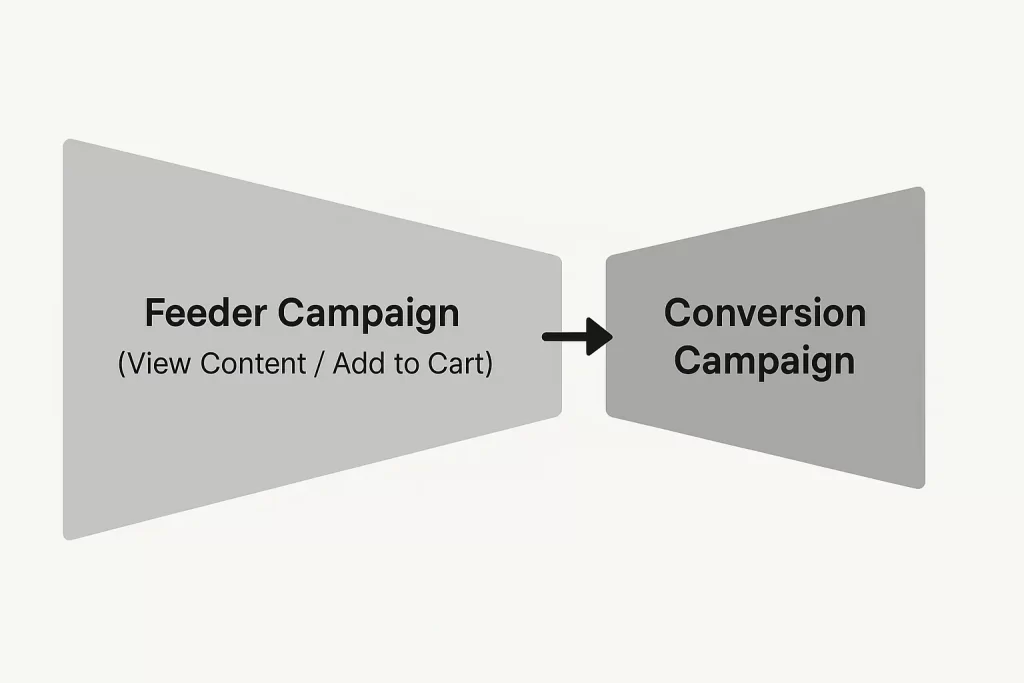
The key to success is budget balance between feeder and purchase campaigns.
A reliable guideline: Keep feeder spend to ~15% of your total budget.
This ensures CPCs stay low while still feeding enough qualified traffic into your lower-funnel campaigns.
Efficiency varies by platform, but in general:
- Google: Feeder CPCs are typically ~2× cheaper
- Meta: Feeder CPCs are often 2–4× cheaper
Let’s look at case studies from Google and Meta showing exactly how different optimization methods play out in practice.
Google Ads Feeder Case Study
Two campaigns were set up for a Home Improvement business driving search traffic with the goal of generating leads for their business.
A feeder campaign was set up using a Max Clicks bid model and $100/day budget, and a Max Conversions campaign optimizing for Leads was set up at $1,000/day.
Performance from each campaign showed the value in a feeder campaign
| Campaign | CPC | Conversions | Cost per Conversion |
|---|---|---|---|
| Feeder | $1.29 | 6 | $503 |
| Conversion | $3.06 | 64 | $341 (-19% M/M) |
While the feeder campaign appeared to drive less efficient conversions, this was only half the story.
During the month with the feeder campaign active, Cost per Conversion decreased 19% in the Conversion campaign.
When looking at performance across the account, we saw very positive month over month growth.
-31%
CPC
+40%
Conversions
+11%
Cost per Conversion
Even though cost per conversion increased slightly, we effectively scaled up leads through lower click costs.
Applying Feeder Outside of Search
This is where feeder strategy extends beyond Search.
On Google, Performance Max can act as a natural feeder layer to drive low-cost engagement and retargeting signals that ultimately improve downstream conversion campaigns, much like the Search-based feeder above.
👉 See a real example of how I implemented Performance Max as a feeder campaign
I touch on why it works best as a controlled retargeting layer, not a full-funnel solution and what you can do now to drive better results.
The same feeder principles apply outside of Google as well. Let’s look at how this concept translates to Meta Ads.
Meta Ads Feeder Case Study
Two campaigns were set up in Meta Ads following a similar structure, except instead of optimizing for clicks, we used a multiple page sessions custom conversion as the feeder objective.
Note: View Content, Add to Cart, or any custom conversion that drives quality traffic can be used as the feeder objective.
Similar to Google, we set up the feeder campaign with a fraction of the daily budget – Multiple Page View campaign was set to $500/day while the Purchase campaign had a $6,000/daily budget.
Unlike Google performance of the feeder campaign looked much worse at the outset.
| Campaign | CPC | Conversions | Cost per Conversion |
|---|---|---|---|
| Feeder | $0.65 | 6 | $2,269 |
| Conversion | $2.56 | 163 | $455 |
However, the CPC told most of the story. Four times more efficient clicks help grow our audience of considering customers.
Looking at year over year performance across the account, the trends supported the shift in strategy.
-2%
CPC
+24%
Conversions
-26%
Cost per Conversion
Interestingly, click efficiency didn’t show significant gains because we had traffic campaigns in market during the prior year.
Where we did see gains however was in traffic quality. Optimizing for mid-funnel conversions was driving intent even though users weren’t converting right away.
Why Feeder Campaigns Fix Algorithmic Blind Spots
While feeder campaigns may seem like a waste of ad spend, “that CPA is much higher than my purchase campaign, let’s kill it”, they act as a valuable piece of the overall user journey.
This is because modern campaign optimization has three inherent flaws.
Algorithms over-index toward Bottom of Funnel
Purchase or Lead optimization focuses on the ~3–5% of users who are ready to buy now – the classic B2B 95/5 rule.
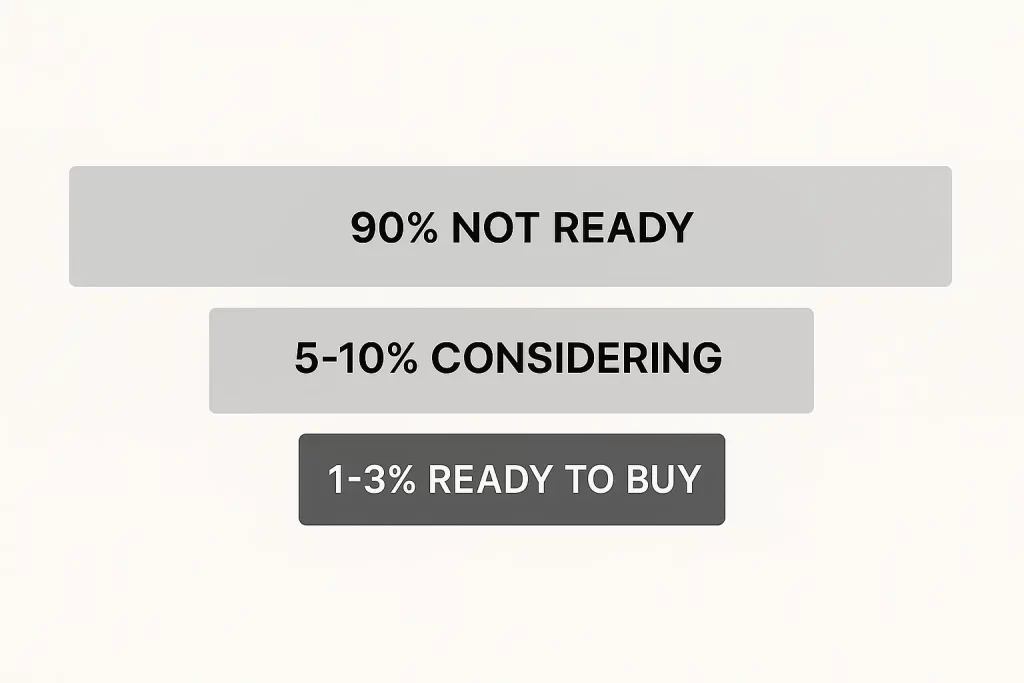
That leaves 95%+ of your true market untouched. Not because they’re unqualified, but because they’re not ready yet.
The result:
- Higher CPMs (you’re paying to join a bidding war for the same small audience)
- Rising CPAs as frequency increases
- Stalled scale, because bottom-funnel audience pools can’t grow on their own
Feeder campaigns re-seed the upper and mid-funnel so your lowest-funnel campaigns have fresh demand to convert.
Poor New Customer Identification
Platforms aren’t biased — they’re opportunistic. Given a purchase event, Meta Andromeda and Google PMax will:
- Target people most likely to convert
- Prioritize returning customers
- Lean into users with existing brand familiarity, high recency, or deep browsing history
Why? Because existing customers are the easiest for the algorithm to hit your goal with.
Without a first-click or new-customer optimization approach, nothing in the system tells the algorithm to prefer new customers, even if they are harder to convert.
Feeder campaigns shift the signal set toward upper/mid-funnel intent, giving the algorithm a healthier pool of new potential buyers to learn from.
Attribution Is Flawed
Attribution models reward bottom-funnel campaigns with too much credit.
When decisions rely solely on purchase attributions, the platform naturally funnels budget toward “finishers,” not “finders.”
It’s why:
- Performance Max steals conversions it didn’t generate
- Meta’s 7-day click window overvalues retargeting
- Long attribution lag hides early-stage influence
Feeder campaigns counter this by:
- Forcing impression share into new audiences
- Generating incremental reach that attribution models normally miss
- Creating a pipeline of future converters that appear downstream in purchase campaigns
This ensures you’re not fully dependent on a single event to guide the algorithm.
Feeder Strategy Playbook
So where do you go from here?
If you’re running purchase or lead campaigns, feeder campaigns aren’t optional. They’re one of the last remaining levers you can still control. Here’s how to implement them effectively:
1. Allocate ~5% of Your Total Budget to a Feeder Campaign
Start small. This keeps CPCs low while still giving the algorithm enough volume to learn.
2. Run the Feeder Campaign for at Least 4 Weeks
Feeder campaigns don’t show value immediately. You need 2–4 weeks of consistent delivery to build meaningful mid-funnel traffic.
3. Measure Success Through Downstream CPA, Not Feeder CPA
The feeder campaign will always look worse in-platform. The real KPI: your blended Purchase or Lead CPA across all campaigns.
4. Watch Your Mid-Funnel Metrics
Early signs the feeder is working:
- Lower Cost per Add to Cart
- Lower Cost per Form Start
- Higher Session depth / multiple page visits
- Rising qualified traffic even if conversions lag
These signals mean you’re reaching the right audience – they just aren’t ready to convert yet.
Finding Success in 2026
Feeder campaigns aren’t a hack or a loophole – they’re a structural fix to how modern algorithms work. Purchase and Lead campaigns will always over-index toward the small slice of users ready to convert now.
For advertisers that are not looking for complex technical integrations, feeder campaigns are a great way to create a system that:
- Lowers mid-funnel costs
- Improves downstream CPA
- Expands your total addressable audience
- Reduces reliance on flawed attribution
- Generates more new customers over time
The key to feeder campaigns is scalability. Building an audience of prospects that are in-market but not ready to convert is the only way to do this.
If you want scalable, sustainable performance, not just attributed conversion, this is the strategy to test next.