How First-Click Attribution Superpowers Meta Andromeda
The difference between good Facebook advertising and great Facebook advertising is smaller than ever before. Yet, some advertisers are able to scale profitably while others are left with shrinking profit margins.
Updates like Meta Andromeda are signaling a massive shift in how advertising platforms will work in the future. Less and less will we have control over levers to optimize ad performance. In Meta’s perfect world, you give them a landing page and credit card, and they do the rest.
Savvy advertisers know that this is still far from reality, but still need to shift in the short term.
One of the remaining areas of control is goals and optimization methods. We’ve reviewed Meta’s optimization goals in the past, and even looked at custom conversions to improve traffic quality.
But how can you ensure that the audience your reaching is incremental – contributing new customers and revenue you wouldn’t have captured otherwise?
TL;DR
Updates like Meta’s Andromeda are giving ad platforms more control over optimization, making attribution the last true lever advertisers own.
First-click attribution restores visibility into the ads that create demand — not just close it.
This guide explains the importance of a robust tracking methodology and shows how to implement first-click tracking using click IDs, localStorage, and advanced server-side setups.
Understanding the Attribution Problem
Ad platforms like Meta or Google use sophisticated algorithms to track users across the journey and divvy up credit to campaigns. More commonly referred to as attribution, this process involves the use of identifiers like browser cookies to determine what ads were seen by a user prior to converting.
Attribution’s Role In The Journey
With complex browsing habits, attribution has become more and more fragmented. Imagine a journey where you are running Facebook Ads.
Someone sees your Facebook ad and clicks on it. They read through your landing page, but decide they need to consider the purchase before buying.
They leave your site – the next day, they get a retargeting ad on their iPhone, and click through and make the purchase. Your retargeting ad receives credit for the conversion.
Obviously, the first ad deserves most of the credit – it introduced the product and brand after all. But attribution can’t put those pieces together reliably.
From Attribution to Contribution
Rather than simply assigning credit, contribution-based measurement reframes the question from who got credit to who truly made an impact.
Ask yourself this: if the user didn’t see this ad, would they still have purchased?
We explored this concept in relation to incrementally testing, but here we’ll address how this plays into ad account optimization.
How Contribution Affects Optimization
Facebook’s standard attribution window is 7-days for a click and 1-day for a view, meaning if the user doesn’t convert within that window, the ad won’t receive credit.
This dynamic explains why ad platforms often overvalue retargeting. It feels efficient, but it’s mostly cannibalizing conversions that were already on their way.
Optimizing for contribution looks to give conversion credit to the ad that did the heavy lifting – the one that introduced the brand.
To understand how to evaluate which creatives actually create demand versus just closing it, see my Creative Analysis in the Meta Andromeda Era guide.
Implementing First-Click Attribution
Unlike standard attribution models (last click or data attribution) which all heavily favor the bottom of funnel, first click attribution aims to find the source of demand generation and credit it.
In a post-Andromeda world where Meta decides who sees what, controlling how conversions are credited may be your last remaining optimization lever.
But how do you implement first-click attribution when platforms like Google Ads removed it in 2023. The key is in how your tags are firing and what data is being passed through.
Let’s take a look at a couple ways you can start to better first-click attribute using simple Javascript as well as more advanced tools.
Method 1: Browser-Based (JavaScript)
Platforms like Google and Meta use click IDs (GCLID, FBCLID) to track click conversions. Read about how GCLID can be used to import offline conversions.
To better attribute to the first click, this click ID needs to be stored and submitted when the user converts. If you’ve already implemented persistent UTM tracking, this setup will feel familiar. It’s nearly identical in principle, but instead of UTMs, we’re storing click IDs.
We’ve also touched on how to store FBCLID (and FBC) in localStorage for better Meta attribution.
For the purpose of Google, GCLID is stored by default in localStorage, but we want the first click GCLID to persist. To do this, we’ll build a small custom Javascript to capture it and store it permanently.
Variable Type: Custom Javascript
Detailed Script
function() {
  // Get current URL parameters
  var urlParams = new URLSearchParams(window.location.search);

  // Check for GCLID in current URL
  if (urlParams.has('gclid')) {
    var gclid = urlParams.get('gclid');

    // Store GCLID (first-click attribution - don't overwrite existing)
    var existingGCLID = localStorage.getItem('first_click_gclid');
    if (!existingGCLID) {
      localStorage.setItem('first_click_gclid', gclid);
      localStorage.setItem('first_click_gclid_timestamp', Date.now().toString());

      // Also store in sessionStorage as backup
      sessionStorage.setItem('first_click_gclid', gclid);
    }

    return gclid;
  }

  // If no GCLID in URL, return stored GCLID
  var storedGCLID = localStorage.getItem('first_click_gclid');
  return storedGCLID || '';
}
With this in place, we can add it to the conversion tag to pass through for attribution when a purchase or lead happen. To do this, adjust your Google Ads Conversion tag settings:
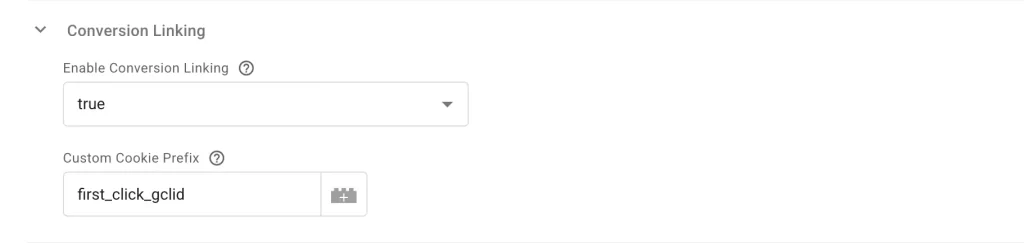
Use the exact name of the cookie storing the click ID in localStorage, and it will pass through in place of the default gcl cookie.
This solution isn’t foolproof though. The cookie won’t persist across devices and is susceptible to ad blockers/cookieless browsers blocking the javascript from firing. But, this is a marked improvement over nothing.
Adding Conversions API for Data Enrichment
With the FBC or GCLID stored in a first-party cookie, it’s also possible to pass the value through your purchase or lead form to store in your CRM. We’ve explained how to do this in our GCLID tracking setup guide.
Once in your CRM, setting up offline conversion imports through Google or Meta to pass the first-click ID helps attribute to the first traffic source.
Couple this with information like new vs returning customers (another field within your CRM) to hone in on either customer acquisition or retention.
Set up Google Ads API to track offline events through CRM or CDPs that don’t directly integrate with Google Ads.
This bridges browser and server tracking by combining the immediacy of client-side events with the persistence and reliability of server-side attribution.
Case Study: Testing First-Click Attribution
We implemented this solution across several Google Ads accounts in different industries with the focus on driving leads or purchases.
Campaigns were split into two groups: engagement or conversion optimized.
Conversion optimized campaigns had goals including leads and purchases. Engagement campaigns had goals including product page views or clicks.
We measured a 2 month pre and post period to assess the difference in conversion performance following the first click attribution implementation.
Results
Conversion campaign CPAs remained largely unchanged, but Engagement campaign CPAs saw significant improvement. CPA declined by an average of 20% across engagement campaigns from all Google Ads accounts.
This helped drive a 10% cost savings for conversions across the account. This method can be taken even further with data enrichment techniques and 3rd party data sources.
Enhanced First-Click Attribution (CDP + Warehouse)
While browser-based tracking can recover a lot of lost attribution, it still has limits – cookies expire, ad blockers interfere, and cross-device journeys often get lost. To truly understand where a conversion starts, advertisers are turning to first-party data infrastructure.
Customer Data Platforms (CDPs) and Data Warehouses take attribution a step further towards real contribution.
Instead of relying on browser storage, these systems capture click identifiers (like FBCLID or GCLID) server-side and store them against a unified customer profile that persists across sessions, devices, and even channels.
This setup doesn’t just restore first-click visibility, it also extends attribution windows beyond the standard 7-day Meta limit by maintaining a first-party record of every ad interaction. When conversions are uploaded server-to-server, those IDs can be matched accurately back to the ad that first drove intent.
Advanced Options for Persistent First-Click Tracking
For advertisers ready to go beyond browser tracking, tools like AudienceX and Blotout combine CDP and data warehouse capabilities to build this persistent ID layer.
They connect directly to Meta and Google’s APIs, automatically passing enriched click data and customer identifiers for improved new vs. returning user tracking.
These solutions require more technical setup, but they’re becoming essential in giving marketers control over what ad platforms can no longer see.
The Future of Attribution Control
Meta’s Andromeda update represents the direction the entire industry is heading in. Platforms are making optimization decisions for you, fueled by data you can’t always see.
That shift makes one thing clear: the last lever advertisers truly control is measurement.
Owning your attribution layer, even something as simple as a first-click ID stored in localStorage, puts you back in the driver’s seat. It lets you decide which campaigns are generating real demand and which are just harvesting conversions that would have happened anyway.
The Takeaway:
In the post-Andromeda era, attribution is optimization.
Automation has made media buying easier, but smarter attribution is what separates great advertisers from everyone else.
Not only does first-click data show where a customer came from, it pinpoints where your growth actually starts and actively optimizes to find more of it.