Meta Andromeda Update: Consolidate Your Ad Sets
Meta announced an algorithm update earlier this year that fundamentally changed how ad optimization works on the platform. The Andromeda update is a machine learning algorithm that significantly improves ad retrieval and delivery capability.
Meta’s Andromeda update is forcing a choice: consolidate your ad sets or watch competitors gain a competitive advantage. The era of hyper-segmented targeting is over and the winners are those embracing algorithmic creative matching.
We tested this new approach against traditional campaign structures and found something remarkable: the same ads, same landing pages, just organized differently, delivered 17% more conversions at 16% lower cost. No new creative development required.
This platform update is a fundamental shift in how successful advertisers will operate in 2025 and beyond.
TL;DR
Meta’s Andromeda update rewards consolidated campaign structures over traditional audience segmentation.
Our testing showed 17% more conversions at 16% lower cost using one ad set with 25 creatives versus five ad sets with five creatives each.
Key changes needed: implement enhanced data capture, diversify creative content (see Meta’s top 10 topics), and restructure campaigns to leverage AI matching.
This is a shift in platform mechanics and delivery logic, not a creative fad. The broader playbook lives in the Advertising hub.
Why Traditional Campaign Structures Are Failing
For the last decade, Meta Ads success meant creating hyper-specific audiences: ad engagers, site visitors, detailed interest targeting, demographic segments. Media buyers spent their time building elaborate campaign trees with dozens of ad sets, each targeting micro-audiences.
That precision used to be a competitive advantage. Now it’s a limitation.
Meta’s algorithm has evolved beyond our ability to manually segment audiences. While we’ve been creating 10-15 ad sets per campaign, Meta’s AI has been processing trillions of data points to understand user intent in real-time. It’s a real chess vs checkers moment.
What this means: campaigns that used to work well are now fighting against the system used to optimize them.
Meta’s Interconnected AI Stack
Meta’s quest to continually improve the experience for advertisers has taken a huge leap in the last two years with the advent of more powerful microprocessors.
Their new AI infrastructure consists of four interconnected systems working together to deliver the right creative to the right person at the right moment:
Meta’s Generative Ads Model (GEM)
The Generative Ads Model is the super brain behind Meta’s improvements in ad optimization. It’s able to process trillions of individual pieces of content for a broad understanding of relevance to each user.
This is then used to create a sophisticated model of what each user is most likely to engage with in real time. In effect, it acts as the foundation for delivering the right ad to the user at the right time.
Meta Lattice
If GEM is the brain, Meta Lattice acts as the framework, organizing Meta’s vast content catalog into a single, efficient matching system instead of thousands of isolated catalogs.
This is effective not only at delivering more relevant ads, but also connecting different topics efficiently. In effect, it removes the category-focused targeting of the past, opting for a single, unified identity graph.
Meta Andromeda
Andromeda is the the delivery engine that ties GEM and Lattice together, filtering through millions of ads to serve the message most likely to resonate with each user’s current position in their decision-making process.
In effect, this means that the ad delivered to the user is best suited to their current position in the decision making process, improving effectiveness.
Sequence Learning
Sequence learning tracks user behavior patterns before and after engagement, identifying journey stages to deliver increasingly timely messaging. This helps identify what stage of the journey a user is in so that more timely messaging can be delivered.
It’s another way Meta uses signals (browsing behavior, dwell time, etc.) to identify what stage of the journey a user is in, and deliver timely, relevant ads.
These four advancements make up a serious improvement. Here’s what this means for your ad campaigns.
To see how Andromeda changes the way you measure creative performance, read my guide on Creative Analysis in the Meta Andromeda Era.
Consolidated Ad Set Case Study
To validate this new approach, we ran a 45-day A/B test comparing traditional segmentation against Meta’s recommended consolidated structure.
Test Setup
- Campaign 1 (Traditional): 1 Campaign + 5 Ad Sets + 5 Creative in Each
- Campaign 2 (Consolidated): 1 Campaign + 1 Ad Set + 25 Creatives
- Control Variables: Same creatives, same landing pages, same optimization goal
- Duration: 45 days
- Budget: Equal daily spend allocation
The Results
+17%
Conversions
-16%
Cost per conversion
The real insight came from how budget was distributed between ads:
- Traditional Structure: 65% of budget spent on top 3 ads
- Consolidated Structure: 50% of budget spent on top 3 ads
The consolidated approach allowed more creatives to receive meaningful spend, giving the algorithm more signals to optimize from. Instead of forcing budget into predetermined audience buckets, we let Meta’s AI determine the optimal creative-to-user matching.
Key Takeaway: By working with the algorithm instead of against it, we were able to drive performance improvements without changing any ads or pages.
Implementation: Four Critical Areas for 2026
The impact of this update will continue to develop over the coming years, but advertisers can take advantage of these improvements now.
This paradigm shift in how to think about Meta advertising introduces four critical areas that determine whether campaigns thrive or fall behind:
Changing how to think about these three areas will carry a competitive advantage as others play catch-up.
Data quality & capture
We’ve covered the importance of data quality before, but Andromeda pushes it further. Sending strong signals back to Meta is no longer “nice to have” — it’s required.
Meta’s GEM learns through billions of data points. Your job is to ensure:
- First-party identifiers are passed back consistently
- Server-side tracking is implemented
- Key events include high-value parameters
- Data is clean, complete, and deduplicated
Pixels alone are no longer enough. Algorithms need richer signal density to perform.
Content Diversification
Meta has long praised the effectiveness of user generated content (UGC) on their platform, and that still stands today. However, Andromeda rewards creative depth, not just quantity
Content diversification means producing multiple angles and narratives, not repeating the same message 10 different ways. Users are at different stages, with different motivations, and Meta’s Lattice organizes your creative into a richer, more matchable catalog.
The thinking: Not every user needs to see the same message.
Some want the origin story. Some want a comparison. Some just want a deal.
Meta’s Top 10 Content Types
Meta has identified the top 10 content topics that advertisers can use to diversify their messaging strategy.
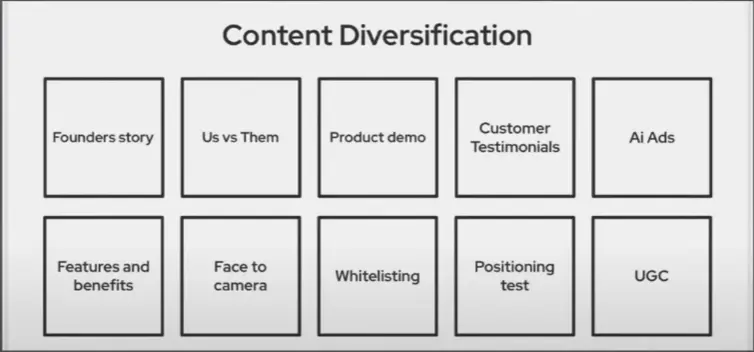
Some of the tried and true favorites like product demos, testimonials, UGC and features/benefits are included in the list. For more examples on what these ads look like, see 6 High-Converting Ad Creative Examples for 2025.
Newcomers to the list include topics like:
- Founder’s Story
- Purpose: Builds an emotional connection and authenticity
- Best for: Awareness and building trust with new audiences
- Us vs. Them
- Purpose: Direct competitive positioning without naming competitors
- Best for: Consideration stage and product education
- AI Ads
- Purpose: Save on creative production costs, appeal to tech-forward audiences
- Best for: Small advertisers with limited budgets
- Positioning Test
- Purpose: Challenge assumptions, reframe the conversation
- Best for: Premium positioning and changing how people think about your brand
These are ad types that cater to more than just in-market shoppers. They offer comparison, emotion, education – all aspects of a story-driven narrative that people are looking for in 2025.
If you want to evaluate which creative themes drive awareness, which build intent, and which close conversions under Andromeda, see my creative performance framework for better analysis in Meta’s Andromeda Era.
Best Campaign Structure for Meta Ads in 2026
For the last decade, Meta Ads media buyers have dedicated most of their time to creating hyper-specific audiences for ad engagers, site visitors, interests, demographics, etc…
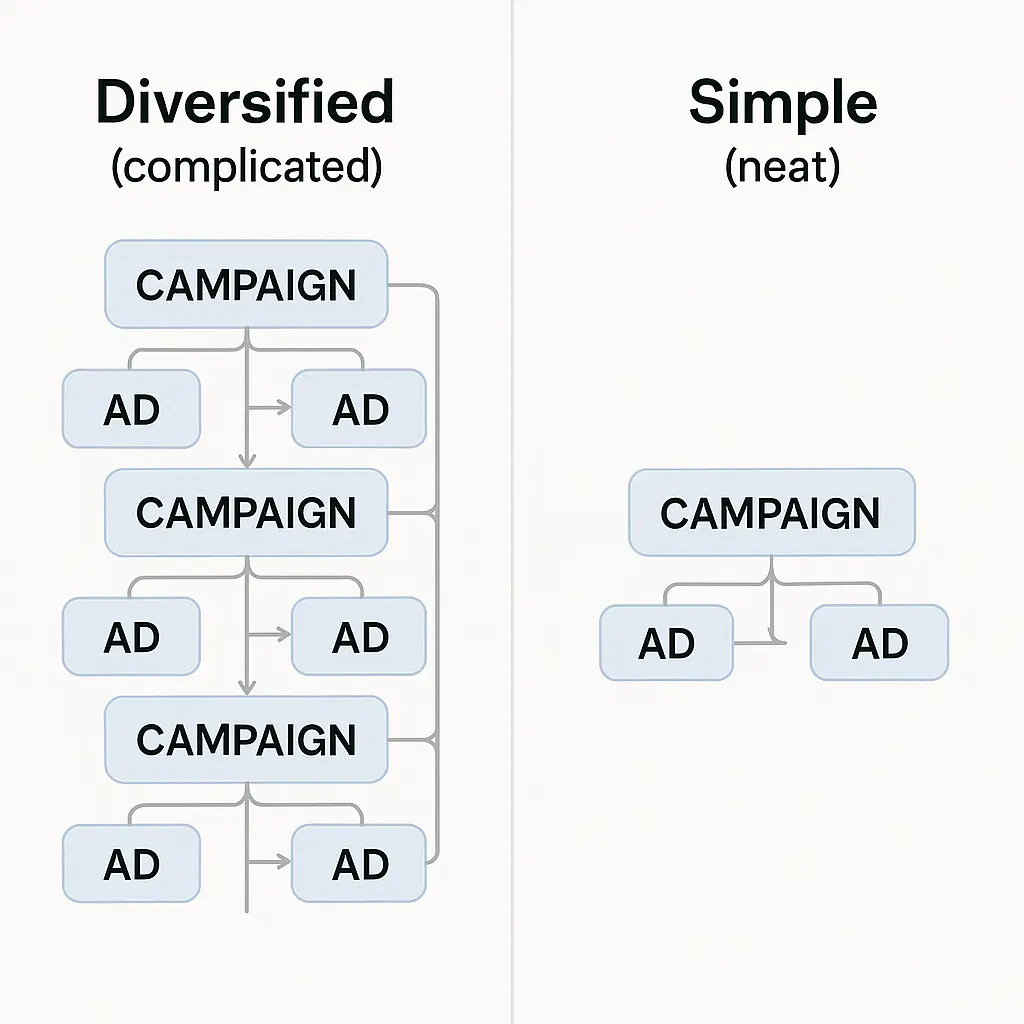
These campaigns have historically looked like:
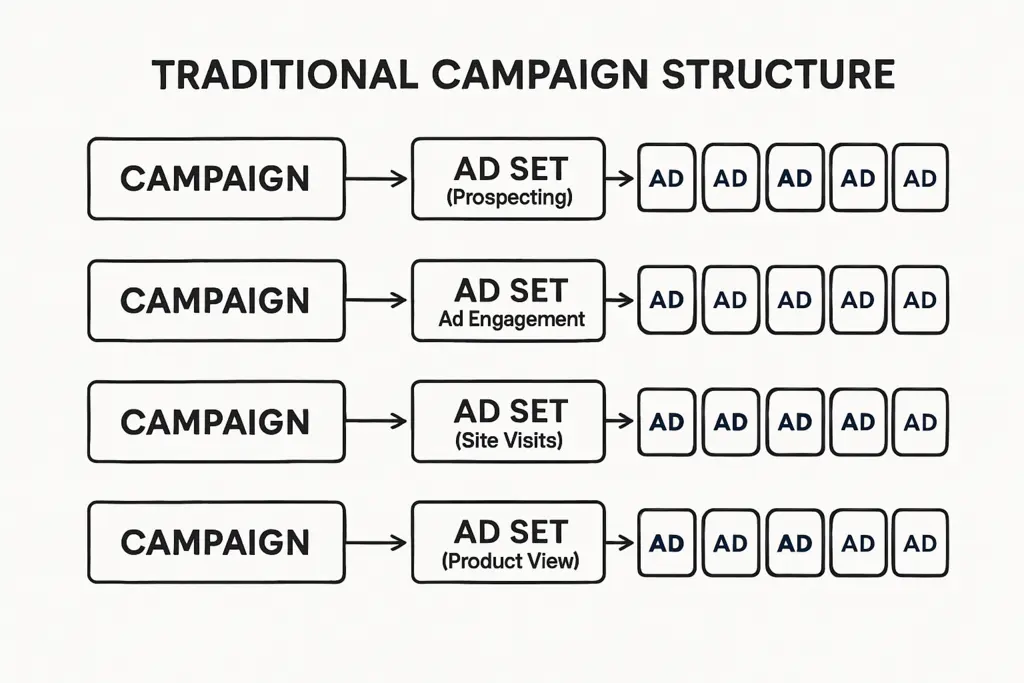
Following Meta’s best practice, consolidated successful campaigns will look like:

This structure leverages Meta’s algorithm to its fullest ability – user targeting, creative selection, and optimization method.
Why Consolidation Still Needs the Right Optimization Event
Consolidating campaigns unlocks major benefits under Andromeda, but it doesn’t solve every problem. In fact, consolidation can accidentally hide weaknesses in your buying journey if you aren’t sending the algorithm the right optimization signals.
Because Andromeda now controls more of where and when ads are shown, the advertiser’s job shifts. You’re no longer deciding placements or micro-audiences — you’re responsible for feeding Meta the right data so it can make smarter decisions.
Bottom-funnel optimization creates two problems:
1. It targets only 1–3% of the market
Purchase campaigns only reach the users already ready to buy. That shrinks scale and inflates CPMs.
2. It over-targets returning customers
Andromeda prioritizes “likely converters,” and existing customers naturally fall into that category. Without first-click optimization, Meta keeps cycling spend into the same people.
The Solution: Multi-Stage Optimization (Feeder Campaigns)
Pairing a consolidated structure with mid-funnel optimization provides Meta with a healthier set of signals.
Feeder campaigns work by optimizing for View Content, Add to Cart, or multiple-page sessions — reaching in-market shoppers before they’re ready to buy. This warms users efficiently, expands your reachable audience, and reduces the burden on the purchase campaign to do all the heavy lifting.
If you want practical recommendations, read my full Feeder Campaign guide
Implications for The Future
While these changes are not necessarily new news – Google’s Performance Max has been a fully automated campaign type for 5 years now – call back to attention the role of the media buyer in managing digital advertising campaigns.
In Google and now Meta for some time, control has been diminished to allow the media buyer fewer ways to manipulate the delivery of ads to their audience.
More than ever, it has become crucial to understand the fundamentals of marketing – offers, value propositions, messaging.
The Future of Media Buying
In the not too distant future, control over campaign settings will be limited to simply uploading a credit card, ad creative, and a landing page. Well, probably not. But if Google and Meta have their way it will be.
To maintain some level of control over the ad buying process, it will fall more to understanding how best to optimize ads, landing pages, and website environments than campaign settings like ad schedules, placement targets, or demographics.
This wouldn’t be the first time digital marketing experiences a paradigm shift. From the days of granular targeting and keyword stuffing, shifting away from precise control over ad delivery is just more step forward.
Skills Evolution for Media Buyers
Yesterday’s Focus: Audience segmentation, bid management, placement targeting
Today’s Focus:
- Creative and Messaging Strategy: Understanding psychological triggers, testing frameworks, content diversification
- Landing Page Optimization: Post-click experience, conversion rate optimization, user journey mapping
- Tracking & Measurement: Multi-touch attribution, incrementality testing, business impact analysis
For comprehensive measurement strategies, see our case study on Multi-Touch Attribution Tracking.
Action Plan for 2025
Rather than lose control altogether, smart advertisers are gaining leverage by leaning and adapting to changes.
Over the next 4 months, make it a priority to:
- Test a consolidated ad set structure in an A/B test against your existing campaigns and consider upgrading your conversion events to track high-quality sessions instead of basic page views for better optimization signals
- Diversity your creative portfolio – aim for at least 4 of the topics above
- Implement enhanced data capture with customer data passback and server-side tracking
Resisting automation will ultimately prove to be futile. The machines are here and they are taking over. The marketers who thrive in 2025 won’t be those who resist automation, but those who master the art of creative strategy within algorithmic frameworks.
It’s not adapt or die. It’s adapt and improve.