How to Make Google Demand Gen Campaigns Work: Lessons from Google Discover
Google’s Demand Gen campaigns promise to rival Meta and TikTok, but for many advertisers, they’ve been more hype than results.
Sure, they drive clicks. Lots of them. But the conversion quality? Often underwhelming.
Even after the mid-2025 update that added YouTube inventory, many advertisers (myself included) are still asking: how do we actually make these work?
The answer: stop treating Demand Gen like a conversion channel—and start using it like a discovery platform.
Here’s how, using lessons from its organic cousin, Google Discover.
(If you’re new to Demand Gen, you can start with my earlier overview for context.)
TL;DR
To apply Discover insights to Demand Gen:
- Lead with curiosity, not hard sells (interest-driven, visual creatives).
- Test multiple angles per audience persona.
- Optimize for CTR, dwell, and engagement, not just conversions.
- Drive to valuable, educational destinations (guides, insights).
- Refresh creatives often to stay in Google’s learning cycle.
Discover: The Blueprint for Demand Gen Success
I recently read an interesting article from Search Engine Journal on how Google Discovery really works. Go read it – it has some really interesting findings.
I’ll summarize some key takeaways, but understand that these are the foundation for Demand Gen campaigns.
Discover Behaves Like a Personalized Social Feed
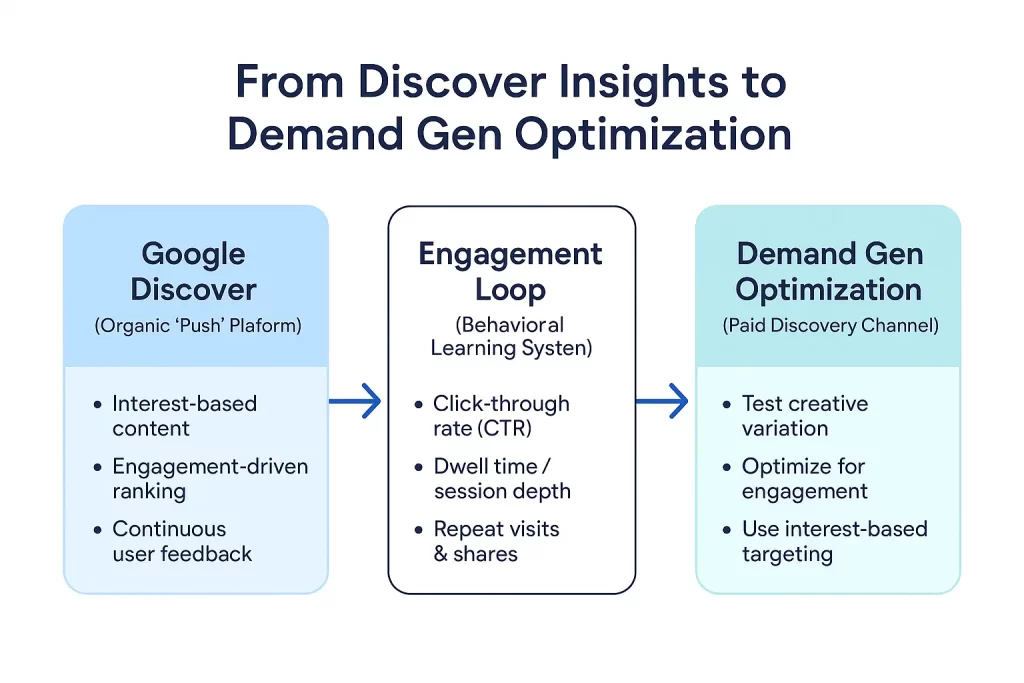
If traditional search is a “pull” experience – a user asks for information – then Discover is a textbook ‘push’ experience – it delivers information before a user searches.
Think of Discover like a curated social feed akin to Meta or X:
- It tracks what you read, click, dwell on
- It uses behavioral data to build a content interest profile
- It uses these content interests to predict what you want to read next
This reward system – content engages reader → reader clicks, dwells, reads → Discover prioritizes content – applies not only to organic content, but to ads.
User Engagement Loops Decide Reach
Rather than a static authority – crawl/index content and rank once – Discover uses a continuous engagement feedback loop.
Metrics used to measure engagement:
- Dwell time (time spent on the content)
- On-page engagement (scroll depth, repeat visits)
- Click-through rate (impressions vs. clicks)
This engagement loop is similar to other social media platforms in that it prioritizes content that is actively engaging.
Google’s Goal: Turning Search Into a Destination
Discover is part of Google’s broader strategy to keep users inside Google’s ecosystem (more ad impressions, more data).
The shift is already visible in:
- AI Overviews which are starting to feature some Discover results
- Social metrics like following topics, publishers and creators
- Reworked Google My Business with more featured images
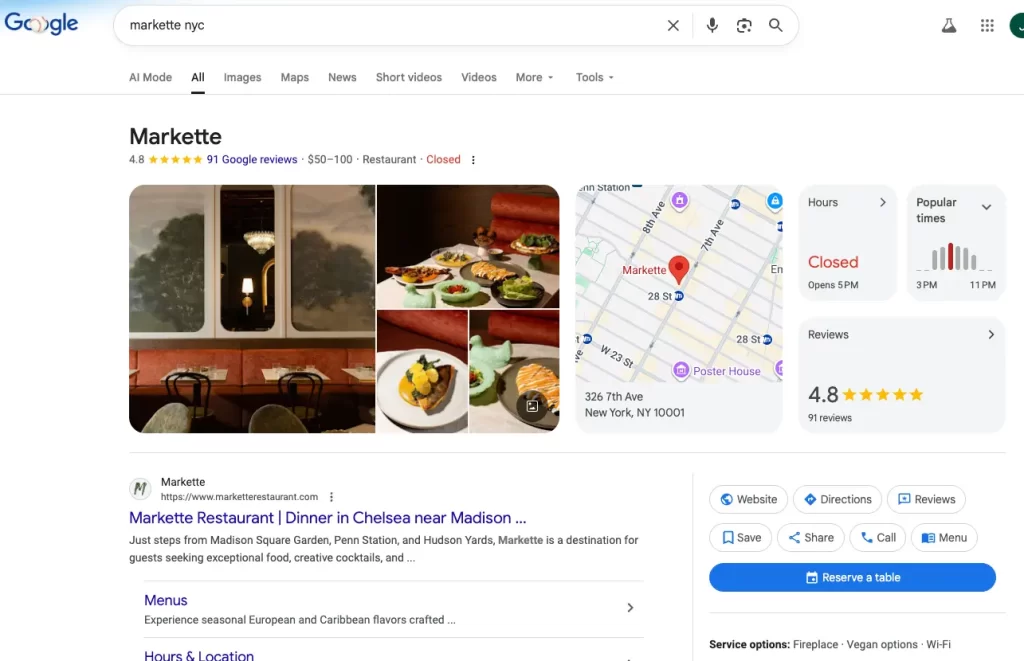
Google’s shift to a content-powered feed is part of its goal to bring a revamped search experience, especially as AI threatens it’s historical business model.
Applying Discover Principles to Demand Gen Campaigns
Because Demand Gen runs on the same algorithmic DNA as Discover, engagement, creative quality, and relevance matter just as much as in organic content.
Let’s take a look at how you can apply this to your ad campaigns.
Lean Into Interest-Based Storytelling
Rather than simply talking about your product features or offer, create ads that speak to the reasons to buy.
- Wants, Desires
- Problems
- Interests
In Discover (and broadly across social media), people don’t want hard CTAs. They want helpful, interesting, or curiosity-led content.
Use case study findings, how-to’s, blogs or guides to develop creative that sparks interest. Then, drive to a page with more content (case study, guide, blog), not straight to a sales page.
Real World Example
I ran two Demand Gen campaigns for a client in the Flooring industry with different content topic approaches:
| Campaign | Creative Topic |
|---|---|
| Blog Focus | 5 signs it’s time to replace your floors Why waterproof floors are important How to install LVP without an expensive contractor |
| Product Focus | Waterproof Durable Easy to Install |
While both campaigns communicated the same topics, the blog-focused campaign ultimately drove much stronger performance.
Results
One campaign, two ad groups optimizings for conversions.
| Campaign Type | CPC | Cost per Conversion | Avg. Time Lag |
|---|---|---|---|
| Blog-focused | $0.86 | $700 | 60 days |
| Product-focused | $1.12 | $2,000 | 14 days |
The blog-focused creative ultimately outperformed product-focused creative. However, it wasn’t Google that told us.
The key: we measured a long sales cycle through a multi-touch attribution tool.
Time lag to conversion is much longer with Demand Gen simply because it reaches users earlier in their journey. Tracking all touchpoints in the path to conversion helped us better compare performance between the two creative approaches.
This further substantiated our findings that the flooring customer journey spans months.
Optimize Like Discover: Engagement Is the New Conversion
Just like Discover, Demand Gen rewards high CTR, long dwell time, and repeat visits. Using an optimization model that prioritizes these is key.
We’ve reviewed the two standard optimization models in Demand Gen campaigns – max clicks and max conversions – but how should you use them in this context.
I have two rules of thumb:
- High Audience Quality → Use Max Clicks
- Low Audience Quality → Use Max Conversions
Real World Example – When To Use Max Clicks
I ran two Demand Gen campaigns for a MarTech SaaS client targeting enterprise decision-makers.
We used 6Sense for account-based tracking and built a Lookalike audience in Google Ads based on site visitors from that ICP.
We tested Max Clicks vs. Max Conversions bid strategies.
Result:
- Max Clicks delivered a 45% lower cost per conversion,
- with conversions defined as sessions over 5 minutes.
Why it worked: When your audience quality is already high (well-defined ICPs), Max Clicks drives more top-of-funnel engagement efficiently.
Real World Example – When To Use Max Conversions
For a retail client targeting sales associates across U.S. stores (a niche audience), I didn’t have an ABM tool.
Instead, I used optimized targeting with a custom conversion event (70% scroll depth + 60s session duration) to measure meaningful engagement.
Result:
- +311% increase in average time on page
- No change in CPC
Why it worked: When your audience quality is uncertain, optimizing for in-session engagement gives Google’s algorithm better data to learn from.
Note: Aim for 50+ conversions per week for best results.
For better conversion signals like click-based events and new customers, pass offline events through Google Ads API.
Feed the Machine: Creative Variation Wins
In Discover, just like with the new Meta Andromeda update, creative diversity is key to finding topics that work across your audience.
Not only will your audience have a wide variety of reasons to buy, they also need to see several creatives to
Discover shows us: early high CTR and quality engagement drive cheaper CPCs and higher delivery priority.
This means feeding new creative that pique curiosity for topics that your audience hasn’t seen yet.
- Refresh copy weekly: new headlines, descriptions
- Refresh creative every two weeks: write a new blog, create a new image set, variate on top performers.
These strategic insights won’t guarantee success, but will make campaigns more effective at engaging your audience.
Strategic Takeaways: The Future of Google Ads
The future of Google Ads is an increasing presence of visual media. We’re not only seeing it with AI responses and Google My Business, but also in Google’s increasing push to prioritize their Discover feed.
The learnings we can take from platforms like Meta and TikTok, as well as Discover, fuel a successful strategy.
- Content must earn attention before it earns action.
- Ad creatives should fit the user’s content journey, not interrupt it.
- Success depends on continuous engagement loops, not one-time clicks.
As Google evolves into a visual-first ecosystem, marketers who learn to think like content creators, not just ad buyers, will win the next phase of attention.