Why Paid Media Optimization Stops Working Before Performance Does
Paid media management has always been built around optimization. Adjust bids, rotate creative, refine targeting, repeat. The assumption is that optimizations improve performance, and if performance improves, campaigns scale.
In reality, most marketers hit a experience a different reality. Performance plateaus. Optimizations keep happening, but nothing meaningfully changes.
Optimization only works when the system responds to change. As campaigns scale, platforms learn faster, delivery stabilizes, and small adjustments stop producing new information. Performance may hold steady, but optimization quietly stops working.
This article explains why optimization loses effectiveness before performance does, and how campaign management must change as scale increases.
TL;DR
Paid media optimization doesn’t stop working because performance collapses — it stops working because the system stops responding.
As campaigns scale, small optimizations are absorbed by increasingly confident algorithms. Performance may hold steady, but learning stalls. To continue learning, marketers must shift from frequent tweaks to deliberate perturbations: larger, system-level changes that force reallocation and reveal new information.
Scaling doesn’t require more optimization — it requires fewer, more meaningful interventions.
Optimization vs Performance
Because marketers often use optimization and performance in the same context, it’s important to understand the distinction – here’s how to think of it through the lens of performance vs decision-making.
Performance: Observable outcomes of the system – tied to a metric like CPA, volume, or revenue.
Optimization: The act of intervening in the system to force it to behave differently. This includes changing creative, keywords, targeting, structure, or changes to campaign settings.
Optimizations are measured through performance, but are not the sole drivers of performance.
Performance can improve or decline for many reasons unrelated to optimization – brand awareness, market demand, competition, product quality, or seasonality.
Optimization is not about improving performance directly. It’s about creating conditions where learning is possible.
Why Optimization Fails Before Performance Does
Optimization works best early because the system is simple.
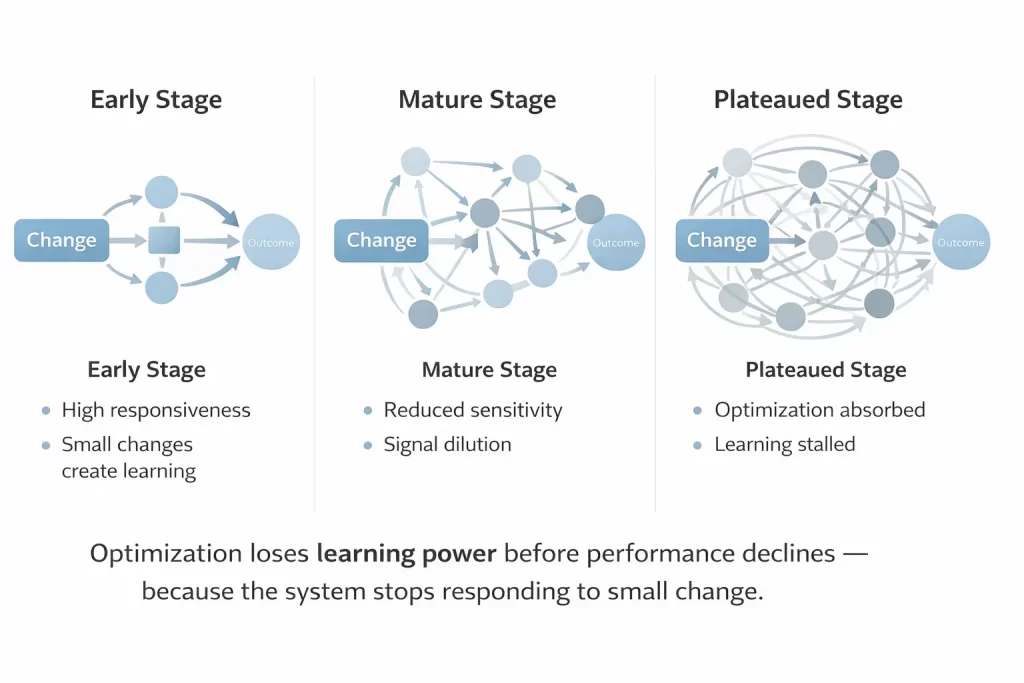
When campaigns launch, platforms are still exploring paths to conversion, and changes create noticable movement. Learning is easy at this stage.
As campaigns scale, platforms identify reliable paths to conversion, and increasingly focus spend on them. That’s why, over time, a small number of ads (3-5) often receive the majority of delivery.
This doesn’t mean optimization stops. It means the system becomes less responsive.
Small changes no longer create outsized effects. Performance may often holds steady, but the marketer’s ability to influence outcomes through minor adjustments diminishes.
The Missing Concept: Perturbations
Most optimizations are absorbed by the system. Perturbations are different.
Perturbations are optimizations large enough to force the system to reallocate spend/delivery.
Increasing budget by 10–15%, pausing a few ads, or adjusting bids slightly typically go unnoticed. Performance may move, but not enough to separate signal from normal fluctuation.
Perturbations – increasing budget 50% or more, adding new creative topics, changing conversion events – inherently change how a campaign delivers.
They are riskier. But they create real learning.
Why Perturbations Shrink as Campaigns Scale
In campaign scaling, learning naturally requires more rigorous forms of evidence. This same principle applies to perturbations.
As campaigns scale, platforms accumulate more data and confidence. That confidence reduces sensitivity to change.
At low spend, almost any change acts as a perturbation because the system doesn’t has little historical data to rely on. As those paths stabilize, larger distuptions are needed to create observable effects.
The result is counterintuitive: the more data a system has, the harder it becomes to learn from small changes.
What Doesn’t Count as a Perturbation
Perturbations are not changes that are made on a daily or even a weekly basis (unless at a high daily spend).
Creative pauses, minor bid adjustments, small budget reallocations (less than 15%), audience tweaks, and other changes that don’t materially effect the strategy are not perturbations.
These actions are still necessary, but they simply maintain the system.
What Does & Doesn’t Count as a Perturbation
Perturbations are not routine maintenance.
Minor bid changes, small budget shifts, creative rotations, or audience tweaks rarely qualify once campaigns reach scale. These actions keep the system running, but they don’t change its behavior.
True perturbations alter the rules the system operates under.
They live at different layers of the campaign:
Creative Perturbations
Rather than simply tweaking existing creative, making large changes to the overall messaging approach qualify as perturbations.
Creative that expands into new personas or value propositions to test efficacy or expand a product’s appeal put stress on the system.
If the perturbation is successful, ad spend is meaningfully reallocated.
See some top converting ad concepts to diversify your creative mix.
Audience Perturbations
Changes to the audience targets of a paid media system qualify as perturbations. This isn’t swapping out 3rd party targeting segments in Display or Youtube.
It is removing branded search from Google campaigns or pausing all retargeting in Facebook to opt for more prospecting-only tests.
These shift the target audience and have a large impact on ultimately who the campaign is reaching and how that drives results.
Structural Perturbations
Campaign structure has never been a more important part of paid media strategy. Simplified campaigns like Performance Max are quickly becoming best practice, and understanding how to effect change in these systems is necessary.
This could look like a simplified campaign structure in Meta or building feeder campaigns in Google to better funnel new audiences into your conversion campaigns.
These are some of the most powerful ways to impact delivery because it’s forced into a different model.
Channel Perturbations
As efforts expand into new channels, learning how to validate performance with incomplete data becomes even more necessary.
This is where introducing concepts like matched market tests or geo-based holdout tests drive learnings. Since these are manufactured tests, learning potential is high.
What these test sacrifice is efficiency, but often deliver valuable insights that wouldn’t have been found otherwise.
Ultimately, perturbations change what the system is allowed to do, and therefore bring the opportunity to learn.
Why Perturbations Must Get Larger Over Time
Similar to the stages of campaign scaling, perturbations must become larger and less frequent to remain measurable
Early campaigns benefit from frequent changes because signals are clear and volume is low. As systems mature, optimization cadence clows and intervention size grows.
At scale, meaningful learning comes from deliberate disruptions, not constant tweaking.
Contrary to popular belief, scaling doesn’t demand more optimization – it demands fewer, more meaningful interventions.
How This Changes Day-to-Day Campaign Management
Day to day management process needs to change in response to this.
Traditional optimization mindsets – constant tweaks, weekly improvements – only apply to a certain threshold.
When campaigns are new and spend is low, these small tweaks to campaign settings are absolutely necessary.
Once campaigns scale however, your job shifts from optimizing performance to crafting learning opportunities.
The perturbation aware mindset focuses on fewer, but larger changes with clear hypotheses. This might mean making a large change once per month and measure its effect on portfolio-level performance.
The Reason Teams Feel “Stuck” at Scale
Feeling stuck at scale isn’t a failure of effort or competence. It’s a signal that the system has matured.
In the world of paid media systems, often times less is actually more. Focus on fewer, but more meaningful tests, and actually wait to see if results follow. Remember, your sales cycle is the minimum amount of time to wait to assess performance.
When optimization stops producing insight, the answer isn’t more activity — it’s better questions posed through larger interventions.
Learning requires disruption proportional to scale.
When performance plateaus, don’t optimize harder. Perturb the system.