The Real Job of Advertising in a Go-to-Market Strategy
Advertising is often treated as the growth engine. If performance drops, budgets are adjusted, new creative is built, and campaigns are restructured.
But in most cases, advertising isn’t the problem.
It’s the most visible part of a system that was never set up to work in the first place.
Advertising doesn’t create demand, it accesses it. The key to successful campaigns isn’t how much money is spent or the number of channels ads run in. It’s how well the message appeals to demand in the market.
Without product demand, positioning, and messaging established before ads go live, the success of the system is not guaranteed.
Let’s look at how to think about advertising in a go-to-market strategy to build a better system for scaling growth.
For a broader look at how these systems are structured, explore the Strategy Hub
TL;DR
Advertising is often expected to drive growth on its own, but it operates within a broader go-to-market system.
Performance is determined upstream by:
- Market selection
- Positioning
- Messaging
- Marketing offer
Advertising’s role is to:
- Distribute messaging
- Capture existing demand
- Generate market feedback
When these inputs are strong, advertising accelerates growth. When they’re weak, it exposes the problem faster.
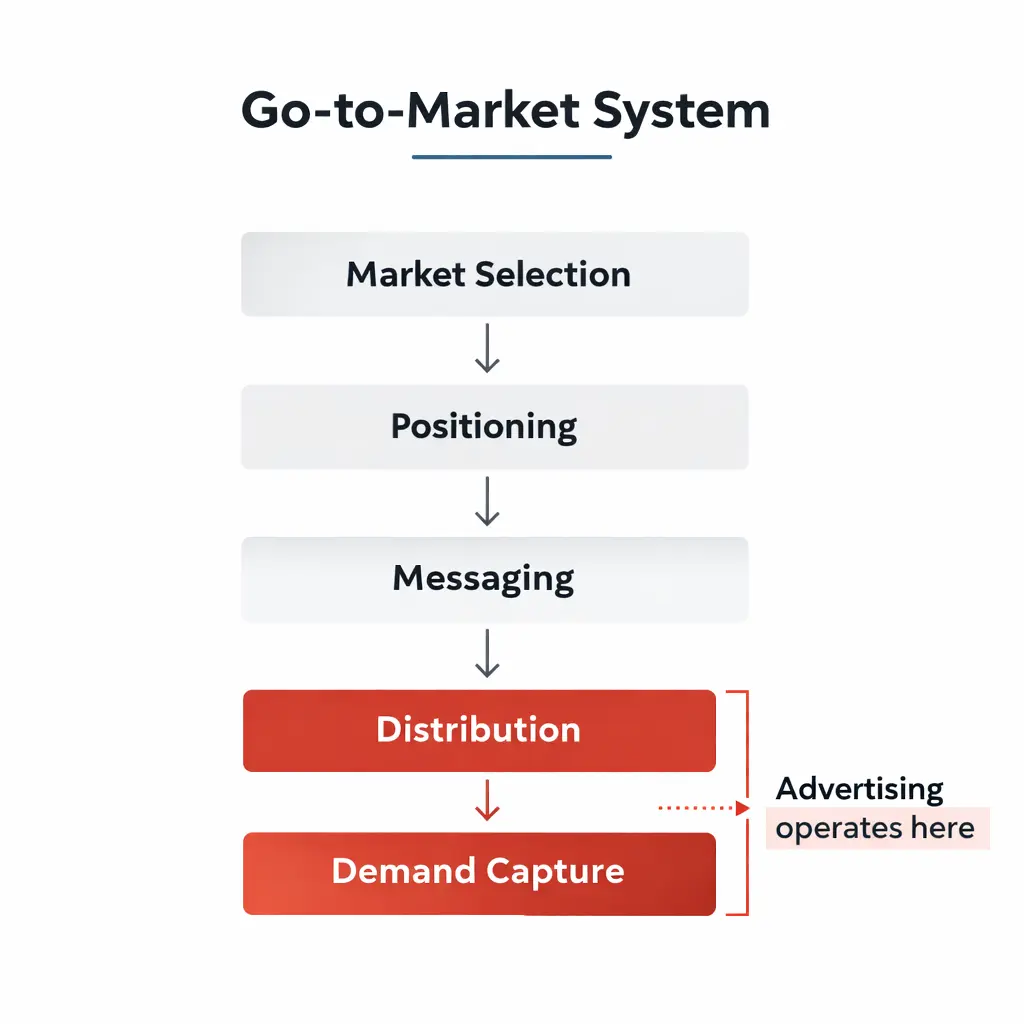
The Components of a Go-to-Market System
A go-to-market strategy is a system that connects a product to the right customers. Advertising is only one part of that system. For most early stage businesses, this means understanding the market and customer before starting advertising.
Market Selection
Most marketers chalk this up to geography, but it’s actually larger than that.
Market encompasses the target audience – who they are, where they live, what they need.
This includes:
- Target segments
- Geography
- Industry
- Customer profiles
Targeting the wrong market is the quickest way to failure. The message first and foremost needs to reach the right people with a specific need.
Positioning
Whole courses are taught on positioning. To break it down simply, it defines why your product matters relative to alternatives.
It answers questions like:
- Why choose this product?
- What problem does it solve better than competitors?
- Who is it designed for?
These are fundamental to more than just marketing – they inform product development, sales, and more.
Without clear positioning, the product defaults to generic claims that don’t stand out.
Messaging
Messaging translates positioning into language the market understands. We’ve covered this in detail in the psychology behind ad creative.
Reasons include:
- Problem/Solution framing
- Value proposition
- Motivation/Identity alignment
These themes apply beyond ad creative into the site experience and sales collateral. Alignment between sales & marketing here is crucial.
Distribution Channels
Where advertising really shines, distribution is the broadcast of your messaging across various platforms and mediums.
Examples include:
- Search
- Social media
- Content (organic)
This is the first step where discrete advertising planning is involved in the form of a media plan. Read a case study on how to build a media plan using market research.
Demand Capture
Demand capture is a critical role of advertising as it aims to convert interest into action.
This is done through various forms:
- Search ads
- Retargeting
- Promotions/Incentives
It’s one of the core roles of ad creative. Check out the four roles ad creative play in an advertising strategy, and which are most important.
Advertising primarily operates in the final two layers: distribution and demand capture. When the earlier layers are weak, advertising doesn’t fix the problem – it exposes it faster.
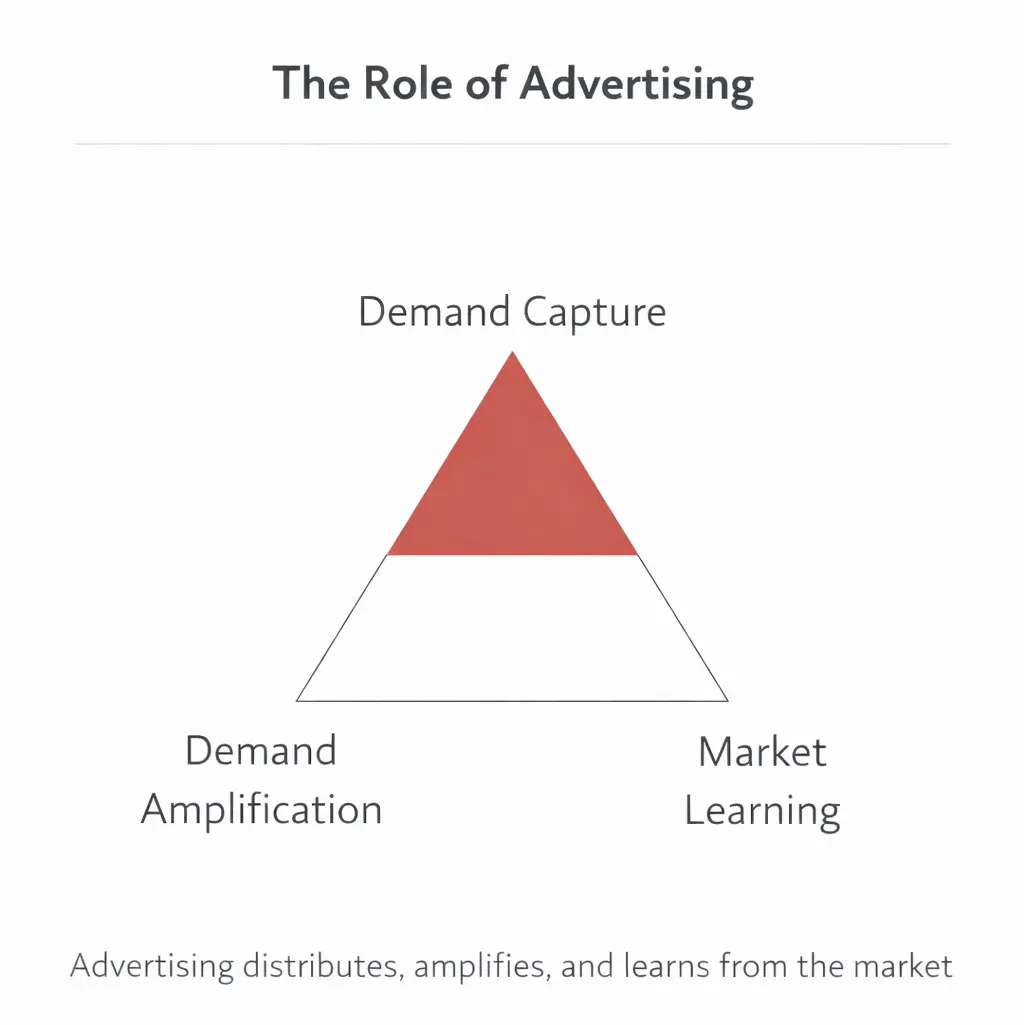
The Real Roles Advertising Plays
How advertising operates within the layers that it supports requires careful planning and strategic thinking. These steps are ordered in terms of importance – working them out in order maximizes measurable returns.
1. Demand Capture
Converting audiences that are interested in a product is a core function of advertising. A small subset of the total addressable audience is ready to buy at any time, and showing up in front of them during those moments is what converts interest into sales.
This can be done through tactical media buying:
- Search ads
- Retargeting
Or, clever promotional amplification:
- Sales
- Limited time offers
- Promotional periods
Read how seasonal promotions convert existing demand into paying customers in the restaurant business.
2. Demand Amplification
Advertising only identifies an existing problem. It doesn’t create the inherent need for a product.
To this end, it should work to call out those problems in a way that prioritizes action. Tying back to real human motivations and identities is an effective way to capture attention.
Get a framework for crafting messages in Why Some Ads Work and Others Fail: The Creative Demand Stack.
The key is amplifying messaging that works.
3. Market Learning
A key element of advertising is the speed to learning. Where organic content can take months to realize potential, paid media produces feedback almost immediately.
This teaches valuable lessons about:
- Messaging response
- Onsite engagement
- Offer resonance
The part most advertisers miss is creating a structured testing framework to learn from the media mix in market.
This expands beyond just ads. It applies to the entire creative production process as learnings from paid media apply to organic, email, affiliate, and pretty much any channel marketing materials are distributed through.
Where Advertising Gets Blamed for the Wrong Problems
A poorly optimized go-to-market strategy causes negative downstream effects for other parts of a marketing strategy. Advertising is one that feels those effects more than most because results are almost immediate.
Weak Product-Market Fit
No amount of exposure will sell a product that doesn’t solve a meaningful problem.
Ads may drive impressions and even some clicks (though click-through rate may be low). But, conversions will be low or non-existent.
This is often interpreted as a targeting or creative issue, but is realistically a market problem. Advertising doesn’t create demand – it reveals its absence.
Poor Positioning
Products that don’t differentiate from competitors live in a sea of sameness that doesn’t drive results.
Positioning often defaults to vague claims: better, faster, easier. These attributes don’t stand out in a crowd. Again, they might garner attention, but won’t drive meaningful conversion.
This is seen as low conversion rates and high CPAs. Often attributed to poor campaign structure or unoptimized targeting.
Generic Messaging
Crafting messages that capture attention is equally as important as strong positioning. As we see on platforms like Meta & TikTok, hook rate (attention) is a key optimization signal.
Messaging needs to appeal to the motivations, desires, and identities of the target audience. Without this, ads fail to retain attention long enough to communicate the offer.
Teams will interpret messaging failure as creative fatigue. We’ve explored why creative fatigue is often a misdiagnosis.
Misaligned Offer
The offer communicates value, and is one of the most common points of friction.
Simply asking your market to buy a product without clearly communicating the value proposition leads to low conversion rate.
Ways to improve an offer are through:
- Pricing models
- Incentives
- Checkout funnels
- Training/Education
Advertising generates interest using these methods, but ultimately relies on a strong offer to drive decision making. Again, failing offers are misattributed to creative or audience underperformance.
Why Companies Expect Advertising to Do Too Much
Advertising gets held to a higher standard in marketing departments because of its ability to generate clear, defined return on investment.
Money spent driving impressions, views, and clicks are expected to return equal or more revenue to justify their existence in most cases. This is the visibility bias at work. Advertising is one of the few marketing activities where spend and results are tracked closely, making it an easy target when performance fluctuates.
This perception is reinforced by the platforms themselves. Every major advertising platform promotes the idea that ads drive growth. Their messaging emphasizes optimization, targeting, and automation as the primary drivers of success.
Combined with attribution – which appears to prove advertising’s effectiveness – advertising often sits closest to the moment of conversion, attribution models frequently assign it the majority of the credit.
Savvy marketers know not to rely solely on attribution. Read Why Attribution Fails as a Marketing Decision System.
The end result: a stacked narrative where advertising appears to be both the growth driver and cause of failure.
How Advertising Should Fit Into a Go-to-Market Strategy
Thoughtful inclusion of advertising in a go-to-market strategy has serious potential upside. However, certain steps must be taken prior to launching ads if success is to be at all guaranteed.
1. Validate Demand First
Before investing in distribution (ads), ensure the product solves a meaningful problem.
Use early sales performance, customer feedback, and organic performance of the brand to identify if a product has natural demand.
If it does, move to the next step.
2. Clarify Positioning
Define why the product matters in the market. Early sales and customer feedback provides this insight as well.
Within this, develop at least 3 of the strongest angles into:
- Messaging
- Creative direction
Positioning becomes the core for how the product reaches an audience. Without it, advertising becomes generic and expensive.
3. Develop Messaging Themes
Translate positioning into language the market understands.
This is where it helps to leverage distinct audience profiles. Identify what that audience’s goals, aspirations, motivations, desires – even fears and concerns are.
Take these ideas and incorporate them into a creative production system. The output is ad creative, landing pages, and sales collateral.
4. Use Advertising to Distribute and Learn
Once these elements are in place, building a media plan turns them into a powerful distribution and feedback engine.
Campaigns can then:
- Capture existing demand
- Amplify high-performing messages
- Generate rapid market insight
Optimizations become ways to enhance the existing campaign structure, rather than simply testing for the sake of it.
For a deeper breakdown of channel strategy and campaign execution, see the Advertising Hub
Advertising Is an Accelerator, Not a Strategy
Advertising is one of the most powerful tools in a go-to-market strategy when it’s used in the right context.
It doesn’t create demand in isolation. It distributes messaging, captures intent, and generates feedback on what the market responds to. When those inputs are strong, campaigns scale efficiently. When they aren’t, performance becomes inconsistent and expensive.
The difference isn’t in the platform or the campaign structure. It’s in the system behind it.
Advertising works best as an accelerator of a well-defined strategy, not a replacement for one.