Creative Production for Paid Ads: A System for Testing and Scaling Creative
Modern advertising systems rely heavily on creative. It’s the main driving force in successful marketing campaigns, and conversely, the most common failure point for many more.
But more than having boring creative, the problem most marketers face is lack of creative diversity. It’s not enough to just have a lot of creative. They need to occupy different roles, and speak to different segments of the audience.
To do this effectively, creative production needs to be centered around systematic, repeatable strategy. Without structure, creative becomes repetitive and harder to measure.
This article explains how to build a scalable creative production system that supports message variation, testing, and analysis – the building blocks for a successful creative & messaging strategy.
TL;DR
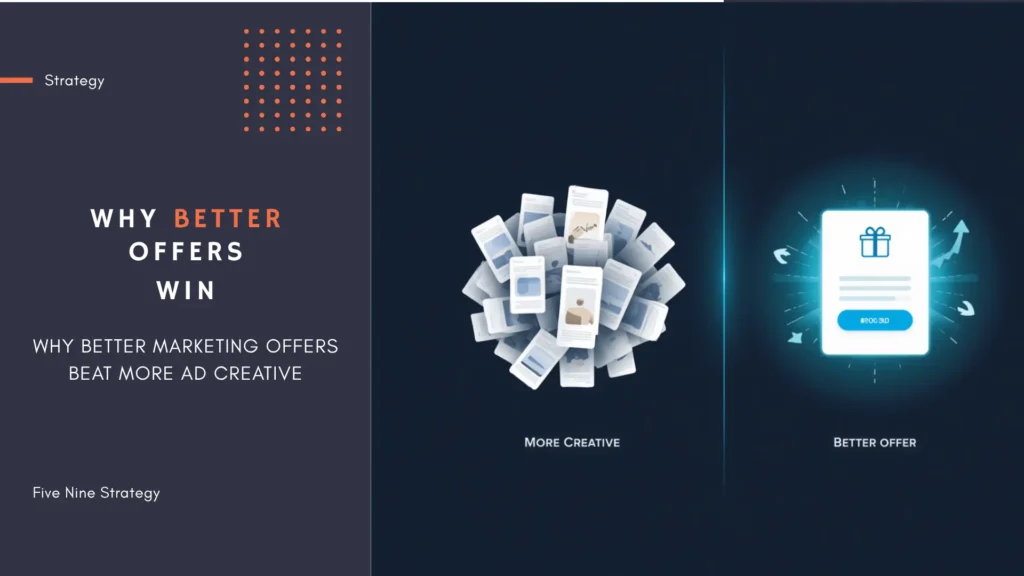
Creative performance rarely improves from producing more ads alone. The real driver of performance is message diversity built around a structured creative system.
A scalable creative production machine follows five steps:
- Messaging Strategy – identify audience motivations and messaging angles.
- Creative Topics – turn angles into themes that generate multiple ad variations.
- Creative Production & Testing – produce ads across different roles in the user journey.
- Creative Analysis – evaluate performance by topic, role, and variant using standardized naming.
- Topic Replacement – introduce new messaging ideas based on what the data reveals.
Over time, this process turns creative production into a continuous learning system that improves messaging, increases creative diversity, and sustains performance as campaigns scale.
Why Most Creative Production Systems Break
Most marketing teams focus creative production on volume – 2 new assets per week to keep feeding the algorithmic machine.
What this misses is strategic input, and how algorithms actually optimize for ads. Sure, new ads introduce new signals into the optimization mix, but rarely improve performance.
Ad platforms today are incentivized to find what works, and stick with that. To improve performance, larger changes to the status quo (perturbations) are necessary. I explained this in my article on Why Optimizations Stop Working.
From a creative perspective, these larger changes come in the form of messaging angle variety, not just volume. That requires planning creative around various audience segments that have different motivations, identities, and aspirations.
For a deeper explanation of the psychological layers that determine whether messaging resonates, see my guide on the Creative Demand Stack.
The role of creative production is to explore and validate messaging, not just pump out assets.
The Creative Production System
Instead of thinking about creative as individual ads, think of it as a layered system.

The system works in a loop, continuously informing how to strategize messaging next. This turns guesswork into a structure system that eliminates uncertainty.
Step 1: Start with Messaging Strategy
Before any graphic design or copywriting begins, messaging strategy needs to be planned. The goal of this exercise is to identify different messaging angles or topics that appeal to the target audience.
An angle represents a specific way the product connects to a problem, identity, or aspiration.
Examples for a restaurant business are:
- Decision fatigue: What should we eat tonight?
- Lack of connection: Family time, friends time
- Comfort: Spend time somewhere that feels good
Each angle supports a cluster of creative executions. Documenting this during the creative briefing process ensures strategy aligns with production.
Not only does that provide transparency, but also objective measure for accountability. Otherwise, there’s serious risk of producing endless variations of the same message.
For a deeper explanation of how messaging connects to human motivation and identity, see Understand the Psychology Behind Working Ad Creative.
Step 2: Turn Angles Into Creative Topics
Once angles are defined, they can be expanded into creative topics. Topics should fit roughly into creative roles that align with typical user journeys.
Read about the four creative roles that define the user journey.
Each topic can generate multiple ad variations across this journey.
Topic: An Easy Weeknight Dinner
- Problem / Solution: Cooking is exhausting, get delivery instead
- Product Demonstration: Show food being prepared
- Transformation Story: Cut from messy kitchen to relaxed evening
- Customer Testimonial: Quote a review – “fastest takeout in town”
- Mechanism Explanation: Locally sourced, chef-driven menu
The same creative topic takes shape in various forms where each ad appeals to a different stage of the user journey.
This structures creative development around two layers:
- Topic
- Variation
The topic sits at the top of the hierarchy as a concept that aligns with motivators, identity, and aspirations.
The variation plays on a particular level of the user journey – finding what stage the topic works best at.
For more ideas on variations, read my guide on 6 High-Converting Ad Creative Examples.
Step 3: Creative Production & Testing
Creative production should feed directly into a structured testing system. To do this, establish what role each creative is designed to play in the overarching creative portfolio.
These roles break down into one of four categories:
- Demand Creation
- Reinforcement
- Demand Capture
- Acceleration
These should align with the topic variations created in the previous stage. However, categorizing them into this framework serves two purposes.
- Goal Alignment
- Creative Analysis
If you want a full breakdown of how to structure creative tests in modern ad platforms, see Creative Testing in 2026: How to Test Ads in Algorithmic Campaigns.
Step 4: Creative Analysis
The first step to doing creative analysis is ensuring standardized naming conventions are in place for each ad. Not only does this sort creative roles, but also allows for topic and variant analysis to better understand creative portfolio performance.
Standard Naming Convention Framework:
Topic_Role_Variant_Format_UniqueIdentifier
Each creative will have a unique set of these creative parameters.
For example:
EasyWeeknightDinner_Creation_ProblemSolution_Video_15s
With this format, reports look like different levels of creative execution. Build CTR, CPA, or even spend level reports for:
- Topic
- Role
- Variant
Each role has different key performance indicators. For a deeper breakdown of how to evaluate creative performance signals, see Meta Andromeda Creative Analysis: New Rules for 2026.
Step 5: Replace Creative Strategically
Creative analysis loops into topic replacement based on how spend is distributed across topics, roles, and variants.
Generally, delivery against topics is aligned with what stage of growth the business is in. However, there is always a need for balance.
Spending too much on demand creation limits conversion potential downstream.
To build a framework based on delivery patterns, consider what goal is most important, and how effective current messages are at supporting it.
Then, map delivery concentration against the creative as a portfolio.
If you want a deeper explanation of how this happens, see Creative Fatigue in Performance Marketing: Delivery vs Messaging.
The end goal is creative refreshes that focus on introducing new messaging topics rather than iterating on the same ideas.
Creative Production as a Learning System
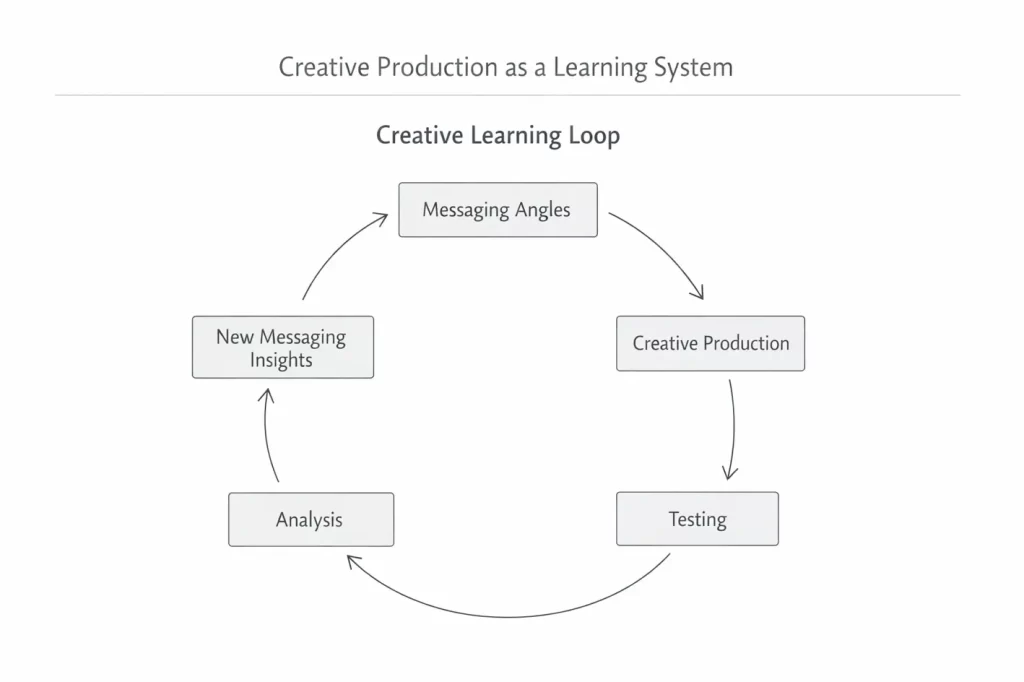
When executed correctly, creative production becomes a continuous learning loop. Messaging angles are tested, measured, and used to inform future creative production.
That process doesn’t remove creativity from advertising. Developing new hooks based on human motivations and decision drivers is an ongoing part of marketing strategy.
Over time, however, this system builds a deeper understanding of:
- Which problems resonate most
- Which identity signals align most with the brand
- Which mechanisms reduce skepticism
Sometimes discovering just one strong hook can scale a business to thousands of dollars in daily ad spend.
But sustaining performance at scale becomes as much a problem of creative volume as creative insight.
Without a system to continuously generate and test new messaging, even successful campaigns eventually stagnate.
Creative Is the System That Drives Learning
When creative production is treated as a one-off exercise, performance eventually stalls. A few ads might perform well, but without a structured process the team is left guessing what to produce next.
The most effective advertisers treat creative production as a learning system.
Messaging angles are the hypotheses about what motivates customers. Creative production turns those hypotheses into ads. Testing reveals which ideas resonate, and analysis turns those results into new insights that guide the next round of messaging.
Over time, this loop builds something far more valuable than a single winning ad: a deeper understanding of the customer.
In 2026 and beyond, advertising success increasingly depends on creative velocity – understanding the customer and supplying a variety of messaging that capture attention and drive action.
Diversifying creative topics is the first step to giving algorithms more signals to work with, particularly since Meta’s Andromeda update.
The goal isn’t to build a single perfect ad, but rather build a production system that continuously discovers it.