What Shapes Purchase Decisions Before the Click
Most marketing is built on a simple assumption: people move from awareness to consideration to conversion in a predictable sequence.
This assumption guides most campaign strategy, reporting, and attribution. But it’s very rarely the way real behavior works.
People are unpredictable. Some:
- Buy after one exposure
- Research for weeks but don’t convert
- Switch between brands unpredictably
Marketing campaigns rarely account for this fact. The issue isn’t that the funnel is useless. It’s that it mistakes a clean planning model for real human behavior.
Decisions don’t happen in a vacuum. Treating them like a step sequence misses crucial moments of choice. They happen when the right conditions are met.
Brand matters more than most performance teams realize. It reduces friction before the moment of choice by making a product easier to understand, trust, recognize, and select.
This article looks at one of the most overlooked parts of marketing strategy: how brands reduce friction before a buying decision is made.
TL;DR
Customer journeys are not linear, even though most campaign strategy assumes they are.
People make decisions based on timing, context, familiarity, trust, and relevance, not because they have moved through a funnel.
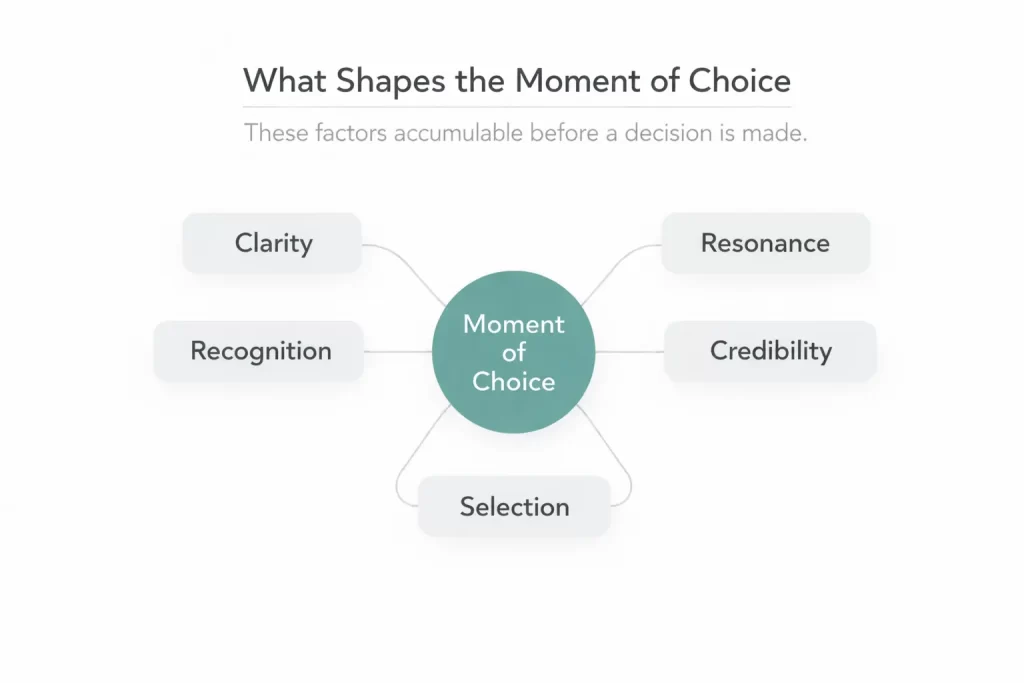
That means the real job of brand is not just awareness. It is reducing friction before the moment of choice by improving:
- Clarity
- Resonance
- Recognition
- Credibility
- Selection
Advertising benefits from these conditions, but it does not create them. When they are strong, campaigns perform more efficiently. When they are weak, performance becomes expensive, inconsistent, and difficult to optimize.
Why the Linear Funnel Breaks Down
The traditional funnel is based on a simple assumption: people are looking for certain information at each stage of the buying journey. If you provide it, they will eventually convert.
That assumption shows up everywhere:
- Campaign segmentation
- Messaging
- User experience flows
It works well at creating clear segmentation, but misses how user behavior really works.
In reality, user journeys are not predictable or controllable. The more marketing respects that, the better it works.
What Actually Happens
Users don’t follow a single path. They:
- Enter at different stages of intent
- Make multiple visits from different channels
- Make decisions based on immediate context
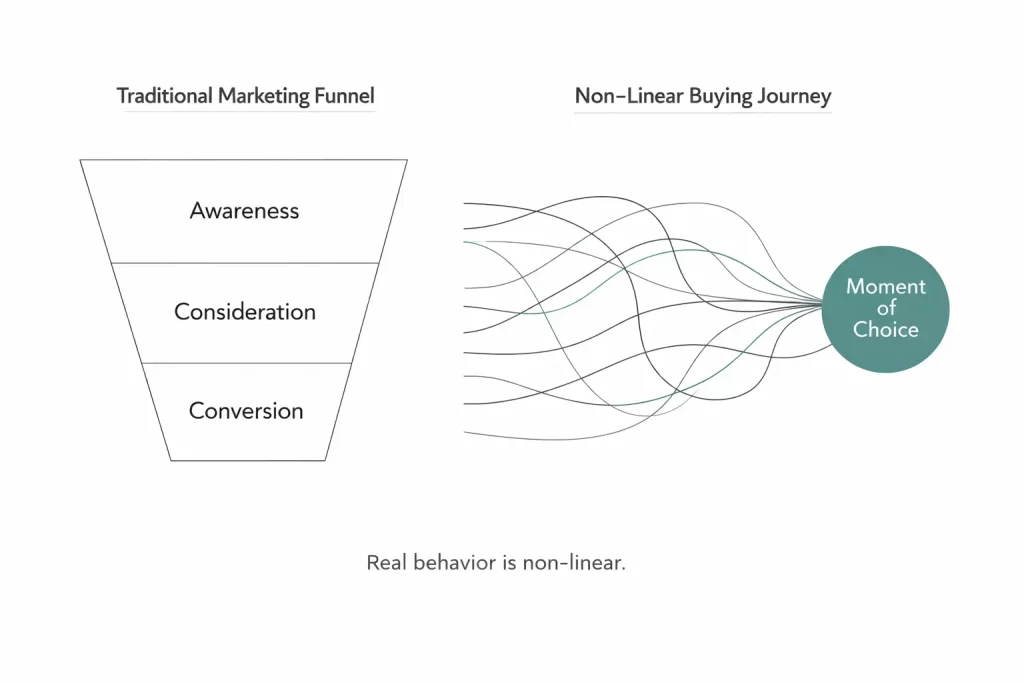
The idea that there is a single time to conversion is flawed. In reality, some users take hours, and others take weeks or months.
The flooring industry has an average time to convert of 6 months, but some shoppers will make their purchase decision in as little as 1 month.
Readiness to buy isn’t the same for everyone, and marketing needs to factor that in.
The Real Unit of Measurement: The Moment of Choice
The purchase decision is more than a step of the journey. It’s a decision made with careful consideration:
- How clearly is the product understood
- Does it relate to a common problem
- Is it easy to understand
- Are the alternatives any better
These aren’t decisions made in the moment. They build over time.
When someone clicks an ad, searches a brand, or compares options, most of the decision is already made.
That’s why I’ve recommended against running branded search ads. Most people searching for a brand have their minds made up.
It challenges traditional funnel thinking as it eliminates the last step before conversion.
However, in practice, it just shifts the point of decision earlier in the customer journey. After all, the goal of advertising is to reach users at the point of decision.
Whether that interaction leads to action depends less on the campaign, and more on the conditions surrounding that decision.
What Actually Shapes Decisions Before the Click
The idea that brand doesn’t drive performance usually comes from a narrow definition of what brand is.
It’s not just logos, colors, or visual identity. At its core, brand is how a product is understood, recognized, and trusted by the market – core elements of a successful creative & messaging strategy.
That understanding influences how decision are made. Five factors consistently determine whether someone takes action.
1. Clarity (Understanding)
Every decision starts with a simple question: what is this, and is it for me?
Clarity comes from aligning product with a specific audience and clearly communicating:
- Who is the product for?
- What is it?
- Why does it matter?
When this isn’t obvious, users don’t engage. Not because they’re uninterested, but because they don’t understand.
2. Resonance (Relevance)
Once understood, the message has to matter.
Resonance is the connection between product and a real-world problem, goal or identity. It’s how the message feels personal.
This is where most messaging fails because it’s too generic to create urgency or attention.
3. Recognition (Mental Availability)
Even relevant messaging needs to be recognized instantly.
Especially on social media, attention spans are short (<2s). Users should be able to identify what they’re looking at within that time span.
Recognition is inherent for common products, but must be built for newer categories. It ensures even with strong messaging that the product isn’t ignored for lack of understanding.
4. Credibility (Trust)
Understanding and relevance create interest. Credibility determines whether that interest turns into action.
At this stage, users are asking:
- Will this actually deliver
- Is this a safe choice
This comes from a combination of product quality, social proof, consistency, and past exposure. Without credibility, hesitation takes over, and hesitation leads to choosing something more familiar.
5. Selection (Preference)
Even when all of the above are present, a decision still requires a reason to choose.
Selection comes down to differentiation – a clear advantage over available alternatives.
If that advantage isn’t obvious, the decision gets delayed. And delayed decisions are often lost entirely.
These factors don’t happen in sequence. They process simultaneously, and differently for each individual.
Why This Matters for Advertising
Advertising doesn’t directly set these elements of go-to-market design, but it benefits from them.
More than anything, those conditions determine how efficiently an advertising system performs.
When clarity, resonance, recognition, and credibility are strong:
- Users engage faster
- Conversion rates increase
- Share rates improve
The most powerful form of advertising is more than simply ads that convert. It’s ads that turn others into product advocates.
Without attention paid to those conditions, the opposite happens:
- Costs rise
- Conversions fall
- Optimizations become reactive and ineffective
This is why many campaigns feel like they require constant adjustment, but results don’t change. It’s not always campaign execution. It’s unresolved friction in the buying process.
Where Most Teams Get It Wrong
Most teams (especially agencies) diagnose performance at the campaign level, even when the real problem exists upstream in how the product is understood, trusted, or differentiated.
Treating targeting as the primary lever
Trying to find the right audience through targeting instead of improving how the product is positioned, recognized, and understood.
Over-optimizing creative
Testing different formats, hooks, and visuals without addressing the deeper messaging problem – what the product means, why it matters, and who it is for.
Focusing only on post-click performance
Landing page optimization can improve conversion rates, but it cannot compensate for weak perception before the click.
Trusting performance data at face value
Using isolated metrics to explain performance instead of reading them as signals. A low CTR doesn’t automatically mean the creative is weak. It may reflect poor positioning, low relevance, or lack of trust.
How to Reduce Friction Before the Moment of Choice
The biggest changes to performance come from conditions surrounding a decision. Improving these steps leads to better performance across the entire marketing strategy – a real valuable ROI.
Improve clarity through positioning
Restaurant marketing often defaults to pictures of food with generic claims like ‘fresh’ or ‘family atmosphere’. Marketing is much stronger when positioned around a specific dining occasion or experience.
An occasion like Valentine’s Day drives real demand, so centering a promotion around it works well. Read how we executed a Valentine’s Day campaign that drove over $160k in sales.
Build messaging that creates relevance
For a travel brand promoting study abroad trips, messaging becomes more effective when it reflects the motivations of the audience.
For college students, that may mean emphasizing independence, personal growth, adventure, or identity, not just program logistics.
The strongest messaging connects the offer to what the audience already wants. Read more about how to build messaging around the Demand Stack.
Reinforce recognition through consistency
Recognition grows through repeated visual cues and message diversity. That’s why a creative production system matters more than isolated ad ideas.
For a brand speaking to multiple audiences – such as parents and teachers in enrollment and recruitment campaigns – recognition depends on a clear visual hierarchy and message structure. That may include distinct landing page paths, color treatments, and creative framing that help each audience identify what is relevant to them without losing the broader brand identity.
Strengthen credibility through proof and experience
Trust is built through evidence and delivery, not polished messaging alone.
Partnerships, testimonials, case studies, and visible proof of execution all strengthen credibility. For a non-profit focused on education, trust is often built through demonstrated community impact, respected collaborators, and a clear record of outcomes.
That’s why attribution alone rarely explains performance. Users are influenced by far more than the final ad they clicked.
Use advertising as a testing and feedback system
Once the foundation is in place, advertising becomes a way to test which messages reduce friction most effectively. This is where creative testing and go-to-market strategy start to overlap.
A brand running across multiple channels can use performance patterns to identify what resonates most strongly, then apply those learnings more broadly across the media mix.
For example, if a specific influencer-led message performs well on Meta, it may be a strong candidate for TikTok as well, even if the measurement model differs between platforms.
Brand Is What Makes Performance Work
Brand is often treated as a soft layer that sits above performance. In reality, it shapes the conditions that make performance easier.
When a product is clear, relevant, recognizable, credible, and easy to choose, advertising works more efficiently. When those conditions are weak, campaigns become expensive, reactive, and difficult to improve.
The job of marketing is not to force people through stages. It is to reduce friction before the moment of choice.
The better those conditions are, the less your advertising has to fight to convert.