
Why Hook Rate Is the Real Optimization Metric in Meta’s Andromeda Era
Meta’s Andromeda update has fundamentally changed how ads win on the platform. Segmented campaigns are no longer best practice. Consolidation now drives better performance.
As audience targeting fades, creative has become the primary signal Meta uses to find and scale ads. Ads no longer earn delivery because budget is forced into them. They earn delivery by proving relevance early.
This shift has also changed how performance should be interpreted. Many campaigns look inefficient at first, not because they fail to convert, but because conversions lag behind attention. Meta evaluates engagement signals well before downstream results fully materialize.
One of the most important and misunderstood of these early signals is hook rate. In this article, we break down how hook rate works and use real campaign data to show why it increasingly determines which ads get scaled in the Andromeda era.
TL;DR
Hook rate (3-second video views ÷ impressions) is the earliest signal that determines whether an ad gets tested, scaled, or quietly deprioritized. Ads with strong hook rates receive more distribution, even when their CTR or CPA looks worse. Ads without it rarely get the chance to prove downstream efficiency.
This explains why some ads dominate spend while appearing “inefficient”. In the Andromeda era, the real optimization question is no longer “did this convert?” but “did this earn the right to be evaluated?”
What Is Hook Rate (and Why Meta Cares)
Hook rate measures a creative’s ability to capture user attention in the first 3 seconds of playback.
Formula: Hook Rate = 3-second video plays / impressions
It’s similar to Thumbstop Rate – the percentage of impressions where the user did not immediately scroll past the ad – but signals more attention.
Three seconds matters because the user:
- Had time to process context
- Decided not to scroll
- Hears your initial pitch
A higher hook rate means more effective attention capture – Meta likes this – especially in a world where we have on average 2 seconds to capture someone’s focus.
Why Meta Andromeda Favors Hook Rate
Before conversions, before CPA, before learning, there’s attention. Hook rate determines whether attention is captured and provides a valuable initial signal.
Meta Andromeda uses its Lattice to test creative in micro-batches. Imagine 10 ads launched together in a single ad set.
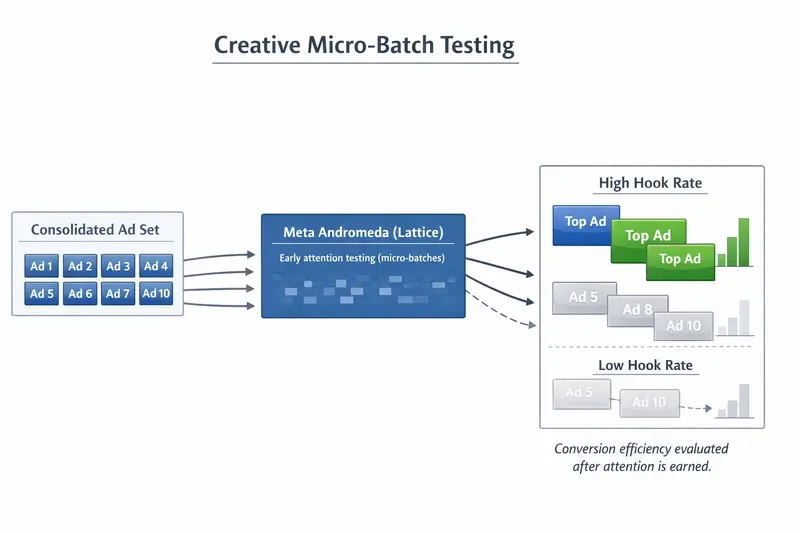
Early on, Meta evaluates which ads capture attention most effectively. Ads that hook users are tested more aggressively, while others receive less distribution even if they convert efficiently when forced spend is applied.
In Andromeda, attention determines which ads earn the right to be optimized. Ads that don’t hook the audience subsequently get less distribution, even if they convert well.
How Consolidation Turns Ads Into Direct Competitors
In consolidated ad sets, ads don’t compete against other advertisers – they compete against other ads in the ad set.
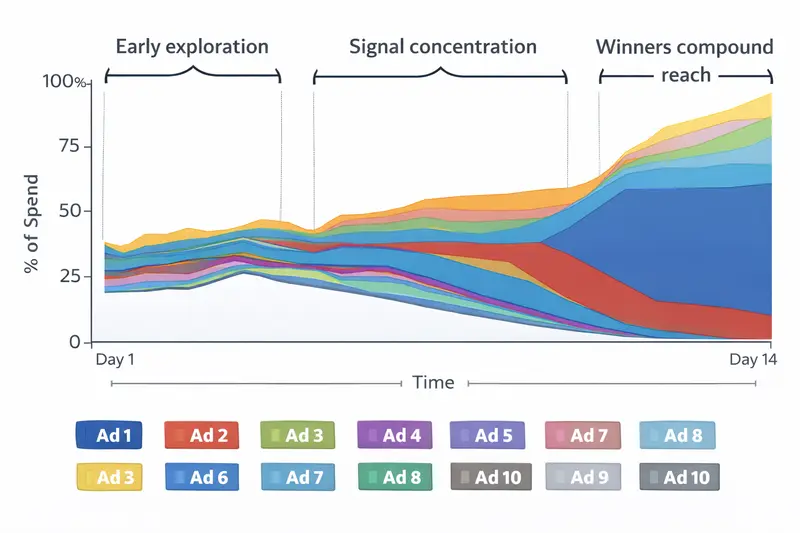
Budget flows toward early winners of attention as it most often connects to downstream conversion performance.
By combining ads into one ad set, you get unique insight into how they compare to each other that wouldn’t be available in a segmented structure.
Why ‘Bad’ Creative Often Fails Before CPA Ever Matters
Ads have always been measured using Click-Through Rate or CPA – this doesn’t tell the full story.
To really understand why an ad ‘fails’, understanding how effective it is at capturing attention is necessary.
Bad performance no longer looks like high CPAs or low CTRs, it looks like:
- Okay CTR with no spend
- Ads that convert when forced spend is applied
- Low spend and low clicks
We’ve explored why CPA is no longer the best performance indicator. Particularly with how people use a platform like Meta, last-click attribution tells just a fraction of the story.
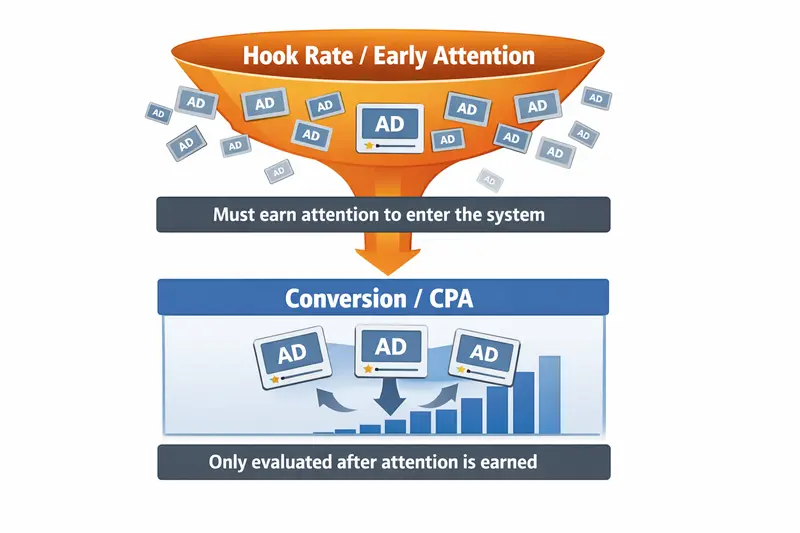
In Andromeda, conversion efficiency is only evaluated after an ad proves it can earn attention.
Next time you analyze creative performance, also look at hook rate – it may uncover some insight in why certain ads are prioritized that was previously overlooked.
Case Study: Hook Rate
An account running lead generation ran the Andromeda framework for 6 months. This analysis looks at the top 12 video ads that ran in the campaign.
| Ad | Spend | CTR | CPC | Hook Rate | CPA |
|---|---|---|---|---|---|
| Ad 1 | $67,702 | 0.8% | $3.1 | 19% | $599 |
| Ad 2 | $24,432 | 1.1% | $2.8 | 29% | $1,062 |
| Ad 3 | $24,354 | 1.2% | $2.5 | 29% | $696 |
| Ad 4 | $18,585 | 1.1% | $1.2 | 23% | $929 |
| Ad 5 | $13,974 | 1.3% | $1.9 | 20% | $582 |
| Ad 6 | $11,380 | 1.5% | $1.6 | 12% | $495 |
| Ad 7 | $8,343 | 1.3% | $2.0 | 19% | $834 |
| Ad 8 | $3,062 | 1.0% | $2.1 | 17% | $3,062 |
| Ad 9 | $2,336 | 0.8% | $1.9 | 9% | $389 |
| Ad 10 | $922 | 1.8% | $1.0 | 16% | $922 |
| Ad 11 | $736 | 2.2% | $0.8 | 16% | $736 |
| Ad 12 | $469 | 2.0% | $0.6 | 15% | $469 |
Even though top spending ads had lower CTR and higher CPC, they were prioritized because of their ability to capture attention early.
These topics usually featured eye-catching product demos, customer testimonials, and face to camera content where the message focused on education – building a diverse creative set that appealed more broadly to the consumer base.
Framework for Understanding Attention Signals
Understanding what captures attention not only explains ad performance, but also opens up new insights for creative revisions and optimizations.
The difference between what Meta can see and what advertisers see in reporting understates this:
Hidden Layer
- Scroll velocity
- Micro-pauses
- Whether the video keeps playing as the feed moves
This is where thumbstop really lives
Exposed Layer
- 3-second views
- Retention curves
- ThruPlays/Video completes
This is where hook rate becomes measurable
What This Looks Like In-Platform
Create in-platform metrics that measure attention at each stage of the ad. The goal is to understand what captures attention and why.
Measurement Framework
| Stage | Internal Signal | What You See |
|---|---|---|
| Scroll interruption | Thumbstop (inferred) | Video Plays / early retention |
| Attention validation | Hook | 3-second view rate |
| Engagement depth | Hold | 25%, 50%, ThruPlay |
| Intent | Click / conversion | CTR, CVR |
You can’t optimize for thumbstop directly, but can optimize for hook rate and deeper engagement.
Practical Implications for Andromeda
Hook rate is a diagnostic metric, not a KPI. Its value lies in explaining why certain creative earns distribution while others never get a chance.
When applied correctly, hook rate helps surface winning topics, not just winning ads. Your top performers will often share a common theme, narrative, or visual style – signals of what the algorithm is able to match broadly across users.
To extract real insight from creative performance:
- Iterate on top-performing concepts, not individual executions
- Launch 2–3 new ads every 2 weeks (more frequently at higher spend)
- Test distinct topics, not just variations of UGC or product demos
In Andromeda, ads don’t fail because they have high CPA – they fail because they never earn attention. If a creative doesn’t hook users early, it won’t spend. Treat this as feedback on relevance, not rejection of your message.
Conclusion: Hook Rate Is the Price of Distribution
Meta’s Andromeda update has shifted optimization upstream. Before CPA, before CTR, before learning, ads must first earn attention. Hook rate doesn’t replace traditional performance metrics—but it explains why some ads are given the chance to perform while others quietly disappear.
In a consolidated, creative-led system, distribution is no longer guaranteed. Ads that capture early attention are tested, learned from, and scaled. Ads that don’t are filtered out long before efficiency metrics stabilize. Understanding hook rate closes the gap between what advertisers see in reporting and how Meta actually allocates spend.
Used correctly, hook rate reframes creative analysis from “did this convert?” to “did this earn the right to be evaluated?”—which is the real optimization question in the Andromeda era.
Sidenote: Hook rate explains why ads earn distribution, not whether they should run forever. There are still clear cases where pausing underperforming creative is the right move.
If you’re unsure where that line is, see what criteria actually justify pausing an ad.