
How Meta Campaign Structure Has Changed
Meta campaign structure used to be easier to understand.
Advertising campaigns were split by funnel stage, audience type, or traffic temperature. Prospecting reached new users. Retargeting followed up with warm users to capture demand.
That structure made sense when advertisers had more control over audiences.
But Meta’s system has changed. With broader targeting, fewer manual controls, and algorithmic delivery through systems like Andromeda, campaign structure no longer determines audience quality on its own. Meta now decides who to reach based on the signals advertisers provide, the creative users respond to, and the conversion events campaigns are optimized around.
That creates a new problem.
A campaign can look efficient while quietly over-retargeting the same high-intent users. CPA may look strong, but the campaign may not be expanding demand. It may simply be getting better at capturing conversions that were already likely to happen.
The goal of campaign structure in 2026 is not to split everything apart or consolidate everything into one campaign. It is to understand when Meta is finding valuable new users, and when it is concentrating spend on the easiest conversions.
This article explains how optimization signals, creative inputs, and campaign structure work together to shape Meta delivery, and how to avoid over-retargeting while still preserving the overall paid media system performance.
TL;DR
Meta campaign structure is not about choosing consolidation or segmentation. It’s about controlling whether the algorithm is expanding into valuable new users or over-targeting the easiest conversions. Use strong conversion signals, discovery-oriented creative, and segmented campaigns only when delivery starts concentrating around the same users, ads, or view-through conversions.
What Meta Is Actually Optimizing For
When optimizing for conversions, Meta is actively looking for the most likely users to convert. That means oftentimes it over-targets existing customers or warm users.
Even when targeting a broad audience, campaigns naturally shift toward retargeting, leading to skewed performance. CPA looks better than it should just because Meta is taking credit for conversions that would happen anyway.
The outcome is high perceived impact, but low incremental impact.
The Two Extremes (And Why Both Fail)
When it comes to campaign optimization, there are two primary approaches. Low funnel conversion actions (purchases, leads) and upper-funnel conversions (page views).
Both have their advantages and disadvantages.
Extreme 1: Fully Consolidated (Low Funnel Conversions Only)
A campaign that only optimizes for the final action (i.e. purchase) reaches the highest intent audience. This is a good thing until it starts over-targeting users that would have converted without ad exposure.
To diagnose these campaigns, look at:
- Frequency creeping above 3 per week
- Low reach compared to total addressable audience
- High view-through conversion volume
Businesses with strong awareness are more susceptible to over-retargeting because the pool of warm users is larger.
Extreme 2: Poor Signal (Soft Conversion Only)
Campaigns that optimize for soft conversions like page views are susceptible to the opposite problem. They’re very good at reaching new users, but often reach the wrong audience.
Ad dollars spent reaching an audience that is so far out of market that they are very unlikely to convert are ad dollars wasted.
To diagnose these campaigns, look at:
- Low CPC but also low conversion efficiency
- Broad reach at low cost
- No measurable business impact
Exploration without a clear intent signal doesn’t create demand. It prioritizes softer metrics like clicks and engagements that don’t lead to downstream conversion impact.
How To Better Control Audience Expansion
The trick to successful Meta Ads campaigns is understanding how to reach an audience of high-intent new users. To that end, there are various levers advertisers can pull to optimize campaigns toward that audience.
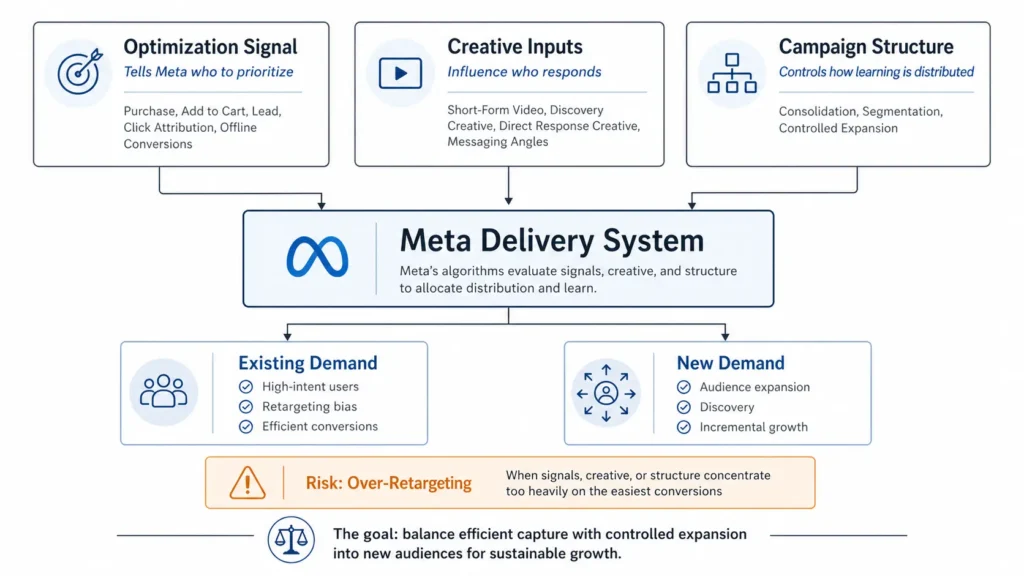
Lever 1: Optimization Signal
Each optimization signal trains Meta to prioritize a different type of user. Purchase signals bias toward high-intent users, while softer signals expand reach into users earlier in the decision process.
A lesser known tactic in optimization signal is attribution window. Meta allows advertisers to choose from 7-day click, 1-day engagement, and 1-day view attribution in ad set settings.
Removing 1-day view and engagement attribution doesn’t just clean up reporting – it removes a major source of retargeting bias from the optimization system.
Read more about Meta’s recent changes to attribution windows in Meta Ads Click Attribution Explained (2026 Update + Reporting Fixes).
Lever 2: Creative Inputs
While not as cut and dry as optimization signals, creative doesn’t just affect performance – it changes who the algorithm can learn from. That’s because different messages appeal to audiences based on their awareness of a product or service.
High-engagement formats like short-form video naturally expand reach because they generate more signals from lower-awareness users.
That’s why short-form video is such an effective discovery tactic. Not only does it present information in a more digestible way, it is better at capturing attention from people that have never heard of a brand.
Read more about content types for Social Media and how to pick the best ones.
Lever 3: Campaign Structure
Campaign structure determines how learnings are distributed across ads. Consolidated campaign structure popularized in Meta’s Andromeda update uses one campaign + ad set to stack learnings.
This helps the campaign learn faster as all signals are fed into one campaign. The downside to this is it’s susceptible to targeting the wrong audience.
Choosing an optimization signal for consolidated campaign structure requires a mix of new and returning users, otherwise it can quickly become a large retargeting campaign.
For businesses with high awareness, segmenting campaigns takes back some of this control. Each campaign optimizes toward a different signal and has its own set of creative, making it more likely to go after either warm or cold audiences.
This idea is similar to the Feeder campaign strategy where a small upper funnel campaign warms up users for a larger lower-funnel campaign.
When it comes to campaign segmentation, the question is not whether it is right or wrong, but when it is necessary to influence delivery.
When Campaign Structure Actually Matters
Campaign segmentation should not be the default. The goal is not to create more campaigns for the sake of organization. The goal is to intervene when Meta’s delivery starts concentrating too heavily around the same users, signals, or creative.
When Consolidation Is Better
A consolidated campaign structure usually works when three conditions are true:
- Cost per 1,000 accounts reached is under $50
- Frequency is below 3x over the last 7 days
- CPA is at or below goal
Together, these suggest the campaign is still reaching enough new users while maintaining efficient conversion volume. In this case, separating campaigns may create unnecessary fragmentation and slow down learning.
When Segmentation Is Helpful
Segmentation becomes more useful when the opposite pattern starts to appear:
- Frequency exceeds 3x over 7 days
- A small number of ads receive most of the spend
- CPA is stable, but view-through activity is doing too much of the work
These are signs that the campaign may be compressing around a smaller pool of high-intent users. Performance can still look healthy, but the campaign may be relying more on existing demand than new demand.
The key is to separate campaigns only when segmentation changes actual delivery. If frequency is low, reach is broad, and spend is distributed across multiple creative types, the algorithm may already be balancing exploration and efficiency.
When delivery is focused on one or two ads, segmentation gives advertisers a way to create different learning environments through different optimization signals, creative inputs, or audience constraints.
Campaign structure helps differentiate between campaigns that are over-retargeting instead of reaching new users.
Structuring Campaigns For Success in 2026
For businesses with one core objective (i.e. purchases), structuring campaigns follows a standard process.
Campaign 1: Core Conversion
Optimize this campaign for the core objective (purchase). Consolidate creative as much as possible to concentrate learning, but separate into additional ad sets only when needed for testing or scale.
The goal of this campaign is to hit a benchmark or goal CPA. Measure against click-through purchases only for a stronger correlation to impact.
Campaign 2: Controlled Expansion (Optional)
Reserve 10–20% of the total budget for a controlled expansion campaign aimed at driving new users to the site. The campaign optimizes for the same signal (purchases) but focuses creative mix on more discovery-focused ads.
Conversely, use a softer signal if ad delivery still concentrates around 1–2 ads. For purchases, a softer signal to use could be an email opt-in or add to cart.
Important Caveat
Skip a dedicated retargeting campaign altogether unless there is a dedicated audience of high-intent users that need to receive a specific message. The core conversion campaign will naturally retarget a high-intent audience captured by the pixel – any dedicated retargeting campaign will overlap with this.
This has the added benefit of concentrating signals into one campaign, speeding up learning.
The goal isn’t to separate campaigns for the sake of structure. It’s to ensure the algorithm doesn’t default entirely to the easiest conversions.
Campaign Structure Is a Control Lever, Not the Whole Strategy
Recent Meta Ads best practices have mostly focused on campaign consolidation. The broad introduction of Meta Andromeda pushed advertisers to rethink how campaigns, ad sets, and creative should be structured.
But structure is only one part of performance. In 2026, optimization signals and creative inputs matter just as much because they shape who Meta learns from and who it delivers ads to.
Signals like first-click attributed conversions and offline conversion imports provide valuable signals that enable campaigns to target the right audience without taking credit for conversions that would have happened anyway.
Creative development also plays a larger role in delivery. A creative and messaging strategy that follows a structured process — defining the creative role in the journey and the motivations behind action — has the potential to reach new audiences more consistently.
Consolidation or segmentation then becomes a separate control lever. It should be used when optimization signals and creative inputs are not creating the right balance between efficiency and expansion.
More than ever, campaign structure is not the starting point. It’s the lever you pull when that balance is off.
Conclusion
Meta doesn’t just decide who sees your ads. It prioritizes your budget based on demand and the goals you set for your campaigns.
Without the right signals, creative inputs, and structure, campaigns will naturally concentrate on the easiest conversions. That leads to strong short-term performance, but limited long-term growth.
The job of a media buyer isn’t to follow a single structure. It’s to recognize when the system is working, and when changes are needed to reach the right audience.
In the end, performance isn’t just about efficiency. It’s about whether your campaigns are actually expanding demand, or just capturing what already exists.