A Better Creative Brief for Performance Marketing
Good creative lives at the very core of successful marketing campaigns. Yet, most teams struggle to build something that resonates with their target audience.
The reason isn’t because they know less or aren’t as good at creating ideas – it’s how they operationalize the creative strategy process. The brief simply outlines deliverables and due dates without really organizing assets around strategic needs.
Strong creative briefs look at more than just what needs to be created. They dig into the diverse target audience personas, purchase motivations, roles of creative in the customer journey, and more.
Without special attention paid to the briefing process or a broader go-to-market system, creative falls flat and fails to perform. This article explores how I set up campaign briefs from strategic intake all the way to tactical execution.
Want the template? Download the creative brief workbook from the resource hub
TL;DR
Most creative briefs fail because they focus on deliverables instead of strategy. A stronger brief starts with strategic intake, then defines five core elements: business context, audience insight, messaging angles, creative role, and learning goal. That structure helps teams create better ads, test more intentionally, and explain why creative worked after launch.
Why Most Creative Briefs Fail
Creative briefs often fail quietly. Ads are created and run for weeks or months, and eventually fail to perform. However, that failure is rarely connected back to the brief.
In many cases, poor ad creative can be traced back to weak creative briefing. There are key elements of creative production that need to be defined prior to any graphic design or copywriting.
This is the step most people skip. Instead, they:
- Start with just creative specs
- Don’t define the role of the creative
- Create variations on the same idea
- Don’t connect to an offer, landing page, or measurement
As I’ve explained in how to build a creative production system, each ad needs to fit a role in the broader messaging system. Without attention paid to this, ads won’t vary enough to drive a meaningful difference in performance.
To understand why, see why paid media optimizations stop working. The concept applies to campaign structure and settings as much as creative and messaging.
What Makes a Good Creative Brief
Without a clear line of sight into the business and target persona, creative feels too general to connect and drive action. That’s why every good brief accomplishes three jobs.
- Clarify the business problem
- Define the message strategy
- Operationalize creative testing
Every strategy begins with a go-to-market plan that supersedes any kind of advertising plan. This piece establishes the basics of business objective, target market, and positioning.
Read how to develop a go-to-market strategy before launching ads.
From there, a messaging strategy connects those objectives to an audience. That step involves identifying the motivations, aspirations, and desires of an audience and relating to them.
The final step is turning messaging strategy into content for each channel of distribution. This could be a website, an ad platform, or in-store. It depends entirely on business size, industry, cash flows, and much more.
These three pieces working together create an efficient system for producing meaningful creative. Let’s explore how to build each level of the brief together.
Start With Strategic Intake, Not Design Sequests
All good briefs start with strategic intake, not asset requests.
Before a team asks for ads, videos, or landing page copy, the core business inputs should already be clear. In most cases, these are decided upstream in the go-to-market strategy.
Set the Business Objective
The purpose of content is to support a business objective.
Sometimes that happens indirectly. A click may lead to engagement, which later contributes to a sale. But even when the path is indirect, the campaign should still be planned against a clear business outcome.
These could be:
- In-Store Visits
- Downloads
- Reservations
- Quote Requests
- Loyalty Community Sign Ups
The specific objective changes by business type, but it should always connect back to the organization’s broader goal, usually revenue.
Plan the Marketing Strategy
Once the objective is clear, the next step is defining the key strategic inputs for the campaign.
These typically include:
- Target audience
- Offer
- Timing
- Online experience
For the purpose of a strategic brief, several audiences can be chosen, but often require unique offers and website experiences.
These are core elements of media planning. For a refresher on the fundamentals, read Full Funnel Marketing: 5 Essential Steps to Strategic Success.
Choose a KPI
A Key Performance Indicator (KPI) is the backbone of campaign measurement. Without one, it’s impossible to say whether the campaign succeeded or failed.
The key is choosing a KPI that is directly influenced by the campaign, typically tied to the objective.
Examples of good KPIs for a marketing strategy are:
- Sales
- Revenue
- Customer Acquisition Cost
- Customer Lifetime Value
Marketing campaigns don’t always measure these metrics directly though. In certain cases, online metrics are better candidates for KPIs, but tied back to these goals.
- Leads
- Store Visits
- Reservations
For more on tracking offline activity, read 3 Ways to Track Store Visits and Prove Offline Ad Impact.
Putting Together a Strategic Intake Brief
These briefs should be streamlined, with one created for each objective.
| Strategic input | What it answers | Why it matters | Example |
|---|---|---|---|
| Business objective | What business result are we trying to influence? | Keeps the campaign tied to commercial outcomes, not just content production | Reservations, quote requests, in-store visits |
| Target audience | Who are we trying to move? | Different audiences usually need different messages, offers, and experiences | New homeowners, loyalty members, high-intent searchers |
| Offer | What are we asking them to care about? | The offer shapes both the message and the likelihood of response | Free consultation, seasonal menu item, limited-time promotion |
| Timing | Why does this matter now? | Timing affects urgency, relevance, and campaign structure | Holiday push, launch window, end-of-quarter deadline |
| Online experience | Where does the user go after the click? | Creative should align with the page, CTA, and next step | Booking page, lead form, product page |
| KPI | How will success be judged? | Without a KPI, performance cannot be evaluated clearly | Leads, store visits, reservations, CAC |
These details form the basis for each creative brief where the focus is creating messaging angles that align with each target audience.
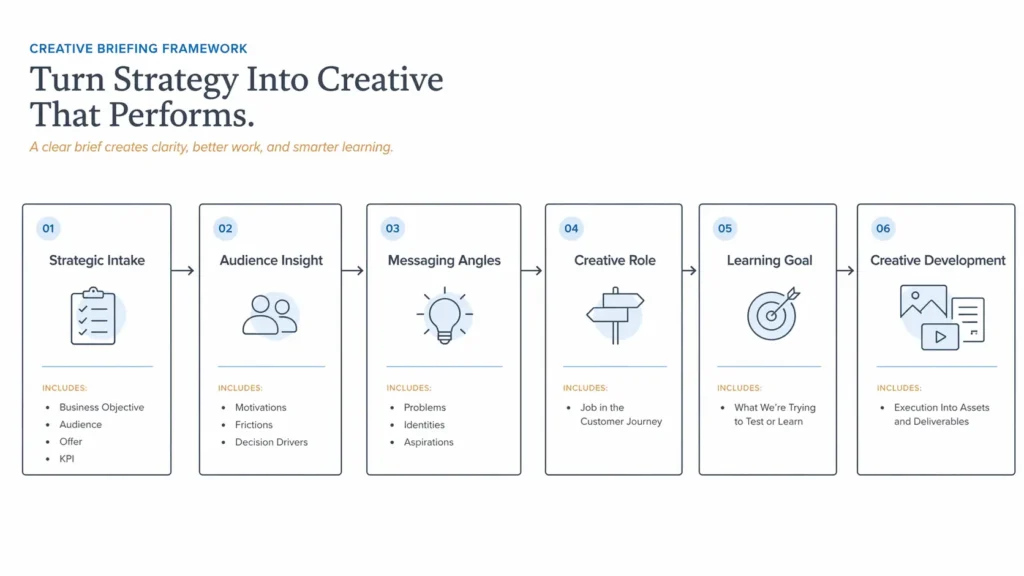
The 5 Elements Every Strong Creative Brief Should Include
Strong creative briefs do more than organize production. They provide the strategic inputs that drive creative testing and learning.
To that end, there are five key inputs required from every creative brief.
1. Business Context
This includes what is happening in the business, often translated into strategic insights that inform creative campaigns. These insights are identified in the strategic brief, but need to be translated into the creative brief.
2. Audience Insight
Audience targets tie the business context to creative & messaging strategy. They identify what offer or experience to provide and how messages appeal to different groups of people.
3. Messaging Angles
Messaging angles are the core element of a creative strategy. They identify the problems, identities, or aspirations that messaging should connect to for different audiences.
4. Creative Role
The creative role takes messaging angles and applies them to a specific stage in the customer journey. They play an important role in crafting the narrative that takes an individual from awareness to conversion.
5. Learning Goal
Sometimes the learning goal is synonymous with optimization goal (i.e. purchase), but is actually much broader. It equates to the goal of running the creative. Is it testing a new promotion, a new website experience, or simply to find a better hook.
Business context and audience are developed and pulled from the strategic intake. Creative briefing really starts with messaging angles, often the most overlooked parts.
A Better Creative Brief Starts With Messaging Angles
Messaging angles are what make a brief strategic rather than a simple asset matrix.
Angles are not just different variations of headline or CTA. They are different topics based on key problems, identities or aspirations of a given audience.
For busy parents, one angle might focus on creating more time with their kids. Another might focus on reducing the stress of a demanding routine. A third might speak to the desire to feel more organized and in control.
Each angle gives the audience a different reason to care, and often a different reason to believe. They create distinct strategic directions for the creative, not just different executions of the same idea.
They also connect directly to ad psychology. The strongest angles work because they attach the offer to something already happening in the mind of the audience. For more on that foundation, read The Demand Stack: Why Some Ads Work.
Once messaging angles are decided, the rest of the brief becomes much easier to build. The team can define creative roles and set goals for testing.
The Brief Should Define the Role of the Creative
The next most overlooked aspect of creative development is assigning a specific role. Not the campaign objective, but the specific job the creative is supposed to do.
Most advertisers create ads that message their offer. But this misses how people actually buy. The customer journey requires introduction of a problem, reinforcement of a decision, and offer to drive action.
Missing any of these steps hurts campaign performance. Not because the message won’t be distributed, but because the wrong message will reach the user at the wrong time.
For example, an ad aimed at introducing a problem may not convert users. Instead, the direct-response message telling users that a product is 10% off may be what ultimately gets them to buy. That doesn’t mean the introductory ad was not effective. It simply played a different role in the messaging strategy.
This also happens to be the reason attribution fails as a marketing decision system.
Defining the role of the creative helps align the message, format, social proof, and CTA with the point in the journey it is meant to serve. For more on this framework, read The Four Creative Roles That Define the User Journey.
Learning Goals Tie Creative to Tangible Results
Defining what to create is only half the job. A stronger brief also defines what the team is trying to learn.
Without a learning goal, it becomes harder to say why a piece of creative worked, or whether the result is worth iterating on. This is what turns reporting from a recap of metrics into a clearer explanation of what actually happened.
A common misconception is that the learning goal is simply the KPI. Sometimes that is true, but not always. A campaign may be measured against leads, sales, or reservations, while the creative itself is used to answer a more specific strategic question.
For example, the goal might be to test a new business line, validate a new messaging angle, or compare whether a certain content type performs better than average. Does UGC outperform a more polished brand-led message? Does a testimonial format generate stronger engagement than a direct product-led concept?
Those questions are really questions of content type selection. For a framework on how to make that decision, read How to Choose the Right Content Type for Paid Social.
Including a learning goal makes the brief more useful to both the creative team and the stakeholders reviewing results. It creates a clearer link between creative production, testing, and future decision-making.
This is what makes a brief more than an organizational document. It turns creative production into a testing framework.
Putting the Creative Brief Together
A strong brief does not need to be overly complicated, but it should capture the core elements that shape creative performance:
| Element | What it answers | Why it matters |
|---|---|---|
| Business context | What business outcome is this work meant to support? | Keeps the brief tied to a real commercial objective rather than just content production. |
| Audience insight | What is true about the audience that should shape the message? | Helps creative reflect real motivations, frictions, and decision drivers. |
| Messaging angles | What are the distinct strategic directions the message can take? | Prevents the brief from becoming a list of asset requests or superficial variations. |
| Creative role | What job should this asset do in the user journey? | Aligns the message, proof, and CTA with the stage of the decision process. |
| Learning goal | What is this creative supposed to help the team learn? | Makes results easier to interpret and improves future testing. |
There is often more detail involved in an actual creative request, but these five elements are usually the difference between a brief that simply organizes work and one that improves creative performance.
The Real Value of a Creative Brief
Creative briefs are not just production documents. They sit inside a larger marketing system and depend on inputs from strategy, audience understanding, messaging, and measurement.
That is why a strong brief should do more than request assets or organize a content calendar. It should clarify the business context, define the message, assign the role of the creative, and make the work easier to interpret once results come in.
Starting with strategic intake before moving into creative ideation gives the team a stronger foundation to build from. Better briefs lead to better messaging, better testing, and clearer learning over time.
I’ve spent years building creative briefs across different clients and campaign types, and I pulled the most important parts of that process into a single template. You can find it in the resource hub.
Creativity still matters. But the briefs that create lasting value are the ones that give creativity direction.