Landing Page Analysis Is More Than Conversion Rate
Landing pages come in many formats and serve different objectives, but they usually have the same purpose: to move users further along their buying journey.
Their value comes down to how well they move users toward the next step.
For top-of-funnel traffic or long sales cycles, the purpose may be education. For ecommerce, it may be a transaction. For lead generation, it may be a form submission, demo request, booking, or application start.
No matter the objective, every landing page benefits from performance analysis. The challenge is that landing page analysis can involve too many metrics: sessions, bounce rate, engagement time, scroll depth, CTA clicks, form starts, conversion rate, and more.
Each metric offers a signal, but none tells the full story on its own.
To properly analyze landing page performance, marketers need a system for connecting user behavior to business outcomes. That makes landing page analysis part of marketing measurement, not just conversion rate optimization.
Without that system, teams risk spending money on ads that drive traffic but never create meaningful progress.
This article breaks down a framework for analyzing landing page performance and identifying the right optimization opportunities. But first, let’s review the problem with traditional landing page analysis.
TL;DR
Landing page analysis should not stop at conversion rate. A better framework separates performance into three layers: Page Views, Meaningful Actions, and Desired Actions. Together, these show whether users are arriving, engaging, and moving toward the next step.
The Problem With Landing Page Reporting
Most landing page reporting starts with one question: did the user convert? If not, the page did not succeed.
That misses a key nuance with how shoppers buy. Most visits won’t lead to a sale. The 5% that do convert are not representative of the vast majority of visitors.
Looking at the 95% that visit but don’t convert is where the real unlock happens.
Why Conversion Rate Doesn’t Give The Full Picture
Conversion rate does measure effectiveness of a system, but attributing all the success to the landing page is where most marketers misevaluate results.
In reality, a lot of factors contribute to conversion rate, like:
- Traffic quality
- Offer strength
- Product-market fit
- Audience messaging
Most of these elements are developed in a go-to-market strategy. Read how they work in an advertising strategy in The Role of Advertising in a Go-to-Market Strategy.
To understand whether a landing page is really working, analysis needs to look at more than surface metrics like sessions, bounce rate, engagement time, or even final conversion rate.
The real question is: What did users do after they landed, and how well do those actions drive them closer to a sale.
A Better Way to Analyze Landing Page Performance
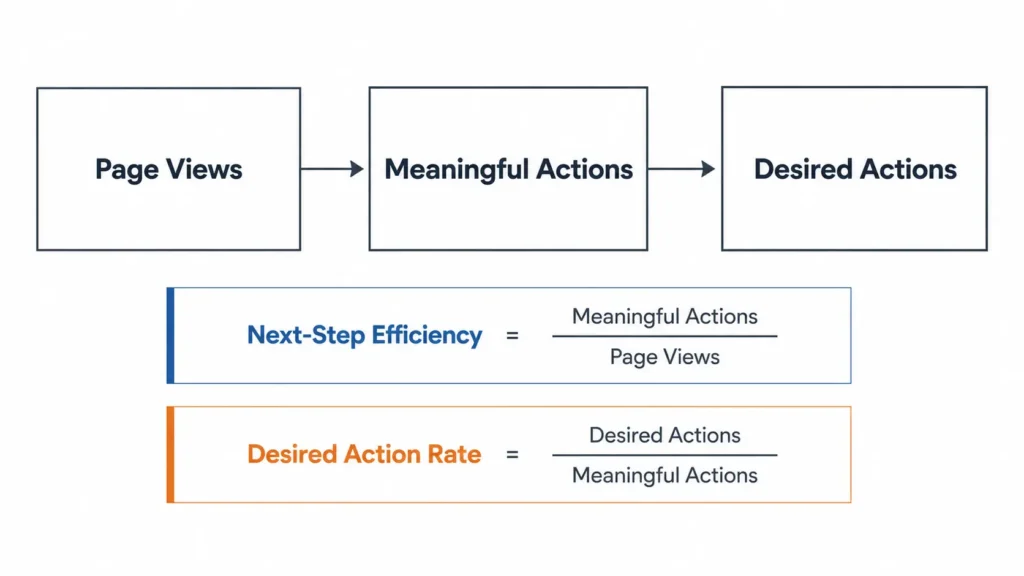
Answering that question requires separating landing page behavior into three layers:
- Page Views: How many people reached the page
- Meaningful Actions: How many users took any action that showed interest
- Desired Actions: How many users took the action the page was built to drive
This approach creates a diagnostic system that identifies opportunities to optimize. Instead of jumping straight to the final action, it opens up analysis for traffic quality, module engagement, or offer resonance.
The Three-Layer Landing Page Analysis Framework
The three-layer framework relies on separating levels of user intent by on-page action. Each stage identifies additional findings about how an audience is engaging with the page.
Page Views
Page views are the threshold to entry in landing page analysis. They show how many users reached the page, but they do not prove the page was effective.
A page view signals that there was enough interest, intent, or curiosity to click through and learn more about a product, service, or offer. However, it does not guarantee real engagement. The user may have landed on the page, skimmed the hero section, and left without taking a meaningful next step.
It is also important to remember that not all page views are equal. Traffic source changes how page views should be interpreted. A user coming from branded search likely understands more about the product or service than a user coming from cold social traffic.
For that reason, page views should be analyzed by traffic source, campaign, audience, and device whenever possible. This adds context to on-page performance and helps separate landing page issues from traffic quality issues.
Volume also matters. If a page has fewer than 500 views, it’s unlikely downstream actions will have the volume necessary to draw statistically significant conclusions.
Page View Checklist:
- Segment by traffic source & device
- Compare paid vs. organic behavior
- Avoid overanalyzing pages with fewer than ~500 views
Meaningful Actions
Meaningful actions are the intermediary between page view and goal of the page. These often include button clicks on content, video views, FAQ engagements, navigation to other parts of the site, and any other actions that aren’t the final goal of the page.
The key is tracking these actions individually in GA4. Strong tracking infrastructure separates page views, CTA clicks, form starts, navigation clicks, and other meaningful actions for cleaner analysis.
They answer a key question: for those that don’t complete the goal, what do they do?
This helps build strategy around how to improve the user experience like:
- What is blocking users from completing the goal?
- Where are users spending the most time? What is most useful to them?
- How far down the page do they make it on average?
For example, if a FAQ lives at the bottom of the page, engagement with it signals real intent to learn more. These actions are valuable even if the user doesn’t fill out a form or buy the product.
Rolling these into ad campaign optimization is an effective way to better segment intent in your audience.
Meaningful Actions Checklist:
- Track all engagements on page
- Identify high intent actions
- Form understanding of what users find most useful
Desired Actions
Desired actions are the goal of the page. They are the clearest indicators of whether the landing page succeeded in driving the action it was built to produce.
For some pages, the desired action is obvious: a form fill, purchase, demo request, booking, application submission, or phone call. This is the part of landing page analysis most marketers are familiar with.
Do they:
- Engage with other parts of the page first?
- Start the desired action but not finish?
- Find what they’re looking for elsewhere on the site?
In many cases, the desired action is not completed directly on the landing page. Ecommerce checkout flows, multi-step enrollment processes, booking systems, and SaaS demo funnels often require users to navigate through several steps before the final outcome is driven.
In those cases, the landing page acts as a bridge between initial interest and final conversion. It is not entirely responsible for the final outcome, so it should not be judged as if it is.
The desired action of a landing page should be the action that moves the user to the next meaningful step. That may be a completed form, but it may also be a checkout start, application click, pricing page click, schedule button click, or product selection.
The key is to define the page’s job before evaluating its performance.
Desired Action Checklist:
- Identify the primary goal of the page
- Define the action the page is responsible for driving
- Separate final conversions from intermediate next steps
The Two Metrics That Drive This Framework
Landing page analysis only works when user behavior can be translated into clear, digestible metrics.
The three-layer framework creates two core metrics that show how users move from traffic, to engagement, to action.
Next-Step Efficiency and Desired Action Rate
Together, these metrics help diagnose whether a landing page has an engagement problem, a conversion problem, or a broader offer and audience alignment problem.
Next-Step Efficiency
Next-step efficiency measures how likely users are to take any meaningful action after landing on the page.
It is the clearest signal that users are not just arriving, but actively engaging with the page.
Formula: Meaningful Actions / Page Views
This creates a rate for how often page visitors take a meaningful on-page action.
Next-step efficiency helps identify:
- If traffic is qualified
- Whether the page matches click-through intent
- If users find the page content useful
Low next-step efficiency usually means one of three things: the wrong users are reaching the page, the page does not match the promise of the ad or search result, or users are not finding what they need quickly enough.
This opens up clear optimization opportunities. The issue may be above the fold, where the headline, offer, and CTA need to create stronger alignment. It may also be a page structure issue, where key information is buried too low or modules are ordered in a way that does not match the user’s decision process.
Next-step efficiency is not the same as conversion rate. It does not measure whether users completed the final goal. It measures whether the page generated enough interest for users to keep moving.
Desired Action Rate
Desired action rate measures how well the page converts active interest into the action it was built to drive.
Formula: Desired Actions / Meaningful Actions
This creates a rate for how often engaged users take the desired next step.
Desired action rate helps identify:
- Whether the page provides enough information to support action
- How clear the offer is
- If the CTA matches the user’s current level of intent
A low desired action rate does not always mean the page content is weak. It may mean the offer is not compelling enough, the CTA is unclear, the form or checkout path has too much friction, or the desired action is too aggressive for the user’s current stage of intent.
Desired action rate expands landing page optimization beyond layout and copy. It forces marketers to evaluate whether the page, offer, audience, and campaign objective are aligned.
You can also calculate desired actions as a percentage of total page views. That broader rate is useful for understanding overall page performance. But measuring desired actions against meaningful actions is more diagnostic because it shows whether engaged users are converting once they show interest.
How to Interpret Landing Page Performance
Together, next-step efficiency and desired action rate turn landing page analysis into a diagnostic tool.
| Next-Step Efficiency | Desired Action Rate | Diagnosis | What It Means | What To Do |
|---|---|---|---|---|
| High | High | Page is working | Users engage and take action. | Scale traffic. Keep the core structure. Test small improvements. |
| High | Low | Interest without intent | Users engage, but do not take the desired next step. | Strengthen the offer, CTA, proof, urgency, or conversion path. |
| Low | High | Qualified users convert | Motivated users take action, but the page does not engage broader traffic. | Improve the hero, page flow, supporting content, and softer CTAs. |
| Low | Low | Traffic/page mismatch | Users neither engage nor convert. | Revisit audience, traffic source, message match, headline, offer, and CTA. |
This model works across objectives and channels because it separates traffic quality, on-page engagement, and conversion intent.
Applied to monthly marketing reporting, it gives teams a clearer way to monitor the full post-click system. Instead of reporting landing page performance as a single conversion rate, marketers can show where users are moving forward, where they are stalling, and what should be improved next.
For more on turning performance data into actionable insights, see Reporting & Performance Analysis.
Landing Page Analysis As A Diagnostic System
Landing page analysis is not just about whether a page converted. It is about understanding how users move from traffic, to engagement, to action.
Conversion rate still matters, but what happens before the conversion is equally, if not more, important. This is becoming increasingly true as paid media platforms shift toward automation and place more weight on the post-click experience. Read more about why landing pages matter more as platforms become more automated.
The three-layer framework segments users into clear behavioral buckets:
- Page Views: How many users reached the page
- Meaningful Actions: How many users showed active interest
- Desired Actions: How many users took the intended next step
Metrics that consolidate actions into these buckets are what make landing page analysis easier to interpret. They help marketers understand whether the issue is traffic quality, page engagement, offer strength, or conversion friction.
This is also why landing page structure matters. A well-structured page breaks the experience into clear modules, making it easier to track how users engage with the page and where they lose momentum. Read more about the key sections to include in a landing page.
The best landing page reports do more than show what happened. They explain where performance is breaking down and what should be improved next.