

Why Attribution Breaks Down as a Decision System
Attribution changed the entire game of marketing. Instead of running an ad through a newspaper or billboard, and hoping that it worked, there was proof that an ad drove a sale.
In the early years of the internet, this worked well. Most shopper activity happened on a desktop, one device. Third-party cookies were persistent in every browser and the data ad platforms shared was much more expansive (remember 28-day click optimization in Facebook?).
Over time, that has all changed. To the point where now, attribution is nowhere near as reliable as it used to be. Instead, it’s almost become a hindrance – failing to answer questions that it used to answer quite well.
Attribution feels authoritative because it’s precise, but precision is not the same as truth. Nowadays, attribution’s main purpose is to take credit, not say what actually mattered.
Working with attribution requires relearning how to think about the entire system. Let’s start by looking at what attribution is actually good at.
TL;DR
- Attribution works best for local, reversible, in-platform decisions
- It creates false confidence when credit is mistaken for impact
- As uncertainty increases, attribution becomes less reliable as a decision system
- Better decisions come from matching evidence strength to decision stakes, not chasing certainty
What Attribution Is Actually Good At
When it comes to making decisions in marketing, attribution is useful only under specific conditions.
In-platform attribution works best when decisions are local, reversible, and made under relatively stable conditions.
Here are the cases where attribution tends to work as intended.
Optimizing within the system
Attribution performs reasonably well when decisions are confined to a single platform.
Comparisons like bidding strategies, audience segments, or campaign structures benefit from attribution because:
- The attribution window is consistent
- The medium and format are the same
- The system is evaluating changes relative to itself
In these cases, attribution isn’t claiming truth — it’s providing directional feedback under controlled conditions.
Short, Fully Observable Journeys
Attribution is most reliable when the user journey is:
- Short
- Fully digital
- Largely contained within one ecosystem
When exposure, engagement, and conversion all happen online with minimal delay, there’s less opportunity for interference or missing data.
As soon as journeys lengthen, cross channels, or include offline behavior, attribution’s apparent precision becomes an illusion.
Creative Iteration
Finding winning creative often relies on driving some form of site engagement. Micro-conversions like button clicks, page views, and other preliminary actions are highly attributable to ads.
Micro-conversions like:
- Clicks
- Page views
- On-site actions
Are closely tied to ad exposure and provide fast feedback loops. Used carefully, they help identify which messages resonate and which don’t.
The mistake is promoting these signals beyond their role – treating them as evidence of impact rather than indicators of interest.
Where Attribution Creates False Confidence
Attribution becomes dangerous when it’s treated as a source of truth rather than a source of signal.
It was never designed to replace business outcomes or explain causality. Its original job was much narrower: to allocate credit within advertising systems. Problems begin when that credit is mistaken for impact.
Here are the most common ways attribution creates confidence without evidence.
Over-Weighting Platform Performance
Modern ad platforms are optimized to capture credit, not contribution.
Campaign types like retargeting and branded search often look exceptionally efficient in attribution models because they intercept demand that already exists. The conversion gets credited to the last visible touchpoint, even if the outcome would have occurred without the ad.
When teams over-index on these results, they mistake capture for creation. Spend increases, apparent efficiency improves, and real incremental impact quietly erodes.
Conversion Lag Distorts Short-Term Signals
Attribution systems assign credit based on clicks or impressions, but behavior rarely resolves on the same timeline.
Users convert days or weeks after exposure. Recent interactions are over-represented, earlier influences are under-counted, and short reporting windows exaggerate noise.
Looking at longer timeframes can reduce this distortion, but it doesn’t eliminate the underlying issue: attribution cannot observe what hasn’t happened yet.
Confusing Attribution With Impact
Attribution assumes that recorded interactions reflect reality. In practice, they don’t.
Privacy controls, cross-device behavior, and offline outcomes ensure that a meaningful share of user activity is never observed. What remains looks precise, but it’s incomplete.
When missing data is treated as absent influence, decisions are made with unwarranted certainty. The cleaner the attribution model appears, the easier it is to forget how much it cannot see.
Attribution creates false confidence not because it’s wrong, but because it’s incomplete. The more complex the system, the more costly that illusion becomes.
Credit vs Impact: The Missing Distinction
Most marketers are taught to use attribution to make campaign decisions. This ignores the real goal of marketing: to drive incremental impact.
Attribution is a credit-based model. Impact is a business-based question.
- Credit: Which touchpoint is assigned value
- Impact: Whether behavior changed because of marketing
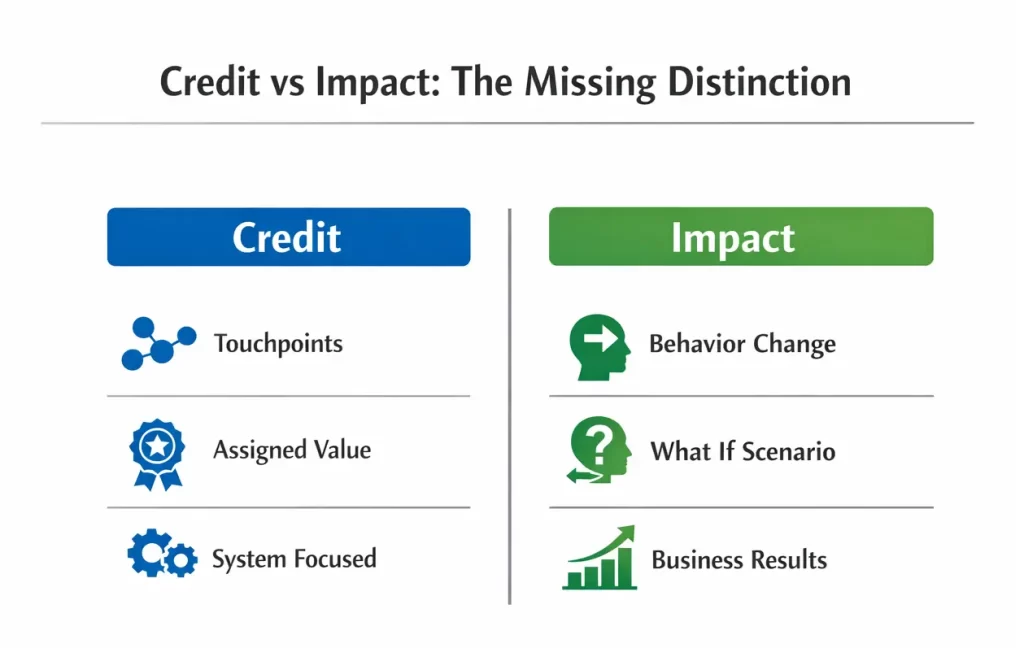
In-platform attribution collapses this distinction. It treats credit as evidence of impact, even when no causal relationship has been established.
That doesn’t mean attribution never reflects real influence. It means that impact must be demonstrated, not assumed.
Why Attribution Assumes Causality
Attribution assigns credit as if the following were true:
If the ad hadn’t happened, the conversion wouldn’t have happened.
This assumption is rarely tested, and almost never observable.
In the real world, no sequence of events can play out twice under identical conditions. We never see the same user, at the same time, in the same environment, with and without the ad.
Without that counterfactual, attribution can only answer who touched a conversion, not who caused it.
That’s why attribution feels confident but isn’t causal.
Why Uncertainty Makes This Worse
This gap between credit and impact widens as uncertainty increases.
Attribution struggles most when two conditions are present:
- There is no counterfactual
- Multiple variables change at once
There Is No Counterfactual
Incrementality tests and synthetic controls attempt to approximate counterfactuals by holding variables constant and changing only one input.
Even then, they are approximations.
Attribution doesn’t attempt this at all. It assumes the counterfactual implicitly, which is why its conclusions often feel stronger than the evidence supports.
Multiple Variables Change at Once
Attribution also assumes that when performance changes, it’s because an ad was shown.
In reality, marketing systems are constantly shifting:
- Seasonality
- Competitor behavior
- Audience overlap
- External demand
Some of these variables are controllable. Most aren’t.
When multiple forces move simultaneously, attribution has no way to isolate cause from coincidence. Credit is still assigned, but confidence increases faster than understanding.
That doesn’t mean abandon attribution, but rather place it correctly within a broader decision system. One that considers its strengths and weaknesses.
What to Use Instead: Match Evidence to the Decision
In a separate article on making marketing decisions with incomplete data, I outlined a framework for matching evidence strength to decision stakes.
At a high level, that framework breaks decisions into four evidence tiers:
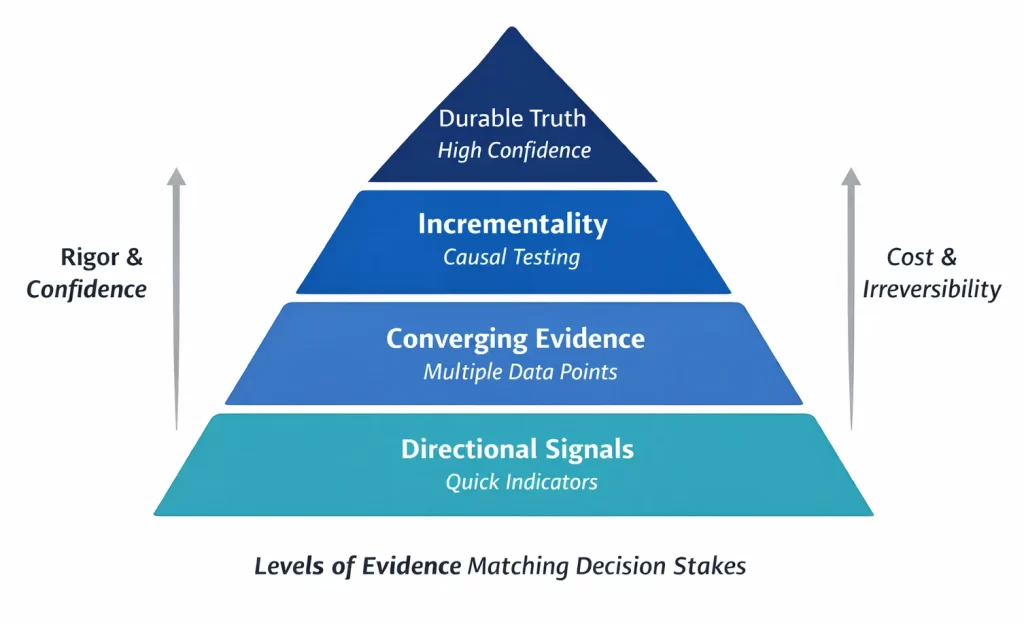
The higher the stakes – and harder a decision is to reverse – the further up the ladder you need to operate and the stronger the evidence required becomes.
Attribution fits into this framework as a directional signal. Useful for movement, but insufficient for many strategic decisions.
The same logic applies operationally. Automation should support directional monitoring inside platforms, but strategic shifts should remain judgment-driven.
Applying Attribution As A Directional Signal
Directional signals are strong diagnostic tools. They help answer questions like:
- Is the new creative performing better?
- Which conversion event is driving higher-quality traffic?
- Do budget allocations need minor adjustment?
Attribution is best served in a weekly reporting cadence, where performance is evaluated as a trend analysis, rather than a binary success or failure.
Performance forecasting also depends on attribution. Estimating the likely impact of spend or creative changes requires some way to connect ad activity to downstream results.
Creative performance analysis benefits as well, with an important caveat. Credit does not equal impact. Upper-funnel creative often drives meaningful engagement without receiving conversion credit, while lower-funnel ads capture demand that already exists.
Used intentionally, attribution helps guide movement. Used as proof, it creates false confidence.
The Goal Isn’t Certainty. It’s Better Judgement
Marketing decisions will never be made with perfect information. More data often creates more uncertainty.
As uncertainty increases, the cost of mistaking credit for impact rises with it. That’s why attribution must be constrained, supported, or replaced when making high-level strategic decisions.
The teams that make the best decisions aren’t chasing certainty. They’re designing decision systems that act accordingly and respond to it appropriately.
Attribution isn’t the answer. It’s one input among many. Judgement is what turns it into a decision.