
Stop Measuring Paid Social Ads by CTR Alone
Social media advertising is often measured using click-through rate, and with good reason. It informs how well a message connected with an audience enough to drive further action – a click-through to a website.
As far as the ad is concerned, it did its job. A click means there was enough interest to continue, and an opportunity to drive further action on site.
If the landing page does its job, the user will move from initial engagement to deeper engagement, and potentially conversion. The same ad can be measured by its conversion potential but this misses an important point: not all conversions happen directly after ad engagement.
When ads are driving sales that happen offline or up to months after initial engagement, performance measurement becomes about more than just the click-through.
This article looks at how to expand social ad performance measurement beyond just the click-through. Let’s look at the social engagement quality framework.
TL;DR
Clicks are not the whole story. Engagement Quality Score helps paid social teams measure whether an ad earned real interaction, not just traffic, by weighting higher-intent actions like comments, shares, and saves.
The Problem with Click-through Rate
Click-through rate is an essential metric in a marketers measurement arsenal. It is one of the clearest signs that an ad resonates with the audience. However, there are key drawbacks to only using click-through rate to measure ads.
It assumes all clicks are equal
Click-through rate assumes all clicks are equal, but that couldn’t be further from the truth. Clicks are measured the same way regardless of user intent.
A click from someone who was curious, distracted, misled, or accidentally tapped the ad – CTR treats them all equally.
This creates an ad optimization problem as ads with high CTRs might not necessarily attract the right audience.
It varies based on platform and placement
Another variable at play with click-through rate is placement. Ads on Meta’s audience network drive suspiciously high CTRs. This might look good in reporting, but it lacks any quality onsite engagement.
Similarly, clicks on platforms like LinkedIn and TikTok are distinctly different from those on Meta. Judging them all based on CTR misses a large part of the impact ads drive.
It can reward curiosity instead of intent
A high CTR doesn’t always mean the ad reached the right audience. Native-format, meme-based, or curiosity-driven creative may attract attention and generate clicks, but that does not automatically mean they are attracting qualified users.
Measuring these ads 1 to 1 with conversion-focused ads is a quick way to overvalue lower intent actions.
Ad performance is best measured within a specific content type, campaign objective, and creative role. For more on content types, read Choosing the Right Content Type for Paid Social.
It misses other forms of engagement
Meta defines link clicks as clicks on links within the ad that led to advertiser-specified destinations. This misses engagements with the ad itself like reactions, shares, comments, and saves.
Meta uses a separate metric, Clicks (All), to include these engagements. However, it also includes any interaction with the ad itself. This means All Clicks tracks:
- Swiping through the carousel cards
- Clicking to expand the ad (e.g., viewing a larger image)
- Clicking the headline, description, or background
- Clicking on your profile/page name or “See More” for text
These are useful actions to track, but not necessarily useful for analysis. A carousel swipe doesn’t carry the same intent as a post share.
This does not mean CTR should be removed from paid media reporting. It means CTR should be supplemented by metrics that explain the quality of engagement an ad creates.
What is Engagement Quality Score?
Engagement Quality Score is a weighted measure of in-platform social engagement. Instead of treating every interaction equally, it gives more value to actions that require more effort or signal stronger intent.
A like may show light approval. A comment may show active participation. A share may show that the content was relevant enough to distribute. A save may show that the user wants to return to the information later.
Measuring engagement quality is especially useful when evaluating creative and messaging strategy, because it shows which ideas are earning more than passive attention.
Measuring Engagement Quality Score
Engagement quality score is indexed measure of social engagement weighted based on level of interest.
| Engagement Type | Weight | Why it matters |
|---|---|---|
| Like / Reaction | 0.5x | Low-effort signal of interest |
| Comment | 2x | Indicates active participation, questions, or objections |
| Share | 5x | Indicates the message was relevant enough to distribute |
| Save | 6x | Indicates future intent or perceived usefulness |
These are added together to create a total engagement score, and divided by impressions to index it. Otherwise, the ads with the most spend will show the highest quality score.
The final calculation looks like:
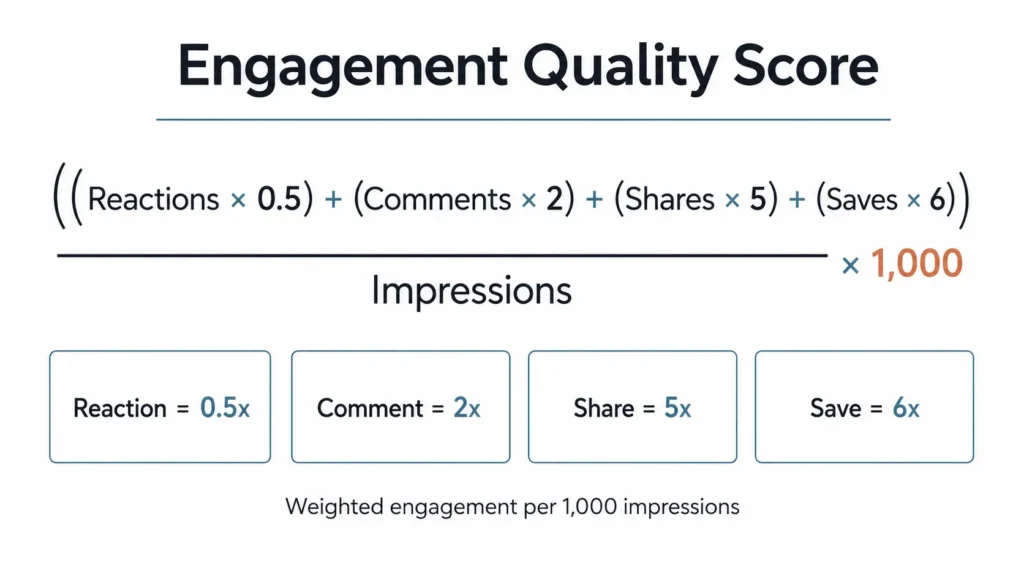
This effectively creates a new metric that identifies which ads are driving the most positive sentiment amongst an audience.
How to Use Engagement Quality Score
Engagement quality score is most useful when analyzed alongside CTR and cost per conversion. Where CTR and CPA show how effective the ad was a driving action, engagement quality score shows whether the ad drove meaningful in-platform impact.
This is important because not all user behavior happens in an online environment. Understanding what messages resonate with an audience more broadly identifies opportunities to variate on that content.
For more on creative testing and how to build a testing strategy, read How to Test Ads in Algorithmic Campaigns.
A Simple Framework for Ad Analysis
Ad reporting and analysis requires more than one metric to understand impact. A simple framework looks at three metrics:
| Metric | What it measures | Best used for |
|---|---|---|
| Click-through rate | How often users clicked | Traffic intent |
| Engagement Quality Score (EQS) | How strongly users interacted | Message resonance |
| Conversion rate | How often users converted | Downstream intent |
In a strong paid media system, CTR, engagement quality, and conversion rate should be analyzed together rather than treated as isolated performance signals.
High CTR, Low EQS
This usually means that the ad is good at reaching users with high intent, but might not be share-worthy – these are often be demand capture or conversion acceleration ads.
A good secondary metric to check here is conversion rate. If conversion rate is strong, the ad is doing it’s job well.
Low CTR, High EQS
These ads are effective at driving interest and engagement, but may not be the action driver. Typically demand creation ads fall into this bucket especially when they’re native or meme format.
They are typically better for awareness, consideration, retargeting pool building, or message testing than immediate conversion.
High CTR, High EQS
These are the strongest signals – when an ad drives both on-platform intent and interest to learn more. These ads are worth scaling, and adapting into new formats.
Use these as the case studies to report on creative performance.
Low CTR, Low EQS
These ads are simply not landing with the audience. Either the message is too general, or the format is not compelling enough to drive deeper engagement.
Avoid iterating these ads unless there is a real business need to learn why they’re not working.
Engagement Quality Score by Creative Role
Not every ad should be expected to drive the same type of engagement.
Demand creation ads may receive more social engagement because they introduce a new idea. Similarly, reinforcement ads may drive more comments or shares because they provide a relatable perspective.
Demand capture and acceleration ads may fall short simply because they are more direct-response focused.
Generally, you want to expect something like:
| Creative Role | Expected engagement pattern |
|---|---|
| Demand Creation | Higher shares, saves, video completions |
| Reinforcement | Higher comments, saves, profile visits |
| Demand Capture | Higher CTR, lower in-platform engagement |
| Acceleration | Higher CTR and conversion rate |
This distinction will provide better insight into whether an ad is working for its intended purpose.
Diagnosing Engagement Quality Score Performance
Not all engagement quality is equal. There are insights in what kind of engagements users are making most often. Pulling these not only informs messaging strategy, but where a message belongs in the journey.
| Pattern | What it may mean | What to do |
|---|---|---|
| High CTR + Low EQS | Clickable but not deeply resonant | Check landing page quality and conversion rate |
| Low CTR + High EQS | Strong message, weak traffic intent | Test stronger CTA or use for retargeting |
| High Saves + Low Clicks | Useful content, longer consideration | Retarget savers/engagers or build follow-up ads |
| High Shares + Low CTR | Broad relevance or social value | Test as awareness creative |
| High Comments + Low Conversions | Interest, objections, or confusion | Mine comments for messaging/FAQ updates |
| High Reactions + Low Saves/Shares | Light approval but weak depth | Test stronger educational or proof-based creative |
The value of each engagement is reflected in the engagement quality score, but subjective insights require analysis of each engagement.
Limitations of Engagement Quality Score
Engagement Quality Score should not be treated as a universal truth. It is a diagnostic metric, not a business outcome.
Key considerations:
- Comment quality matters. A negative comment should not be valued the same as a buying question.
- Platform behavior varies. A save on Instagram may not mean the same thing as a save on TikTok or Pinterest.
- Engagement can be inflated by controversial or polarizing creative.
- Conversion-focused ads may score lower because they are designed for action, not discussion.
- The weights should be adjusted based on business model, platform, and campaign objective.
CTR Measures the Click. Engagement Quality Score Measures the Message.
Click-through rate still matters. It shows whether an ad created enough interest for someone to leave the platform and take the next step. For traffic, lead generation, and conversion-focused campaigns, that signal should not be ignored.
But CTR is not the full measure of paid social ad quality.
Engagement Quality Score adds a second layer to paid social analysis. By weighting actions like reactions, comments, shares, and saves, advertisers can better understand which ads are earning meaningful in-platform engagement, not just traffic.
The goal is not to replace CTR, CPA, or conversion rate. The goal is to interpret them with more context.
Better paid social reporting should not ask only, “Which ad got the most clicks?” It should ask, “Which ad drove action, engagement, and intent?”
Using CTR, Engagement Quality Score, and conversion rate as layers of analysis, marketers can better explain whether a message was clicked, whether it resonated, and whether it moved users closer to action.