
Google Ads Search Term Reports: How to Turn Search Intent Into Strategy
Google Ads has changed dramatically over the last five years. What used to be a more controlled, keyword-led search platform has become a broader AI-driven advertising system, with Performance Max, Demand Gen, broad match, and automated bidding pushing advertisers toward more full-funnel campaign design.
But despite that expansion, Google Search are still at the core of Google Ads platform mechanics. When someone searches, they are not just being reached. They are declaring a problem, need, comparison, or next step.
That is why search term reporting matters more, not less, in 2026. As Google Ads becomes more automated, search queries are one of the remaining places where advertisers can still see how market demand is being expressed in the user’s own language.
This article breaks down how to do search query reporting in 2026 with an emphasis on data-driven insights that inform strategy across the whole marketing journey.
TL;DR
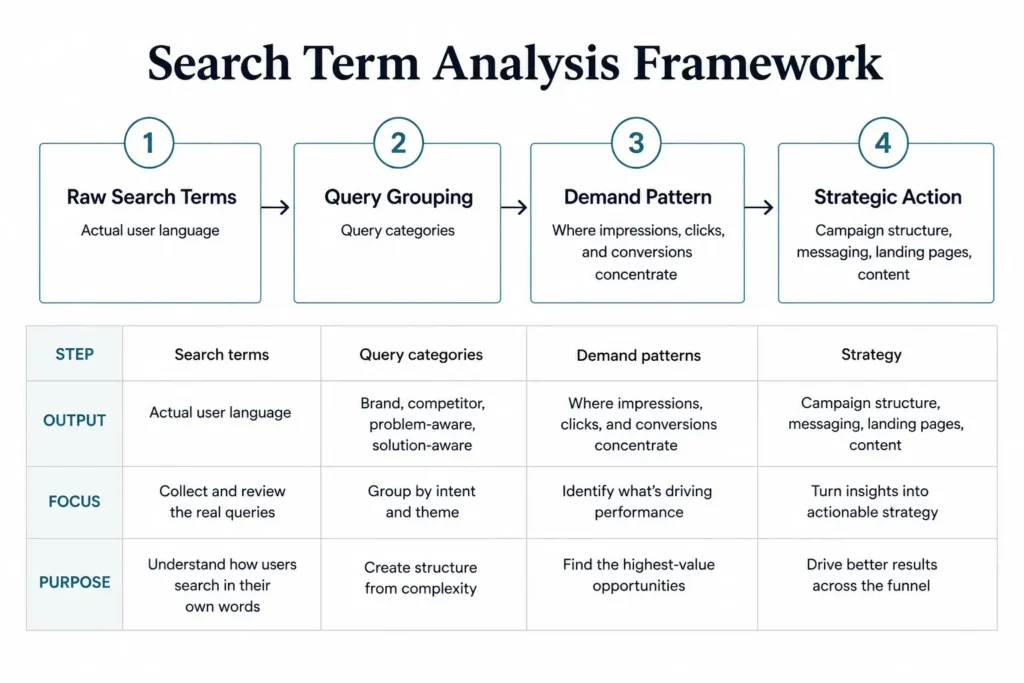
Search term reports show how real users express demand. When queries are grouped by theme, intent, audience, and offer relevance, they become more than a Google Ads optimization tool. They become a strategy input for campaign structure, messaging, landing pages, and organic content.
What Search Terms Are And Why They’re Important
Unlike keywords, which are chosen by the advertiser, search queries are the actual phrase searched by the user.
This offers unique insight into what users are looking for. Searches have traditionally fallen into four distinct categories:
- Informational
- Commercial
- Transactional
- Navigational
A transactional query might include terms like ‘buy’ or ‘price’ while an informational query includes ‘how to’ or ‘what is’.
This helps identify opportunities – particularly with commercial or transactional queries – but often follows common sense. Where real insight lives is breaking queries down into sets.
These categories also explain why SEO and paid search play different roles in search strategy. Informational queries often create content opportunities, while commercial and transactional queries are usually better suited for paid search. For more on this relationship, read SEO and Paid Search: Friends or Foes?.
How Search Terms Reveal In-Market Intent
The real insight from search queries comes from groupings based on similar keyword searches. This allows advertisers to see where real search demand is coming from based on impressions (potential clicks) and clicks (actual interest).
For example, groupings can be:
- Brand
- Competitor
- Problem-aware
- Solution-aware
- Categories
For example, a charter school that is looking to enroll students might have categories like:
- Grade level: kindergarten, middle school, high school, pre-K
- Program type: charter school, public school alternative, after-school, STEM, arts
- Decision factor: tuition, lottery, application deadline, reviews, school ranking
- Brand/competitor: specific school names or networks
If kindergarten and middle school searches drive most qualified volume, the campaign should not treat “school enrollment” as one generic demand pool. Budget, ad copy, landing page modules, and follow-up messaging should reflect the actual grade-level demand showing up in search behavior.
Search Terms Are Directional, Not Complete
Search term reports are a powerful tool, but are not a complete view of the market. For privacy and targeting reasons, Google hides a significant portion of queries searched by users.
However, when grouped into categories, terms show where there is more demand on average. If one category consistently drives more impressions, clicks, and qualified actions than another, that pattern is enough to inform campaign structure, messaging, landing page content, and offer strategy.
A strategy that uses search queries does not need every individual term to be visible. It needs enough directional signal to understand where demand is concentrated and how that demand is being expressed.
This is also why search term reporting should be treated as one evidence source, not the entire decision system. For a broader framework on using imperfect data correctly, read Making Confident Marketing Decisions With Incomplete Data.
Building A Search Term Report
A search query report starts with the right metrics and dimensions. Dimensions explain where the query came from. Metrics show how much demand, engagement, cost, and performance each query generated.
Recommended Dimensions
- Search term
- Campaign
- Ad Group
- Matched keyword
- Match type
Metrics are broken up into traffic (market demand) and conversion (performance). Both identify different opportunities.
Demand represents opportunities to expand strategy through content and messaging. Conversion represents opportunity to scale up campaign efforts.
Recommended metrics
- Impressions
- Clicks
- Cost
- Conversions
- Conversion value, if applicable
Once pulled, take the list of search terms and de-duplicate it. Use the deduplicated list to build categories.
I like running the list through ChatGPT or Claude to build category groupings, then evolve it from there.
For example, a restaurant business might have search term groupings like:
- Meal Type
- Food Type
- Cuisine
- Healthy/Dietary
- Occasion
- General/Location
Each grouping is broken down into further groupings. For example, meal type could be broken down into:
- Brunch
- Lunch
- Dinner
- Late Night
- Happy Hour
Once the report is structured this way, the advertiser can stop reviewing search terms as isolated phrases and start reviewing them as evidence of demand patterns.
Analysis of these groupings leads to better understanding of where there is opportunity.
| Field | What It Tells You | Strategic Use |
|---|---|---|
| Query category | What type of demand is showing up | Budget allocation and campaign structure |
| Intent stage | How close the user is to action | Ad copy and CTA strength |
| Audience segment | Who appears to be searching | Messaging and landing page personalization |
| Offer relevance | Whether the query matches the business | Negatives and keyword expansion |
| Conversion quality | Whether interest turns into value | Optimization and budget shifts |
These metrics become more useful when they are pulled into a recurring reporting system instead of reviewed only inside the Google Ads interface. For more on turning campaign data into strategic recommendations, read How to Build a Monthly Marketing Report That Guides Strategy.
How to Analyze Search Term Data
Once search terms are grouped, the analysis should focus on patterns across categories, not just individual queries.
Good starter questions are:
- Where is impression volume concentrated?
- Where are clicks concentrated?
- Where are conversions concentrated?
- What categories are the most efficient?
- What categories are under-supported by campaign messaging?
Each metric contains a unique insight that identifies potential opportunities. Clicks may indicate strong message to audience alignment while conversions signal strong offer alignment.
When conversion rate is failing despite strong click-through, landing page optimizations may be the biggest opportunity. For more on this, read Why Conversion Rate Is Not Enough to Analyze Landing Pages.
| Metric | What It Tells You |
|---|---|
| Impressions | Where Google is finding available demand |
| Clicks | What themes are attracting actual user intent |
| Conversions | What groups are driving action |
| Cost per conversion | Where is there room to scale up efforts |
| Spend | Where is there wasted ad dollars |
These opportunities can be applied to campaign, messaging, landing page, targeting strategy and more.
How Search Term Insights Inform Strategy
Search query insights are bigger than just Google Ads optimizations. They inform the larger marketing strategy with learnings about audience and in-market demand.
Campaign Strategy
Search queries identify opportunities for campaign expansion based on top performing categories. Is Brunch content driving the lowest cost per conversion? Maybe it’s an opportunity to break out a dedicated campaign budget.
Messaging Strategy
Perhaps the biggest value in search query reports – messaging strategy is the best chance to respond to in-market demand.
If competitor terms are receiving significant traffic, messaging may need to focus more on comparison, differentiation, or reasons to choose the brand. If price-related terms dominate, the ad and landing page may need to address value, affordability, or what is included.
Search terms also inform what creative role is necessary to reach an audience. Informational keywords? More demand creation assets. Commercial? Reinforcement and demand capture.
Landing Page Strategy
Top queries are obvious options for landing page alignment. If the landing page doesn’t include the keyword above the fold, it will have a harder time capturing initial attention.
Tailoring the landing page to respond best to top queries is part of an effective Google Ads strategy. Read more about how to build landing pages for Google Ads in 2026.
Content Strategy
Search queries can also surface content opportunities for organic search. Is the public school system getting a lot of search intent? Perhaps content written to speak to that audience is worth writing for a blog.
Informational and commercial queries that are too early-stage for paid conversion can still be valuable content opportunities.
Common Search Term Reporting Mistakes
The first mistake is using search term reports only for negative keywords. Cleaning up wasted spend matters, but it is only one use case.
The second mistake is analyzing individual terms without grouping them into themes. Individual queries are often too fragmented to guide strategy. Categories reveal the larger demand patterns.
The third mistake is ignoring impression volume. A category with few conversions but high impression volume may still reveal meaningful market interest, especially if the landing page or ad copy does not address that intent well.
The fourth mistake is treating the report as a complete view of the market. Search term data is directional. It is shaped by budgets, bids, match types, campaign structure, and Google’s query visibility limits.
Conclusion
Search term reports are not just cleanup tools. They are one of the clearest views advertisers have into how real users express demand.
Keywords show what the advertiser chose to target. Search terms show what the market actually said.
When those terms are grouped into meaningful categories, they can inform more than keyword strategy. They can shape campaign structure, messaging, landing pages, offers, and organic content.
Early results are especially effective in building go-to-market strategy. For more on that connection, read The Role of Advertising in a Go-to-Market Strategy.
As Google Ads becomes more automated, that visibility becomes even more valuable. Search term reporting is one of the few places where advertisers can still connect platform performance back to real customer language and in-market intent.