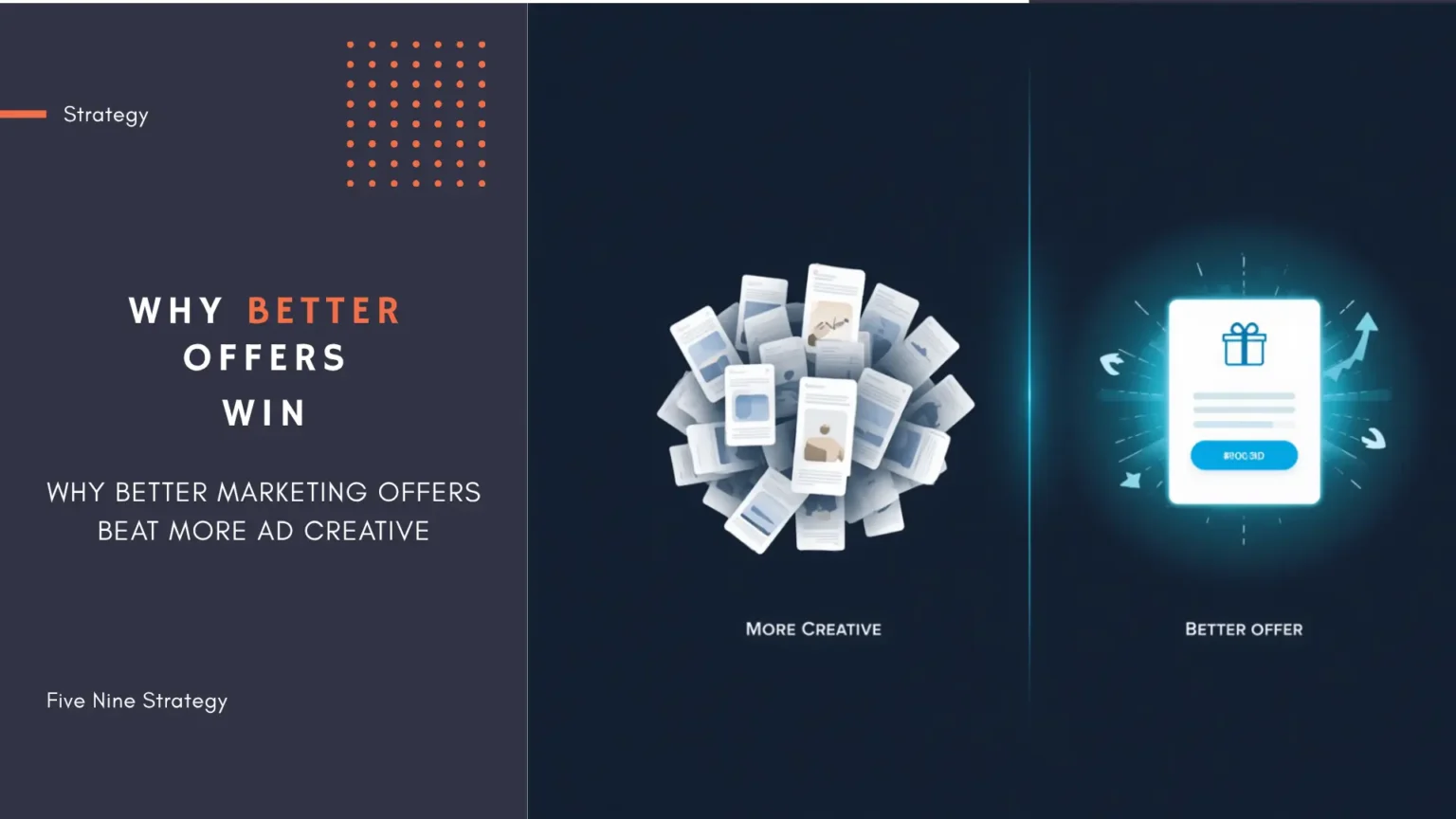
Why Better Offers Beat More Ad Creative
Offers are at the core of marketing campaigns, but often receive less attention than other parts of the message.
Most marketers see poor performance and immediately react with more creative variation, landing page edits, or targeting changes. These might change what is said or who it’s said to, but don’t change the reason to act.
A marketing offer serves as the underlying value proposition – why pay attention to this brand, product, advertisement.
A good offer is more than just stating a value proposition. It connects the brand, product, and value to an audience in a way that drives action. This solves more than just creative messaging – it provides better feedback through attribution when clicks actually turn into conversions.
This article will look at how to structure marketing offers including some specific examples of offers that have worked to drive real business objectives.
TL;DR
Offer strategy is one of the most important parts of a creative & messaging strategy.
In one recent promotion, a specific, time-sensitive value-add offer reduced cost per booking by more than 70%, generated over 300% ROAS, and contributed to a 4% sales lift without lowering average customer spend.
The lesson: before making more ads, make sure the offer gives the audience a clear, relevant, and urgent reason to act.
What is a marketing offer
A marketing offer is the complete exchange presented to a customer: what they receive, what they must do, why it matters, and why they should act now.
There are certain components of an offer that are crucial to plan before it is ready to test.
Components of an offer
- Core product or experience: What is ultimately being purchased?
- Added value: What extra benefit does the customer receive?
- Desired action: What must the customer do?
- Audience relevance: Why should this particular customer care?
- Urgency: Why act now instead of later
- Friction and risk: What might prevent action?
- Economics: Does the offer still create value for the business?
Offer strategy works within three areas of a marketing plan.
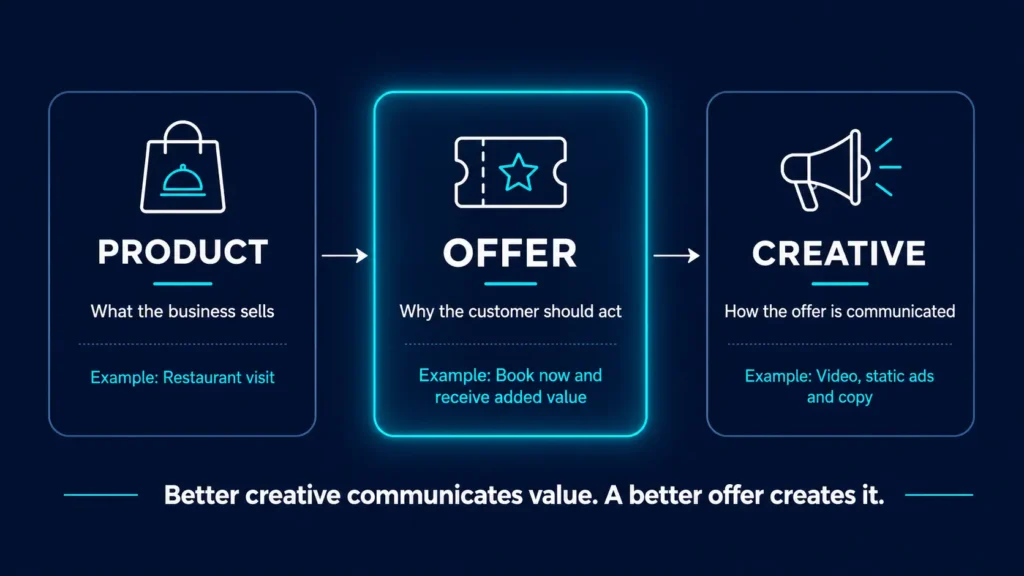
A landing page works to communicate all three which is why landing page design is so incredibly important.
It’s also why creative is often over emphasized when evaluating underperformance.
Why creative gets the blame for underperformance
When it comes to diagnosing underperforming campaigns, creative often takes the majority of blame. If people aren’t buying a product, it’s because they don’t understand it, or the ad doesn’t look good enough.
The instinct too often is to change the ad. It’s often the easier and faster option.
However, that decision ignores an underlying issue that most ads face – there usually isn’t a good enough reason to buy something you weren’t already planning to.
That’s where the offer comes in. An offer influences parts of the consideration process that creative simply can’t do alone.
- Weak customer value
- No meaningful differentiation
- Lack of urgency
- Poor price-value relationship
- Short-term inconvenience
The truth is that most marketers are good at the message + creative. But fail spectacularly when it comes to offer mechanics.
A real life example shows this quite clearly – simple creative can perform very well when the offer is strong.
Case study: Summer Patio Reservations
A national restaurant chain looked to increase patio reservations during the week of July 4th – a historically slow time for them.
Instead of simply advertising their summer menu or brand-forward messages, they decided to create a promotion aimed at their dog-owner audience.
The promotion included a free dog meal and bandana for a reservation booked during the week of July 4th.
Analysis of the Offer
Looking at the components of the offer, it’s easy to see the consideration paid to how it was structured.
- Core product or experience: Brunch & Lunch
- Added value: Dog meal + bandana
- Desired action: Book reservation
- Audience relevance: Dog-owners, take your dog out
- Urgency: Limited spots available, limited days running
- Friction and risk: Offering multiple days to limit risk of availability
- Economics: Contributes to top-line sales, customer sentiment
The message was simple: Reserve a patio table for one of the selected dates and receive a complimentary dog meal and branded dog bandana.
So simple that even basic static creative drove excellent performance.
Results from the campaign
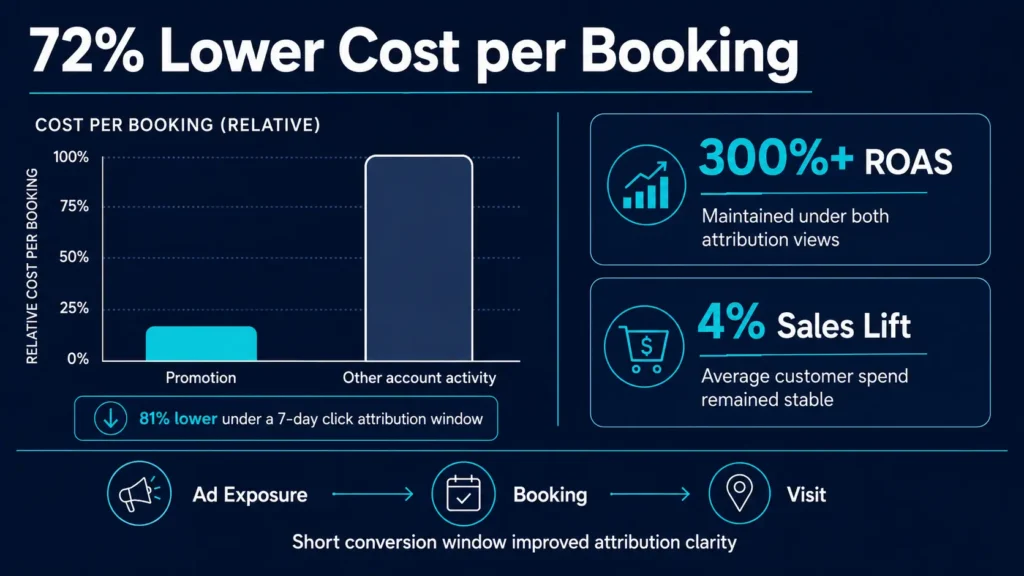
The promotion produced the strongest booking efficiency of any Meta campaign run in the account that year.
Cost per booking was 72% lower than the rest of the account using all attributed conversions and 81% lower under a stricter 7-day click window. ROAS exceeded 300% under both attribution views.
Sales also increased 4% during the promotional period, while average customer spend remained flat to slightly ahead of the prior year. This suggests the offer generated additional traffic without reducing transaction value.
The limited booking and redemption window also shortened the path to conversion, creating a clearer connection between ad exposure, reservations, and sales than a typical evergreen campaign.
Overall, the offer improved booking efficiency, increased sales, and made campaign impact easier to measure.
Why the offer worked
The offer used some clever psychology to move customers toward a decision faster than they normally would.
It created an occasion, not just a transaction
Instead of simply asking someone to visit a restaurant, the offer gave them an opportunity to bring their dog, invite a friend, and receive something memorable.
The real product being marketed was not a free dog meal. It was an occasion to share an experience with a pet, with like-minded individuals.
It targeted a specific identity
Dog-owners aren’t the only segment that dine at the restaurant, but are a part of the core demographic.
Instead of using an offer that applies to everyone, this particular promotion made it very clear who the offer was for. Tapping into this existing emotional relationship is a strong way to get people to respond.
It created credible urgency
The event created a real reason to act quickly thanks to the limited nature of the offer.
It worked on two levels: limited dates and limited bookings on those dates.
Unlike the artificial urgency created by things like countdown timers or sale ads, urgency was tied to actual availability rather than a message.
It was easy to understand
The exchange was simple. Make a reservation on a selected date and receive added value.
To the customer, this perceived value helped drive action. For the business, demand without discounting the core purchase.
Minimal complexity while retaining profit margin helped drive the success of the promotion.
The takeaway: Value-add offers work for restaurants – as long as the core mechanics of the offer are carefully considered.
Value add isn’t always the best offer type however. In e-commerce, offers typically favor discounting because in-platform attribution is much stronger.
The difference between discounts and value-add offers
Where value-add offers include the addition of some item, experience, or service – think free consultations for home improvement products – discounts are monetary incentives.
The benefit of this: they are extremely easy to understand.
I save 20% on this purchase or free shipping equals money saved.
The major drawback is making the cost differential work because they eat more directly into profit margin.
Analysis of a Discount Offer
The same analysis can be applied to discount offers.
- Core product or experience: Any product or service
- Added value: $ saved, free shipping, etc.
- Desired action: Purchase now
- Audience relevance: A specific niche or product category
- Urgency: It’s a sale! Sales don’t typically last forever
- Friction and risk: Oversaturating with discounts, cheapen brand value
- Economics: Eats directly into margin. Need to balance sales with volume to maintain profitability
Not all business types benefit from discount offers – especially those with products that are considered luxury or high value.
In those cases, complimentary services or value-add maintains brand value while continuing to build on the luxury perception.
Types of marketing offers
The offer depends entirely on the business, audience segment, product, goal, and many more factors. Let’s look at a few other types.
Bundles
A common tactic industries like cosmetics and insurance alike, bundles are positioned as both product discovery and savings tactics.
Product kits offered by cosmetic companies offer customers the opportunity to try new products in a low-risk way. Sample sizes keep cost low and let a customer decide if they like it before buying a full sized product.
Insurance or internet service providers bundle plans together to increase customer value, but also afford the customer some savings in cost compared to buying separately.
Each carry unique customer value that work as marketable messages.
Trial periods
Almost ubiquitous in SaaS businesses, trial periods give the user the option to try features normally paywalled for free.
In exchange, the business collects personal information that aids in the future sale of a paid subscription.
With the advent of AI search, publishers on the internet started adopting this method much more rigorously. Not only does it give the opportunity to market and collect user data, it creates a relationship with the brand that aids in purchase consideration.
Exclusive-access
Member’s only sales or loyalty programs are not only enticing to shoppers for the unique benefits they provide, but also for a business as a way to grow loyalty and customer lifetime value.
Airlines use loyalty programs as a status symbol. Loyalty measured by dollars spent affords better benefits and perks. Resetting this at the beginning of each year ensures customers stay loyal.
Even restaurants have started adopting this method with mobile apps that promote discounts for logged-in members.
The extent of exclusivity is entirely dependent on the type of customer being targeted. Higher income will have a higher threshold to ‘loyalty’. Higher volume will typically be lower.
Experience-based
One of my personal favorites for targeting Gen Z and Millennial shoppers, experiences lean into the community-driven aspect of marketing.
Workshops, tastings, seasonal events, or. community activations are all ways of bringing people together, but also messaging something unique and compelling.
This could include trivia nights at local bars or webinars/in-person sessions for information-based businesses.
Risk-reversal
Risk is a core part of the decision-making process. Limiting it reduces hesitation and speeds up decision.
Online retailers often rely on risk-reversal when reputation is low. Money-back guarantees or free returns alleviate a concern that something might not live up to expectation.
Likewise, some service-based businesses like marketing agencies will guarantee results over a certain period of time or refund a portion of the cost.
Ultimately, the offer that works best depends on the segment of an audience that you are trying to appeal to.
A framework for building a stronger offer
Stronger marketing offers start with careful planning around the components of the offer and its use case.
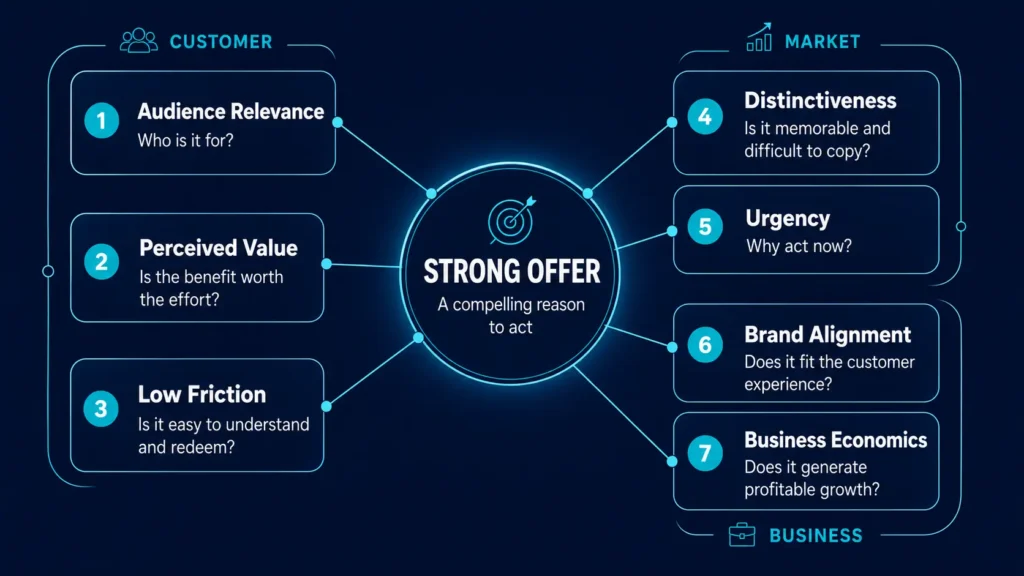
Audience relevance
Crucial to the success of an offer is who specifically the offer is for.
While a discount might target price-conscious shoppers, an experience is more likely to appeal to those yearning for connection. Exclusive access further appeals to those longing status.
Aligning the offer with the segment of the audience you want to reach is crucial.
Perceived value
Value is tied to the benefit the customer receives. If that benefit is worth more than the effort required to obtain it, action becomes more likely.
Monetary incentive isn’t always effective alone. Pairing it with experience, urgency, or exclusivity enhance its effectiveness.
Distinctiveness
Offers that are unique fare better simply because they are memorable.
When crafting an offer, ask yourself: could a competitor easily copy it?
If the answer is yes, then work to differentiate it better.
Urgency
Urgency drives decision making. That is especially true with offer messaging.
If there is no compelling reason for the customer to act now, they won’t.
Always be sure to make the urgency credible. Nobody likes feeling like they’re being coerced into making a decision.
Friction
Offer complexity is a common point of friction in decision making.
If the offer isn’t easy to understand quickly, it’s too complex. That means several intermediary steps or terms should be removed if possible.
Make it simple to explain and it will be significantly more effective.
Brand alignment
An often under-rated consideration. The offer has to match the brand or risk causing some friction.
Mostly this falls onto the segment of the market the offer appeals to. If the core demographic of a business is 55+, then the offer can’t be tailored to 30 year olds.
Business economics
The offer needs to work within the confines of unit economics. Even with sales, profitability needs to remain positive.
That means a good understanding of expected revenue per conversion, contribution margin, and whether the offer attracts incremental customers or recycles existing demand.
Another factor to consider when measuring offer effectiveness is what metrics to use.
Three measures of success for offers
Offers are only as good as your ability to measure them. The good part is that a strong offer is much easier to measure.
That’s because it often leads to quicker conversion which aids attribution especially on platforms with longer attribution lag.
Campaign Performance
Cost per result and conversion rate are the primary metrics of success. Offers should be measurable online for best chance of success.
Baring this, click-through rate and social engagement (see engagement quality score) are good directional metrics for sucess.
Business Performance
Ultimately, there should be some notable increase in sales and revenue when looking year over year, or period over period.
As mentioned, it’s important to also look at profit margin to make sure the offer drives sustainable growth.
Incrementality
The final measure is more nuanced, but involves measuring whether conversions and sales were from customers that wouldn’t have converted anyway. See more on incrementality measurement in my guide to incrementality testing.
Existing customers are more likely to convert, but won’t contribute to the same growth potential as acquiring new customers.
Understanding what the new vs existing customer split in offer performance is extremely important.
Better performance starts with a better reason to act
When campaign performance declines, the instinct is often to produce more creative, test new formats, or adjust targeting. Those changes can improve how a message is delivered, but they do not necessarily improve the underlying value presented to the customer.
That is the role of the offer.
A strong offer connects the product, audience, incentive, timing, and desired action into one compelling proposition. It gives the customer a clear reason to care and a credible reason to act now.
The summer patio campaign worked because it did more than advertise a restaurant visit. It created a specific occasion for dog owners, added memorable value without discounting the core purchase, and made the next step easy to understand.
The lesson is not that every campaign needs a giveaway, discount, or limited-time promotion. It is that offer strategy deserves the same level of attention as creative development, audience targeting, and landing-page design.
Before making another batch of ads, ask a more important question:
Is the customer seeing the wrong message, or do they simply need a better reason to act?