Campaign Segmentation Is a Data Model, Not a Naming Convention
Paid media teams spend a lot of time thinking about campaign structure inside ad platforms.
Should prospecting and retargeting be separate? Should each market have its own campaign? Should a launch get a dedicated budget? Should different products live together or independently?
Those are important activation questions. But campaign structure has another job that is easy to overlook: it determines how easily you can understand the media program later.
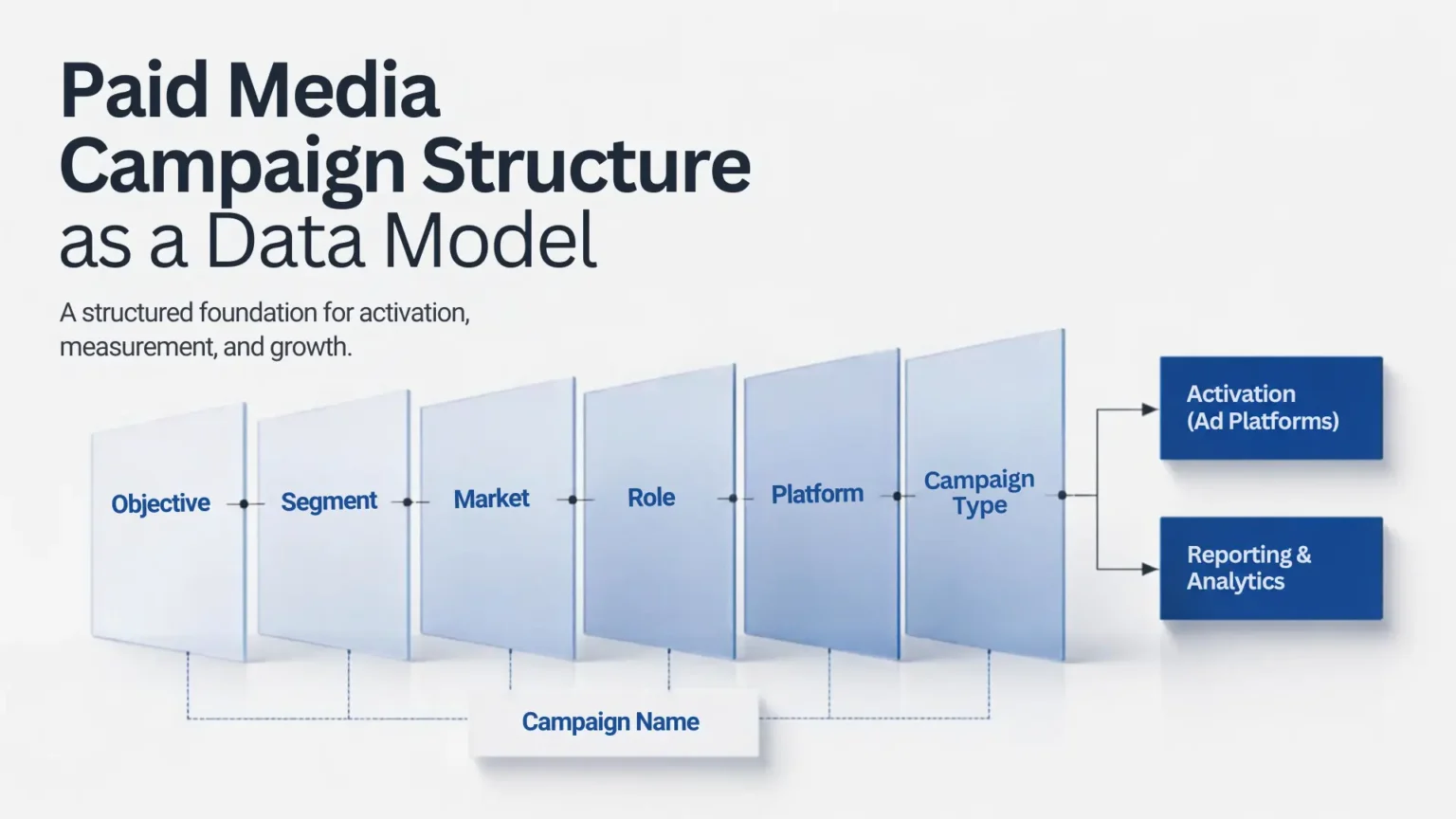
A campaign should not only make sense inside Google Ads, Meta, LinkedIn, or The Trade Desk. It should also create consistent dimensions that can move from the media plan into activation and eventually into reporting.
That distinction matters because many teams unintentionally use campaign names as their data model.
A name like: Brand_Meta_LeadGen_Enterprise_US_Prospecting_ProductA_FY27
might contain everything someone needs to understand the campaign.
But none of those concepts actually exist as structured data unless you store them somewhere else.
The campaign name knows that the campaign is prospecting. Your reporting system does not. It just sees a string.
A better model is to treat every campaign as a row of structured dimensional data first, and then generate the campaign name from those dimensions.
The Problem With Making Campaign Names Do Everything
Naming conventions are useful. I use them extensively.
They make campaigns easier to navigate, help teams maintain consistency, and can even support automation. In my Google Ads budget pacing automation, for example, campaign naming becomes an important part of matching actual campaigns back to planned budgets.
The problem starts when the naming convention becomes the only place where campaign attributes exist.
A typical convention might look something like:
Brand_Platform_Objective_Audience_Geo_Tactic_Product_FY
That works reasonably well when a media buyer is looking directly at a campaign list.
But reporting eventually needs to answer questions like:
- How much are we spending on prospecting versus retargeting?
- Which markets are performing best?
- How much budget supports each business objective?
- How are launches performing relative to always-on activity?
- Does the same segment perform consistently across platforms?
- How much media investment supports a particular product or business line?
If those concepts only exist inside a campaign name, every downstream system has to reconstruct them.
Maybe you use spreadsheet formulas to split the name.
Maybe a dashboard uses regular expressions.
Maybe someone maintains a campaign mapping table manually.
Maybe your data warehouse creates transformation logic to infer what each part of the string means.
All of those approaches can work.
But they are solving a problem that did not need to exist.
The underlying information was already known when the campaign was created.
Treat Campaigns as Dimensional Data
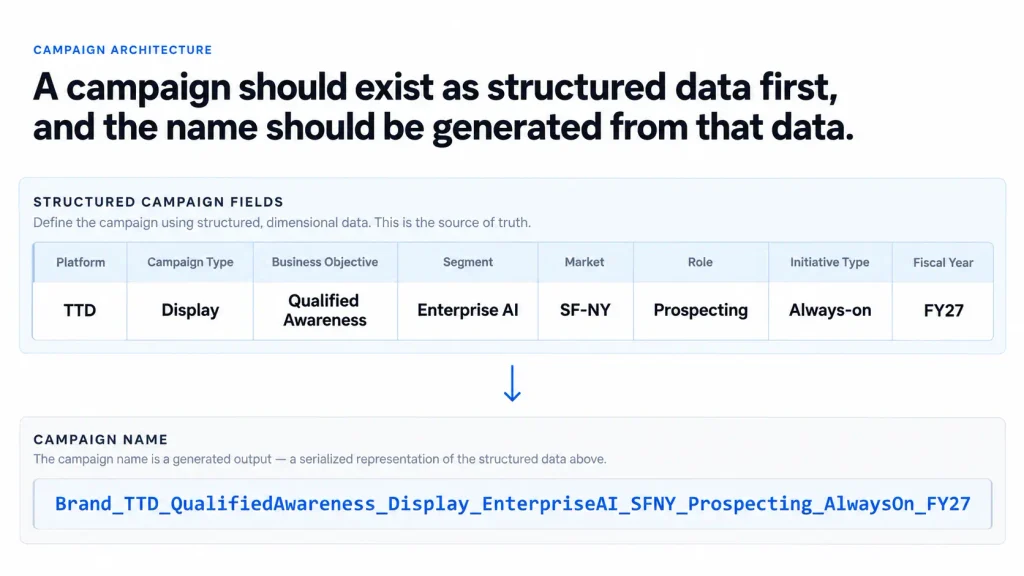
Instead of treating a campaign name as the source of truth, treat the campaign itself as a structured record.
Conceptually, each campaign becomes one row.
| Platform | Campaign Type | Business Objective | Segment | Market | Role | Initiative Type | Fiscal Year |
|---|---|---|---|---|---|---|---|
| TTD | Display | Qualified Awareness | Enterprise AI | SF-NY | Prospecting | Always-on | FY27 |
The campaign name might still become:
Brand_TTD_QualifiedAwareness_Display_EnterpriseAI_SFNY_Prospecting_AlwaysOn_FY27
But now the important difference is that the structured fields existed before the name.
The name is just a serialized representation of the data.
That changes the architecture substantially.
Instead of repeatedly decoding a campaign name downstream, you can carry the same dimensions through planning, activation, data ingestion, and reporting.
For most media programs, I find it useful to think about those dimensions in three groups.
Media Context
These describe how the media is being delivered.
- Platform
- Campaign Type
Business Context
These describe what the business is trying to accomplish.
- Brand / Business Unit
- Business Objective
- Business Line
- Initiative Type
Segmentation Context
These describe how the activity has been divided for activation or analysis.
- Segment
- Market
- Role
- Fiscal Year
The exact taxonomy will vary by advertiser. The important part is not the specific fields. It is deciding which distinctions the business actually needs to preserve.
Business Objective: What Are We Spending Money to Accomplish?
One of the most useful dimensions is Business Objective.
This is deliberately different from the optimization objective selected inside an ad platform.
An advertiser might define objectives such as:
- Qualified Awareness
- Retargeting / Reinforcement
- Lead Generation
The value of this field is that it creates a bridge between the media plan and reporting.
It lets you answer a very basic question:
What are we actually spending money to accomplish?
Without that dimension, reports tend to default to platform organization.
You see Meta spend, Google spend, LinkedIn spend, display spend, search spend.
Those are useful operational views, but they do not necessarily tell a business where its investment is going strategically.
If every campaign carries a Business Objective, you can instead report:
| Business Objective | Spend |
|---|---|
| Qualified Awareness | $125,000 |
| Retargeting / Reinforcement | $62,000 |
| Lead Generation | $213,000 |
That is often a much more useful conversation.
Segment: What Is This Campaign Actually About?
Segment is intentionally flexible.
It should represent the distinct subject of the campaign rather than simply becoming another word for audience.
For one advertiser, segments might be:
- AI Conference
- AI Labs
- Agent Builders
- Enterprise AI
- Retargeting
For another business, Segment could represent:
- a product
- an audience proposition
- an event
- a service line
- a program
- a messaging territory
- a customer group
A useful rule is:
If the business needs to understand performance or investment against something independently, it probably deserves its own segment value.
This becomes particularly important once campaigns are analyzed beyond the platform hierarchy.
I have written previously about situations where the most useful analytical unit is not necessarily the individual ad or campaign—for example, evaluating Meta creative at the broader topic level rather than treating every individual asset as an isolated test.
The same principle applies here.
The dimensions you choose should reflect the level at which the business actually makes decisions.
Market Should Not Be Hidden Inside Segment
Geography is another common source of messy campaign structure.
Suppose you have a campaign targeting enterprise AI prospects in San Francisco and New York.
You could create a segment called: Enterprise AI - SF/NY
But now two different concepts have been combined.
A cleaner model is:
- Segment: Enterprise AI
- Market: SF-NY
- Role: Prospecting
- Business Objective: Qualified Awareness
Now each field answers a different question.
You can analyze Enterprise AI across every market.
You can compare SF-NY against other markets across every segment.
You can compare prospecting campaigns regardless of geography.
That flexibility disappears when multiple ideas are compressed into one field.
Role: What Job Does the Campaign Perform?
Role describes what the campaign does within the overall media system.
Examples might include:
- Event
- Prospecting
- Retargeting
This matters because campaigns with different jobs often should not be judged against identical expectations.
A prospecting campaign may be responsible for reaching new qualified audiences.
A retargeting campaign may be expected to convert existing demand more efficiently.
An event campaign may have a fixed window and a completely different response curve.
If Role is stored explicitly, reporting can preserve those distinctions instead of forcing every campaign into one undifferentiated performance table.
It also helps prevent structural decisions from becoming arbitrary.
If two campaigns are separated because they genuinely perform different jobs, Role gives you a way to document that distinction.
Initiative Type: Separate Persistent Media From Temporary Activity
Another useful dimension is Initiative Type.
Examples:
- Launch
- Always-on
- Promotion
- Test
- Seasonal
- Event
Media programs frequently mix persistent activity with short-term initiatives.
Without a structured distinction, it becomes difficult to answer questions such as:
- How much of our budget supports always-on activity?
- How much investment went toward launches this year?
- Are launches producing incremental results?
- How much money are we putting into temporary promotions?
- What portion of the media plan is actually experimentation?
Those questions are difficult to answer reliably if initiative type is buried inconsistently inside campaign names.
They are trivial if Initiative Type is already a field.
Platform and Campaign Type Describe Mechanics
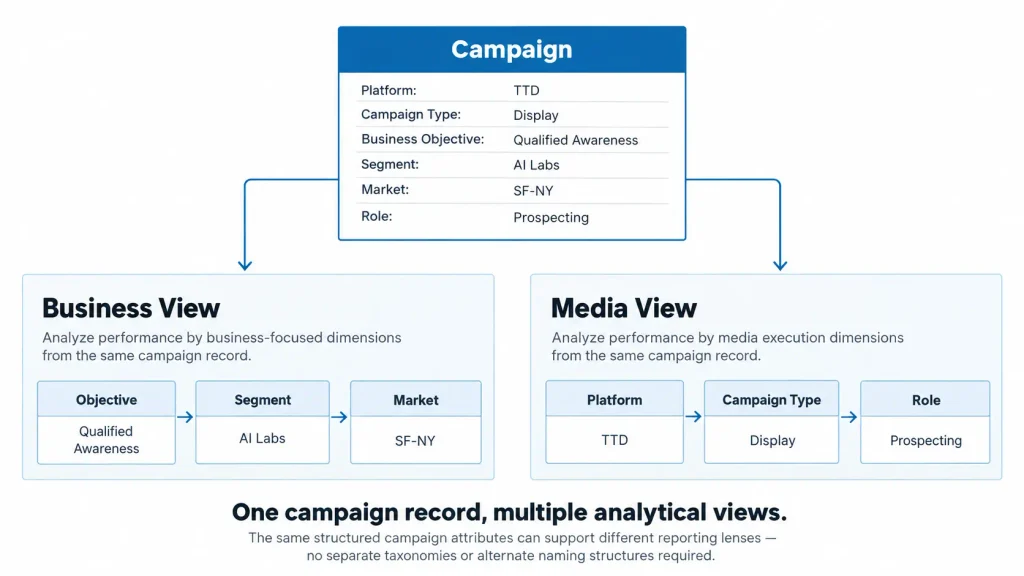
Not every dimension should describe business strategy.
Platform and Campaign Type describe media mechanics.
For example:
- Platform: TTD
- Campaign Type: Display
tells you how the media is being delivered.
Whereas:
- Business Objective: Qualified Awareness
- Segment: AI Labs
- Role: Prospecting
tells you why the media exists.
That means the same campaign registry can support completely different analytical views.
Business View
Objective → Segment → Market
Media View
Platform → Campaign Type → Role
Neither view requires a new data model.
You are simply grouping the same campaign records differently.
This is where structured campaign data becomes substantially more powerful than a naming convention alone.
Campaign Segmentation Also Improves Setup
The reporting benefits are obvious, but I think the activation benefit is just as important.
A structured campaign schema functions like a miniature campaign brief.
Before creating a campaign, the planner has to define:
- Business Objective
- Segment
- Market
- Role
- Initiative Type
That forces a useful discipline:
Why does this campaign need to exist as a separate campaign?
This does not mean every difference requires separate structure.
In fact, the opposite is often true.
Modern platforms increasingly reward consolidation, and unnecessary fragmentation can work against optimization. I have covered that problem more specifically in my article on structuring Meta campaigns without over-retargeting.
The dimensional framework gives you a better way to decide when separation is justified.
If two proposed campaigns have identical values across every meaningful segmentation dimension, there may not be a strong reason for them to exist independently.
On the other hand, if one dimension differs in a way the business will want to control or analyze separately later, separate campaign structure may be warranted.
That is much more useful than creating campaigns because “this is how we have always structured the account.”
The Reporting Payoff
Once structured dimensions exist, the same performance dataset can support many views without changing the underlying architecture.
You can aggregate:
- Spend by Business Objective
- Spend by Segment
- Spend by Market
- Performance by Role
- Performance by Initiative Type
- Performance by Platform
You can also combine dimensions:
- Segment × Market
- Objective × Platform
- Role × Campaign Type
- Segment × Role
- Initiative Type × Business Objective
This becomes especially valuable in cross-platform reporting.
When you start pulling Google, Meta, TikTok, LinkedIn, programmatic, or other media into one reporting environment—as in the cross-platform Fivetran reporting architecture I have written about—platform-native campaign hierarchies stop being enough.
Each platform structures media differently.
A consistent dimensional layer gives you something they can all share.
Instead of asking every reporting system to understand how each platform organizes campaigns, you normalize the campaigns into the business dimensions that actually matter.
Build the Dimensions Once
The practical goal is not to create an enormous taxonomy.
You do not need 40 fields attached to every campaign.
You need the handful of dimensions your organization repeatedly uses when planning, allocating budget, evaluating performance, and explaining the media program.
For many advertisers, that may be enough:
Media context
- Platform
- Campaign Type
Business context
- Brand / Business Unit
- Business Objective
- Business Line
- Initiative Type
Segmentation context
- Segment
- Market
- Role
- Fiscal Year
Operational fields such as Campaign Key, Registry ID, Status, or Sync Status can sit around that model to support governance and automation, but they are implementation details rather than the core strategic framework.
The real value comes from defining the business and media dimensions consistently.
Campaign Structure Should Create a Common Language
Good campaign segmentation creates a common language between media planning, activation, and reporting.
The planner defines the campaign using structured dimensions.
The media buyer uses those dimensions to determine how the campaign should be activated.
The naming convention turns those dimensions into something readable inside the platform.
The reporting system carries the same dimensions forward to analyze investment and performance.
That continuity is the point.
The goal is not to create the longest possible campaign naming convention.
It is to identify the handful of dimensions the business actually uses to understand its media program, store them explicitly, and carry them from planning through activation into reporting.
Once that structure exists, the campaign name becomes much simpler.
It can just serialize data you already have: Brand_Platform_Objective_Type_Segment_Market_Role_Initiative_FY
The name is still useful.
It just no longer has to be the database.